martes, 10 de junio de 2014

Webinar Report #2: Focus on Global English - Richard Cauldwell / Katy Davies & Laura Patsko

Today I travelled to England, comfortably sitting on my Buenos Aires armchair. The British Council organised the "Focus on Global English" event and streamed it live all the way from London.

This event was aimed at exploring issues regarding the role of accent and identity in different ways. Whereas Richard Cauldwell (whose brilliant book I'll be reviewing here soon!) set out to report his experience and views on how accent, identity and prejudice are intertwined, Laura Patsko and Katy Davies have taken English as a Lingua Franca into the classroom and provided us with practical ideas to teach it.

Below you will find a sketchy summary of what was presented, with some comments of my own, and the link to the playback, once it is made available.

(Digression alert!) (Speaking of accents, by the way, the BC presenter's accent was lovely! Sorry, couldn't help it! Picked out some things such as [i:vnɪŋk, rɪ?tʃəd], worth commenting on some other day!)

The BC presenter also made a point of the British Council partnership with Google for this interesting resource: https://spellup.withgoogle.com/

(Version 2. Since its publication, some typos and minor errors have been corrected)
***

Richard Cauldwell - Accent and Identity, Prejudice and Insecurity

Richard began his talk as a "personal journey on accents", and made a point of how people's feelings about accents may affect our own self image, and in spite of the fact that we may control or overcome them, "insecurity lives inside".
He refers to Part 3 of his (brilliant!) book, Phonology for Listening, as some of the audio samples and issues raised are (thoroughly) developed there.
The talk begins with a few definitions:

Definition of accent - I particularly like the idea of "flavouring" and "colouring".... :)

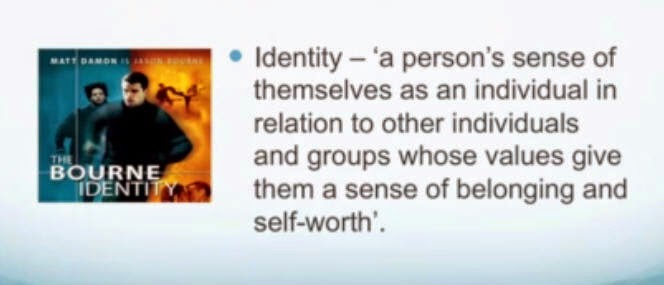
Identity - Richard's selected definition - The issue of self-worth and sense of belonging were delved into in the talk

Interesting definitions for "prejudice"
After presenting these definitions, Richard went on to re-visit his own history of accents, from his early Irish beginnings, to public school in England, to Oxford, to his current home in Birmingham. Certainly a story of accents!
There are some funny and interesting remarks in the fact that Richard's parents were born in 1926, the year of the "birth" of the BBC, as well as on the "official christening" of Received Pronunciation.

Richard's next step involved the discussion of reference models. We know about the current "embarrased" (sic) status of Received Pronunciation, all the prejudice associated with it as a prestige accent, and no wonder, given some of the (thought-provoking) quotes selected by Richard:

Richard reported a teacher's "protective" attitude towards a Scouse-speaking student, warning him of the how you may "lose marks" if you use your Liverpool accent. This type of prejudice is also taken up in a quote from the 19th century:

This idea of prejudice is ingrained and as the table below shows, which is far different from what many people may believe now, attitudes to accents and the role of accents may change and are, in fact, changing.  Richard makes a hilarious remark on this table, saying that probably the order would change if the question was "Who would you like to have on your side in a fight?"


Richard moves on to present a number of successful professionals, with a high level of proficiency in English, who may have some sort of self-loathing or a lowered self-image because of their accents, or because of the reception towards their accents. Some of these quotes show the role of accent and identity and the "perpetuation of the prejudice":


After listening to different non-native and native accents of English, and drawing on intra-speaker variation, Richard makes a point that accents are variable within the same speaker, and that they can be used for accommodation in different situations. He makes it really clear that we "should be allowed to be who we are".

The next point raised is that of reference models. Received Pronunciation does not have the "status" it used to have, particularly its "refined" version, and hostility towards RP is clear in many areas, as it reveals a "stigmatisation of privilege" (Geoff Lindsey). Richard makes a point that these models should not be attainment targets, just references to where students may want to approximate. But most importantly, "any accent of English is acceptable as long as it is intelligible"
A few other useful reminders Cauldwell has drawn our attention to:
  • English is no longer the property of the native speaker
  • attainment models are achievable learning targets, reference models are not and there are not too many native speakers of those models (Refined RP just for some Royal Family members and the Navy!)

And some thought-provoking conclusions by Richard, which I post in his own "voice":

A short Question & Answer session ensued:

1. Audience: What accent should we teach? If teachers teach with their own voices, isn't this confusing for learners? The member of the audience retells an experience of teaching with her own RP accent alongside another Irish teacher. Don't we need some sort of model?

Richard: There are lots of resources online to choose voices learners can aim to attain without having to go for a reference model. Learners can choose how to establish their identity as speakers of English.

2. Audience: To what extent can you modify your pronunciation?
Richard: It depends on own personal capacity to handle the input that comes in and moderate what comes out. But most importantly, there are some emotional filters that may give people high motivation, or maybe lead them to resist the acquisition of a target accent.

3. Audience: We have to admit there are many Englishes. So pronunciation is not very important for English at a basic level (sic).
Richard: We need to distinguish between production and perception. We have to prepare people to encounter many accents and produce something reasonably consistent.

4. Audience: Teacher working with multilingual classes. I modified my speech for my students, I don't use norhtern accents. If students change their vowels completely, that is not all right for me, that is my line. Spelling definitely affects pronunciation.
Richard: It is important to teach the issues between spelling and sound. But we should aim for intelligibility as a priority.

***
That was a brief report on Richard's talk.
You can read more on this in Richard's book and on this blog post: http://blog.britishcouncil.org/2014/06/09/what-does-your-accent-say-about-you/


***
Laura Patsko and Katy Davies: Practical ideas for teaching pronunciation and listening in an English as a lingua franca (ELF) context 

Laura and Katy introduce themselves as teachers working in multilingual context, with non-native learners of English from different L1s. English is their communicative medium of choice, and at times, their only option. They teach "English as a Lingua Franca", which represents the communicative reality of use in English accortding to statistics, and the pronunciation aspect is highlighted in their teaching as "pronunciation was biggest cause of breakdown of communication" (Jenkins, 2000)


The presenters covered the following areas in their talk:
  • How to know what to prioritise in an ELF context?
  • How can you "standardise" your teaching practice within this variation?
  • What practical ideas can you apply in the teaching of ELF pronunciation?

Establishing priorities for an ELF context
1. Conduct a needs analysis: 
  • discussion with students, knowing their needs and motivations for learning English;
  • diagnostic work:  listening to their pronunciation, identifying gap for intelligibility problems. For example: taking a dictation exercise between fellow ELF users (and not the teacher as the "authorised voice"), using sentences in the coursebook, and asking students to take down what their classmates are saying. This allows the teacher and students to identify areas of "high risk" for intelligibility.

2. With the newly-found data: Apply an ELF filter
Check the areas of the Lingua Franca Core and make decisions. The teaching techniques for pronunciation do not need to differ from those used in EFL contexts: minimal pairs, drilling, etc.

3. Come up with a syllabus, based on coursebook/teaching materials and data from the diagnosis
4. Adapting classroom practice


Some things to be considered for an ELF practice:
  • We need to help students become aware of what they are doing and why.
  • Students need to be conscious of the fact that accent is flexible, and that in an ELF context accommodation is important, and they should know how to modify their speech if necessary.
  • Students should be allowed to make choices.
  • Weak forms are not essential in the LFC but may be presented as part of receptive skills to be taught.
  • Focus on stress is important and textbook activities or tapescripts may be adapted to this end.
  • RP may not be a model in itself, but it is useful to teach spelling patterns and their connections to sounds.
  • The learners' needs are taken into consideration and not necessarily the native speaker norm. Students may be judges and models themselves, and teachers should support their choices, particularly if they are "informed" choices.
  • It is better, in a multilingual context, to encourage pairwork over groupwork, so as to enable students to improve comprehension on a particular task being exposed to one "ELF" variety at a time.
  • It is important to teach learners different chunks of language to ensure a smooth negotiation of meaning, request of repetition, or reformulation. 
Use of authentic materials

"Authentic" defined as "materials which have been created in English but not for the purpose of learning English".
These may be used to look for proficient users of English as a Lingua Franca and try both productive and perceptive skills:
Using scripts of these materials may help learners assess intelligibility over the native speaker norm.

Some conclusions by the presenters, inviting us to reconsider and revisit some assumptions:
Laura Patsko rounds off the session by quoting Robin Walker, and the need to re-think goals and the role of error, rather than modify classroom practices. 

Some questions ensued:

Audience: You said you only teach the "bird" vowel, do you teach diphthongs? 
L & K: Key thing on the LFC is length, even for diphthongs. Achieving a particular quality for a vowel sound is not important, but a particular consistent quality is, as well as to preserve length.

Audience: Brazilian speakers learn /θ/ by imitating "th" from speakers with a lisp.
L&K: Even though /θ/ is out of the LFC as it may be replaced by other consonants, it is true that we may get "models" and "tips" from unconventional places. It is also important to consider and question notions of "correctness" and focus on "variation". We ought to remember LFC is a set of features, not a model or variety.

Audience: How can we continue improving our pronunciation after finishing a course?
L & K: An example of a good resource, BC ESOL Nexus website. Watching snippets from videos may also help. 

Audience: Some learners still expect the native speaker norm.
L & K: Respecting students' choices is part of our job, and asking them why they are making the choices they are making is important to see if their choices are informed. Presenting statistics is important. Those "ELF moments" we have in the classroom can also help us to make a point.


***
This was my brief report on Laura and Katy's Talk.

***
Hope you have enjoyed this summary of the sessions.
No time for my own input on these today, but I promise a follow-up on this. I think that all the speakers in this session mentioned the reality of English today, but also considered the fact that attainment targets are to be planned by the teacher based on the expectations of the students, and the contexts of use students will be applying their English to. As a teacher trainer, this is a very important point, and I was truly hoping to hear these views made explicit.

Replay link available HERE.
Thanks for reading me!

viernes, 6 de junio de 2014

Teaching Segments #1: English /ð, d/ - Part 1: Exploring phonemic and allophonic differences


I have been teaching general English and English "for international exams" (OMG, I do have a grudge for that) for over ten years now, and I started teaching phonetics at College in 2006. I wouldn't say I'm tooo experienced, but I would say that one of the features I have "corrected" and "systematised" the most among my Spanish-speaking students, is the contrast /ð/,/d/.

Some basic, general remarks for General British /ð/,/d/.:
  • General British (GB) has a phonemic contrast between /ð/,/d/. This means that if we apply the process of commutation, through which we change one phoneme of a word for another, then we will have another acceptable English word, creating a minimal pair: "they"/"day", /ðeɪ//deɪ/. This proves that these two are phonemes of English.
  • /ð/,/d/ are represented by different spellings in GB as well: /ð/ is generally, if not always, "th", /d/ is unproblematically spelled with "d" or "dd".
  • /ð/,/d/ are clearly different in terms of place and manner of articulation, but share the same voice: both sounds are produced with vocal fold vibration. Curious to see what that looks like? Try this video
    • /d/ is an alveolar sound in terms of its place of articulation, i.e., the tip and blade of the tongue are in contact with the alveolar ridge:
Image credit: http://www.study-languages-online.com/images/sounds/sound-d.gif
    •  As far as manner of articulation is concerned, it is a plosive sound, which means that it is produced in three stages: a closure stage, whereby you put your articulators in firm contact, a compression stage in which the air is kept "hostage" behind the closure, and a sudden, "explosive" release (If English is your L1, or you have already "acquired" this sound, you can try this in slow motion). This is generally represented with parametric diagrams like the one below (adapted from Ortiz Lira & Finch, 1982):
    • /ð/ is a dental sound, as the tongue articulates with the teeth (Mott 2012:134 states that in English it is generally "dental rather than interdental", though it is more useful in pedagogical terms to go for an interdental articulation, in my humble opinion!). This dental articulation is made fun of in the famous cartoon from the book How to be British:
Regarding manner of articulation, /ð/ is a fricative sound, and instead of presenting any degree of closure, there is a narrow opening between the articulators which creates friction (i.e, "turbulence"):
Fricatives. (Diagram adapted from Ortiz Lira & Finch, 1982)
You can watch an animation of their articulation in the University of Iowa site.
 (Digression alert!) Check out this MRI of a person singing a rap song (It's awesome!). It's great to see what goes on in your mouth cavity as you talk in real time!

What do we know about "d"-related sounds in my Riverplate variety of Spanish?

  • We have got only one phoneme, /d/. As García Jurado and Arenas (2005:99) explain, it is an (post)dental plosive ("oclusiva apicodental")
Image credit: University of Iowa-Phonetics http://www.uiowa.edu/~acadtech/phonetics/spanish/frameset.html
Now. The interesting thing about our Spanish/d/ is that it has two main allophones, that is, two main variants. If you listen to my rendering of the word "dedo" ("finger"), you may notice two different productions of the sound (I'm still at odds with PRAAT's text grid feature...sorry!): 


  1. This goes to say that my Riverplate Spanish /d/ has two "versions": a dental plosive []; and a dental fricative (even approximant at times for some speakers!) [ð], which appears in intervocalic position, and sometimes after nasals as well: ['eðo].
(Not after nasals, my colleague Zabala corrects me. In my articulation it is true it is not a fricative, though I recall having read this somewhere. I'll trace the source)

So the RS learners of General British finds themselves entangled in what is called an allophonic split (Lado, 1957), that is, two allophones of their L1 which are two separate phonemes in their L2 (a "phonemization of allophonic variation", Moore, 2013).

Now. Is it only this split that makes /d, ð/ difficult for Argentinian learners of English? After all, how truly aware are we of the sounds we use in our language, as a general rule?

The answer to this question can to a certain extent, be found in a Contrastive Analysis (Weinreich, 1953), like the one carried out just now. But there may be other psycholinguistic factors also operating which may affect the mispronounciation of /d, ð/ among my learners . Part 2 will explore these phonological processes in more detail, explain some of the most common problems RS learners of English face regarding these sounds, and present some tips and tricks for classroom use.

miércoles, 4 de junio de 2014

Webinar Report #1: Teaching Tips for Pronunciation - Tim Bowen

Today I attended my second pronunciation-related webinar this year. The first one I participated in was by Luke Harding, and it discussed several issues regarding pronunciation assessment. It was truly interesting, since at times it is difficult to consider, when it comes to oral performance, what can be a sort of "fair" grading, and how to give a grade out of a speaking or reading aloud activity. (Worth another post? Or research?) You can watch a repeat of that session HERE and I have copied and pasted the chat bar (which you can't see on the playback) HERE.

To avoid excessive, distractive, wordiness (which by now you should know I am guilty of!), let us discuss some bits and pieces I have collected from this second seminar, "Teaching Tips for Pronunciation", by Tim Bowen, author of The Book of Pronunciation: Proposals for a Practical Pedagogy. The abstract of the seminar reads:


"In this webinar we will look at a series of practical activities designed to raise learners’ awareness of different aspects of pronunciation – sounds, stress, intonation and sounds in contact – and to provide productive practice in these areas."


***
Below you will find an account of some of the activities presented by Bowen, organised into content/skill areas:

1) Difficult / Tricky Words to pronounce
A list of words difficult to pronounce, and some common mistakes. Plus, a few tips on how to go about them:
  • clothes (same pronunciation as for "close")
  • suit (mistake: pronounced as "sweet")
  • iron (think of earning money, and say: "I earn")
  • queue (think of letter Q)
  • examine (mistake" making it sound as "eggs are mine")
"Test the Teacher" activity: Ask your students to produce a word in the list, and point to the one you think you hear. If your students correct you, then they are probably mispronouncing the word. A great chance to teach the pronunciation of tricky words with /ɒ/ and /əʊ/!


2) Spelling-to-sound awareness: 
These activities introduce students to the complexities of English spelling-pronunciation:

Homophones dictation: Dictate these words to students, then check what they have written (I could not get "Pharaohs" myself!)
Other activities: 
  • provide endings of words (e.g. /aɪn/ and find rhyming words (I would personally suggest playing with rhyming dictionaries on the web as well, such as Rhyme Zone)
  • playing the "Word Categories" game, by which you suggest a list of categories (e.g.: food, countries, colours...) and you produce a sound, and students need to find words with that sound for each category
  • Alliteration: draw on common idiomatic phrases with alliterative patterns, such as the ones below:


3) Word Stress
Tim began his discussion of this section by referring to a study (which I would most certainly like to read!) in which someone changed the stress of the word "normally" to "norMALly" and asked people to write down what they heard. They were driven astray by the stress pattern and apparently, no one got to the word "normally" at all. 

Some tasks presented by the speaker included:
    • Spot the different pattern out of a list of London placenames  (they were all double stressed except "Oxford Street")
  • Stress in compounds and longer phrases: Bowen explained the tendency of N + N patterns to be single stressed (though we all know this cannot be a hard-and-fast rule at all!) and ADJ + N combinations to be double stressed. 
(Nerdy comment: As Tim was explaining this, I couldn't help taking this down: "the stress is always in the first ONE". I was reminded of Wells' (2006) Chapter 3, where a point is made about the accentuation of "one" in phrases like "the first/last/only one". I remember recalling this while watching the last Harry Potter film, with Harry saying "the last ONE" of the Horcruxes. I am still not entirely persuaded because I do hear contrastive accents on "first", "last" in many lectures, for example, but I must admit that as I am not a native speaker myself, I need corpus work!)

4) Connected Speech

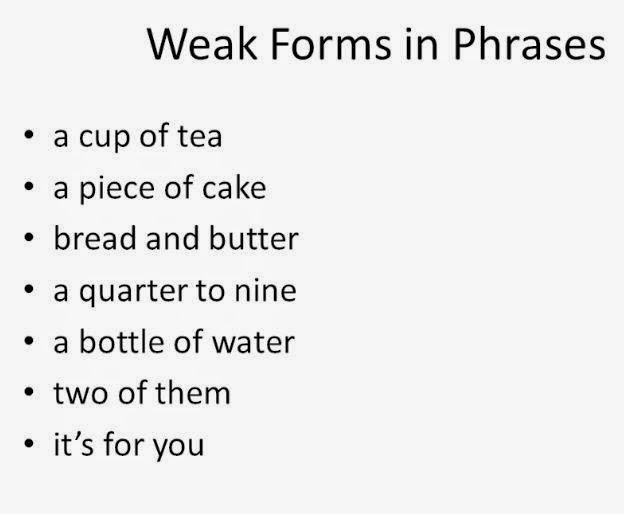
  • Weak Forms in common phrases: "accenting all words is not fluent", Tim reports. He suggests dealing with weakening through "doing away" with sounds: "a" and "d" in "and", "o" in "to", in the phrases below:
  • Elision: Spot the "disappearing sound" in other common daily phrases
  • Linking: Link the final consonant to the vowel in other common phrases and phrasals:

  •  
5) Intonation
  • Nucleus placement and contrastive accent: Speaker A says "I thought she liked Peter" by selecting a particular nucleus, and the rest of the students select the right answer:
  • Rhythm: Bowen suggests using poetry, and Googling "fun poetry" to find samples with clearly-defined rhythm.

6) Student errors : Tips and Tricks
  • Getting rid of onglide in initial /s/ + consonant clusters: Go from bus estation to bust ation and produce it faster.
  • Teach /h/ and avoid its elision in content words by asking students to produce "happy", "here" by whispering the words.
  • Correcting the sequence /w/ + /ʊ/ sometimes realised as [gʊ]: break /w/ into its constituent parts: Say "uuuuuu + aaaa" and speed up: "uuuuuaaaaaud" for "would"
***
I have more or less summarised most of the ideas presented, and if you would like to read about a rationale for them, or get further ideas, Tim Bowen's textbook is filled with theoretical and practical ideas and thoughts.

The recording of the webinar now available HERE.

I have personally enjoyed the webinar, as it is always good to have new ideas, or be reminded of issues I sometimes take for granted in my lessons, and I consider that most of Tim's activities fit in perfectly with the idea that pronunciation CAN and SHOULD be integrated within other areas and skills of language teaching.


Thanks for reading me and I hope you will find this useful!


domingo, 1 de junio de 2014

Summer School in English Phonetics: 4 years later. An exploration of my own intonation.


To anyone who's embarked on the world of ELT, visiting London is both a must and an excursion into some sort of fairy tale. It came quite late for me, being 29 and having been teaching English for 10 years, but money and fear are never to be underestimated. Or maybe they should.

Anyways. I'd been dreaming of visiting the UK, and of studying Phonetics at UCL, and one day in May 2010, after having talked to hubby about it weeks on end, he "forced" me to enrol. The next day, he was dragging me to the tourist agency, against all my fears, to get my plane ticket. And this is how it all started (BTW, I will always be thankful to Leo for this, <3, and for so many other "pushes".)

The Summer Course in English Phonetics (a.k.a SCEP) is a two-week course in University College London, and it is organised into a general strand, and an IPA strand (a group of candidates for the IPA certification who train for the exam and sit for it at the end of SCEP). The course includes general lectures on pronunciation, intonation and their didactics, as well as tutorials in smaller groups according to your professional/academic profile. For us with a previous thorough training (and obsession) in Phonetics, many things were mostly revision (though the lectures were truly clear and didactic, I would like to lecture like that myself!) and I myself was a bit disappointed at not seeing much of my passion, Discourse Intonation (which I wrote on the feedback sheet! Couldn't help it!), but the whole experience was brilliant, particularly, the tutorials and ear-training sessions.

Me on the first day, upon entering the Cruciform Building. Excited, to say the least!


The course director is the renowned phonetician Michael Ashby. We all know he is more than knowledgeable, but I also want to stress that he is a really kind, generous person, even when I, cheekily, asked for a change of group (I had been placed in a group of teachers who did not know about the IPA, and it had probably been my fault as I had not given further details about my background in the application). I will never forget that first day when I approached him, and, unknowingly, used a really low fall whgen sayin "Excuse me". He sensed from my intonation that bad news were coming, and I did not notice at first that a more polite intonation was appropriate. I felt sooo ashamed, and he was so kind about it all. I am so careful with my "Excuse me"s now....
(I now always pester my students with the "right"(?) "more appropriate" (?) "least face-threatening"(?) intonation of social rituals (Paul Tench devotes chapter 10 in his 2011 book to them).

Manuela and I with Michael on the last day. Before that, I had been given a tour of the Chandler House Library. I was dazzled.

In spite of my intonation (and yes, I do want to sound like a native speaker, I am afraid), I was lucky enough to be given a place at the groups led by none other than Jack Windsor Lewis, and Jane Setter.
Jack Windsor Lewis. What can I say?
With Jane Setter. Glad to see strong women like her in the Phonetics field!

It was a true privilege to be part of those groups and to meet such fabulous classmates from all over the world. It is quite strange, when you are abroad, and especially if you come from a country which is not truly multicultural (OK, that can be questioned now), you lose track at times of how your habits, your way of dressing, or greeting, or addressing other people, may not be taken the way you expect them to. I now listen to my audio files from SCEP, and I hear myself as "pushy", even "smug", when I probably didn't mean to be so. And I guess my awareness of intonation has changed now, but I wonder what I came across as at that particular moment, especially when asking questions, to the people around me.

I wonder how much of our interlanguage intonation can be "damaging" in building rapport with native and non-native speakers of English. I believe that if you have a good "control" of the sounds of L2, inaccurate intonation may even make it more shocking or create the wrong effect. I think this also applies to other paralinguistic features, and I guess some of us Latin Americans with Italian blood can be "loud" as well. This is me, back in 2010, and I can't help feeling I was a bit "cheeky" and "abrupt" in my way of presenting these questions, both in terms of wording, the speed and maybe mostly because of my divergent intonation (sorry about the sound quality):


I was listening to BBC 4 this morning, and I came across this programme, "Gardeners' Questions Time". I paid special attention to the questions by the participants (I've been doing so in other open forum shows as well), and I do hear some noticeable differences (I can grant you that there may be age differences, an altogether different context, but still, this appears to be a nice example for me of the way I would like to sound when presenting a question, both vocab and intonation-wise):


It's funny how when you use English quite frequently (40 teaching periods a week!) in a non-English speaking environment and you listen to English at home (BBC, London Heart, Smooth Radio and TV series), some things become more "natural", and you achieve "gut" feelings and reactions to other people's performance in English. This can also be a disadvantage, but I find that nowadays I am more sensitive to the perception of convergence in both wording and intonation of my students. (I am not necessarily passing any judgment on this, but this is how I feel). At times, as for my example above, it is hard to "pin down" what it is that makes me feel I may sound "pushy", and I find this same "quality" in the way some Argentinian teachers of English here talk as well.

***

Now. Back to 2010. Lots of interesting lectures at SCEP introduced me to people I had not read before (shame on me!) such as Beverley Collins, whose textbook I now use with my Phonology I students, Geoff Lindsey, whose blog I follow devoutly, Tim Wharton (the pragmatics-prosody link I was looking for!), and my favourite accent at SCEP, Bronwen Evans'. There was a great lecture by Eva Estebas Vilaplanas, and her book on pronunciation is a great asset for Spanish speakers seeking to improve their pronunciation of English.

And of course, John Wells was there, he delivered a lecture on Accents and some of the dictation sessions, and I made the most of Question Time to ask questions about his book on Intonation and the latest edition of the dictionary, both extremely popular in my country (Luckily, as the questions were written down, my intonation would not sound "impertinent". Phew!).
With John Wells.
So all in all, if you feel like brushing up your knowledge on Phonetics or learning more about it, or getting some good feedback, I would recommend attending SCEP. It is not just about meeting and networking with the "big names", it is mostly about bonding with wonderful people who can help you see how wide and large the world is, and how a simple passion as pronunciation can bring people together (or apart, if you use divergent intonation as I did!). (Speaking of past traumas....back to blog post 2, right?!)
***
Of course, during my two weekends in London in August 2010 and in the afternoons, I just hopped on and off the Tube /tʃu:b/ to visit the landmarks. I was puzzled by the Englishes I heard in my daily interaction with people while shopping or seeing the sights, or commuting, and my own stereotypical view of the "oral London" was reshaped by this trip. My fascination with accents had begun. (More on this, on another post!)
***
Magic occurs when you travel, and as my cousin says, when you are away on your own, you are kind of "naked", and still, you don't fear to show who you are. This is what happened to me. As a woman entering my 30s, this "me-time" allowed me to open up and make new friends, and be myself. One of those great friends is Manuela, another Argentinian, and who remains a close friend, even though we live 1000 kms away from each other and have not met face-to-face again since 2011.
Manu and I holding our certificates! :D
And life has given me the chance of meeting Angelica  and Jan again this year on my trip to Barcelona and to the UK, and I am so glad we can still stay in touch.
Our fabulous group. I still remain connected (thanks to Facebook!) to Angelica, Anabela, Jan, Manu and Veronika.
***
If you want to read more about prosody and perceptions of "pushiness", politeness, and connections between communicative functions and tone from a discoursal or psycholinguistic perspective, here are a few selected references:

Intonation as an interface between language and affect - Didier Grandjean , Tanja Ba¨nziger and Klaus R. Scherer http://cms.unige.ch/fapse/neuroemo/pdf/Grandjean_ProgressBrainResearch2006.pdf


Couper-Kuhlen, E. 17. Pragmatics and prosody: prosody as social action.Handbooks of Pragmatics, 491.
Culpeper, J., Bousfield, D., & Wichmann, A. (2003). Impoliteness revisited: With special reference to dynamic and prosodic aspects. Journal of Pragmatics35(10), 1545-1579.
Culpeper, J. (2005). Impoliteness and entertainment in the television quiz show: The Weakest Link. Journal of Politeness Research. Language, Behaviour, Culture1(1), 35-72.

Tench, P (1996). The Intonation Systems of English. Chapters 4 and 5.

lunes, 26 de mayo de 2014

Pronunciation and I: Intrinsic (!?) Motivation (a bit of a Freudian session)

Pronunciation has been my passion for many years now. I would feel tempted to say it was because of my Phonetics I trainer, Prof. Graciela Moyano, and I would say "certainly, yes!". And I would not be wrong. I am determined to devote a whole post to my wonderful training in Phonetics by Graciela. However, I know there is something about my curiosity about pronunciation that goes back to very early in my life, probably when I was 5 and I was sent to a speech therapist because I could not produce my "rr"s (BTW, I am a native speaker of Riverplate Spanish.  Curious what that means? Wikipedia may enlighten you...a little bit).

A bit of theory first. The "rr" sound is called a voiced alveolar trill, usually known as a "rolling r", and represented thus: [r]. It is a liquid consonant (though Cruttenden 2014:51 points out there is no common agreement on this) and it is a trill because it is produced with intermittent closure between the tip and blade of the tongue with the alveolar ridge. It is a very common sound in Spanish, represented by spelling "r" (initial in the word) and "rr". You can see an animation for the articulation of this sound in the University of Iowa website: http://www.uiowa.edu/~acadtech/phonetics/spanish/frameset.html (Look it up under "vibrantes"). 
You can hear the English frictionless continuant approximant and the Spanish alveolar trill (together with other manifestations of /r/) here
This is what the spectogram of my Spanish [r] and my English [ɹ] look like in PRAAT:

And what they sound like: 
(BTW, for some reason at times (not here, I think) my English /r/ includes a labiodental articulation, very much like Johnathan Ross' own [ʋ] and I guess I was trying to avoid it here. I wonder why!)

Here's a video that shows some people attempting to produce a Spanish trill (BTW, that was my "rr" at the age of 5! My Italian granny used to call me "my little Frenchy", at least that was what my /r/ sounded like to her, much to her dismay) and some tips and tricks which may (?) work (I don't really think the protagonist's achieved "rr" is truly alveolar, as there is some sort of velar start to my ear...but I may be wrong!):


You will hear it in Scottish, as this video shows:


I remember my speech therapy sessions quite vividly, which I guess is quite telling. I can recall disliking the speech therapist, a very tall, slender woman, and I get the feeling she was not very patient. I remember she filled a notebook with drawings and words with "rr", nursery rhymes as well: "Erre con erre cigarro, erre con erre barril..." and I was expected to repeat. I don't have any recollection of having been asked to do anything else than repeat. 

After six or seven sessions, she told my mother I had to keep attending sessions, even during the summer break. I remember getting in a tantrum, saying I was not going to go on attending, and my mother politely saying that since I was going to start swimming lessons, I would not be going back to my speech therapy sessions again. I was relieved.

I eventually got the sound "rr" on my own. I was probably not ready for my /r/ before this time (after all, it is one of the last sounds to be acquired,) or there had been, very likely, more articulatory practice in the sessions which my subconscious mind has "blocked".

***
I heard someone say that we choose our profession as a means of healing a past trauma. I don't know if this is the case (this experience competes with the fact that I was locked inside an English Institute when I was 8), but I do believe this was a significant event in my life and there is something about the impression that I was only asked to "repeat" which I react against, now, in my teaching. (Worth another post!)

Thank you for reading me! Any personal experiences to share regarding your /r/ sounds?

jueves, 1 de mayo de 2014

"Pronunciation Bites" and I


I first conceived Pronunciation Bites at least three years ago. At the time I was teaching Phonetics at College already, but I also had a considerable number of periods at secondary school, and I was determined to find a more systematic and effective way of integrating pronunciation work in my lessons (not that I had not tried before, but things didn't work out too well!). Time constraints, institutional requirements, discipline issues, an apparent lack of interest on the part of students, and my own lack of confidence were always on the way.

As it generally happens, during a long journey back home (I used to commute 1 hr 45 min to work at the time), I just went "Eureka"!. I got my yearly plan, took a look at the grammar and vocabulary contents I was expected to teach for my CAE class, and started deciding on "companion pronunciation features" to those topics.

I first came up with the obvious (looking back, quite a difficult topic to teach, given the clusters which gave my students so much trouble...):

Review of simple past --> past regular verbs --> -ed suffix.
Review of present simple --> 3rd person singular suffixes --> (e)s suffix 

And then I got more creative, and thought of....

Grammatical emphasis: pseudo-clefts and inversion --> issues of tonality and tonicity
Causative structures--> tonicity (noun often accented when expressing urgency or present relevance!)
Expression of regret --> contracted forms of "should've", use of the fall rise for many conditioning clauses (3rd conditional)

So little by little, notions of stress and accent, intonation patterns and consonant clusters became part of my classes, and an important part of grading and assessment, too. 

And so the pronunciation+grammar/vocab+grammar list grew! And these notes, ideas, moments of epiphany, as it were, are now presented as snippets, and pictures, and stickers, and coloured notes in my Evernote app in my phone and tablet, as well as on an Evernote-compatible paper notebook:


However, my inquisitive mind thinks that taking notes and ideas is not enough. I need to supplement this with theory and reflection. And I guess this has always been on my mind, but it became more of a purpose, or a project, a month ago.

Last April I had the chance of taking part in the wonderful IATEFL conference, in Harrogate. And on the very last day, almost by chance, I got into a room where a talk was taking place. It was by Anthony Gaughan, and it was related to professional development, and to how we do not need to travel a long distance to actually engage in it. The text of the talk is available HERE, and I guess it was a perfect way to finish the conference for me, as I definitely need to revisit some of my beliefs and long-established assumptions. So this blog is, to a certain extent, a way of addressing this uneasiness I felt after the talk.

So just like my pocket notebook, this is what Pronunciation Bites is meant to be, at least for me. A place to take down those "Eureka" moments before, during and after lessons, with a touch of theory to shed light and a rationale onto them. An excuse to do further reading on the pronunciation topics that interest me and share them with whoever is willing to hear about them and comment on them as well. A spot to lay bare those ideas and thoughts and reflections which shape my teaching, which is always on the move, always evolving, always growing stronger from mistakes.

Welcome to Pronunciation Bites.