
Those of you who know me well know that my favourite area within the Phonetics and Phonology field lies with the suprasegmentals. I love everything prosodic-related, and I live to find connections between the prosody-pragmatics, prosody-discourse, prosody-systemic functional linguistics, prosody-conversation analysis interfaces. And of course, I'm always looking into ways of making this "teachable". So when I saw the title of the PronSIG webinar by Tamara Jones and Marnie Reed I knew I had to make it. So the webinar I will be briefly reporting was called: The Melody of English: Research and Resources for Teaching the Pragmatic Functions of Intonation" and you can see the event poster with the speakers' biodatas, and the abstract, here.

***
I will be posting some of the presenters' views and ideas here, and in a different colour, my own input.
***
Marnie Reed began the presentation by referring to her own classroom research, and particularly, to the question "What is it that students (and teachers) don't understand about intonation?". She found that many advanced students got to pick the individual words in a message, but they "miss the point" when they do not catch the pragmatic functions of intonation, such as in this example:
Student: Can I turn my homework in late?
Teacher: You \/CAN
The use of the implicational fall-rise here may be lost (an "affirmative answer with a negative meaning") if students are not aware of the actual pragmatic potential of intonation. In this particular case, Reed quotes Wells (2006), regarding the use of the fall-rise:


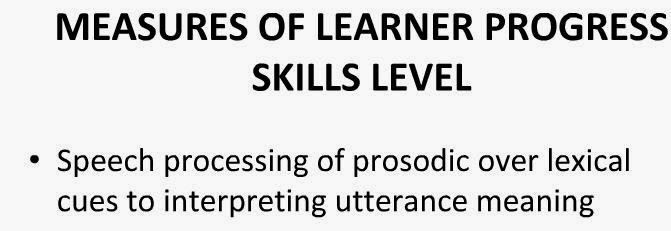
One of my favourite points was raised by both Reed and Jones, and it has to do with the criticism towards the attitudinal approaches of intonation (Yay! Great to hear other people say this, too!).


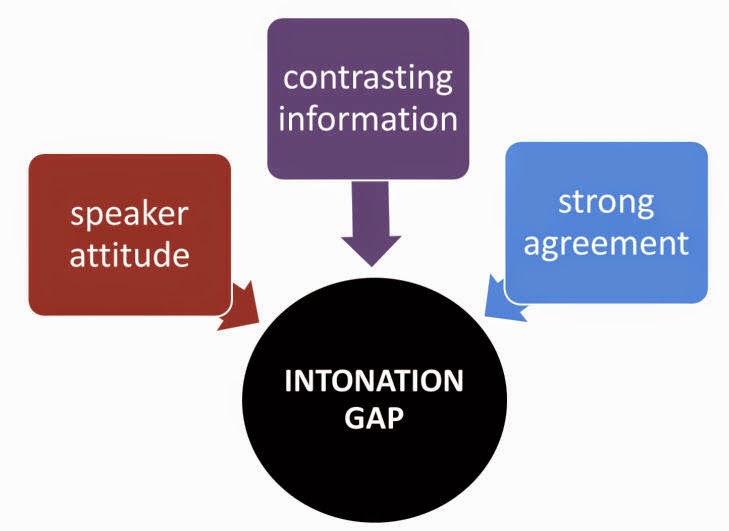
Tamara Jones presents three interesting pragmatic functions in which intonation may have a great role for students to be made aware of.
Reed and Jones both present some great ideas to work on learners' awareness of the role of intonation in the areas above.


Some activities require that students see the patterns in the real word by conducting "field work", that is, getting native speakers to read these sentences to them:
 Some interesting production and also awareness raising activities proposed by Jones were related to prediction and inference work. By relying on intonation, students can be asked to predict what will come later, or what happened earlier.


Jones presented a few tips on how to help students produce prominent words/syllables. She referred to Gilbert's use of the rubber band (which you stretch every time you accent an item), and its alternatives: opening or closing your hand, raising your eyebrows, closing your eyes. And a very interesting alternative was presented, as inspired by Linda Grant: the use of yo-yos!
Many of the activities above encourage peer work, and the following activity is quite interesting, and can be used to exploit several functions of intonation in context. Jones presented this activity to deal with corrections and contrast, thus:

(Student A has B's card:)
A: 'My favourite colour is \blue.
B: Your favourite colour is /purple?
A: \No, my favourite colour is \bluuuuue. (Wide range, and high key, I suppose? Sorry, I am transcribing the prosodic aspects I think I heard when Tamara read the activity)
Teacher: You \/CAN
The use of the implicational fall-rise here may be lost (an "affirmative answer with a negative meaning") if students are not aware of the actual pragmatic potential of intonation. In this particular case, Reed quotes Wells (2006), regarding the use of the fall-rise:
(I noticed that throughout the presentation the speakers referred to the implicational use of intonation, but I believe that some things they mentioned regarding "implication" were in fact not connected to the role of the fall-rise, but to the selection of certain nuclei).
Reed makes a point of the fact that some students believe that English intonation is just "decorative", that meaning resides in words, and she makes a point of the role of intonation in English as a mechanism in terms of speaker intent, which may be different from the ones employed in other languages:
Reed makes a point that if a continuum was made between different languages, English would stand at an extreme point, when it comes to the defining role of intonation and meaning in everyday discourse, with other languages probably making the most of syntactic resources.
Reed also reminds us that intonation is esssential in communication, and in much the same way Brazil (1980, 1982, 1995) does, Reed believes intonation may not go hand in hand with grammar and the wording:
(Gotta love Wichmann!)
 |
Contribution by Tamara Jones later in the presentation |
In this respect, Jones exemplifies the importance of intonation in the speech of her local Korean grocer (I think it was!), who says "Thank you very much, come here again". In spite of how polite the choice of words may be, the prosodic pattern of it sounds more like "go away". (I guess there must be something in the pitch range, maybe too low? Maybe too high and high volume? Forgive my lack of knowledge of Korean!)
I was very happy to hear Reed insist on the role of metacognition for intonation, as at times many of my students do not easily see that theory can be empowering, that knowing about intonation use and the communicative values of the choices of intonation can really help us produce and perceive what is going on. So when asked about the role of repetition, Reed suggested working with both metacognition and skills, "quality repetition" (Jones), to allow students to "own" the intonation patterns and make it "theirs" while at the same time being aware of the "why" a certain pattern is used.
Another very very interesting finding of Reed's which would surely render the same results in my context is students' feelings towards their own production of tone patterns. Reed has heard students produce really nice native-like patterns, which students themselves reject because they feel they are "silly", "ridiculous", "dramatic", "sing-songy", "exaggerated", and they would probably not use them outside in the real world. (I can vouch to that, when I hear my own Lab students in other lessons! Sooo frustrating! )
One of the words that both presenters used and which I couldn't quite make out is the word "exaggerated". I would not personally say English intonation is "exaggerated", and I noticed that most of the examples the speakers gave to refer to this intonation was the fall-rise. I got the feeling that at times the presenters were referring to wide pitch ranges for some emphatic constructions, and in other cases, to the fall-rise itself. Maybe they just used the term to quote learners' impressions on the overall intonation of English, but I don't know. I am afraid I failed to ask about that (and I will, I'll update this section of the post here).
It is very important then, Reed believes (and I agree!), to be aware of the role of students' beliefs in the process of awareness and successful production:
Some of the activities required working with "minimal pairs", so to speak, and using the same wording with a different intonation pattern. In some cases students are invited to decide if the sentences are and mean the same, or happen to different. In other cases, the same utterance is exploited to mean different things, based on the intonation. Students may also be given a number of pragmatic interpretations to see which matches the meaning intended by the speaker in the context. (And no, I am not going to talk about the problems with the notion of "speaker intention" here, so don't frown!)
Changing the nucleus according to the meaning intended
Matching utterances to their meanings
This is a TOEFL-based activity on what Jones called "emphatic surprise" (I would probably use it to deal with rise-fall in GB, or high key)
Some activities require that students see the patterns in the real word by conducting "field work", that is, getting native speakers to read these sentences to them:
This is one of the moments in the presentation where I think the speakers were not dealing with "implication" as they said, but rather, "deaccentuation". It may have been a slip, though!
An activity by Judy Gilbert
Jones presented a few tips on how to help students produce prominent words/syllables. She referred to Gilbert's use of the rubber band (which you stretch every time you accent an item), and its alternatives: opening or closing your hand, raising your eyebrows, closing your eyes. And a very interesting alternative was presented, as inspired by Linda Grant: the use of yo-yos!
(Student A has B's card:)
A: 'My favourite colour is \blue.
B: Your favourite colour is /purple?
A: \No, my favourite colour is \bluuuuue. (Wide range, and high key, I suppose? Sorry, I am transcribing the prosodic aspects I think I heard when Tamara read the activity)
I think this activity can also be used to exploit the fall-rise, probably leading into more polite corrections. Something like:
A: So your favourite colour is \red.
B: 'My favourite colour is \/not red, I am afraid, it's \blue.
Another activity which also engages metacognition and prediction is the marking of dialogues. Students can be given a script, they predict possible accents, and compare with the scene. Jones suggested the following Seinfield scene:

 |
| Very interesting scene to deal with deaccentuation, contrastive focus AND counterpresuppositionals as well, though to be honest, I would have made different nuclei choices myself! |

***
Marnie Reed concluded that all aspects of pronunciation should be integrated into core classes, and they should be part of regular lessons in much the same way other areas and skills are. (Yay!). I think both Marnie and Tamara have shown to us attendees that intonation is essential for meaning in English, that meaning does not reside in words alone, and that students need to be made aware of that. I believe their activities are really engaging, and easily integrated in the language classroom.
In my personal opinion, "theory" is very important when it comes to the teaching of intonation, much to my students' dislike. Because in our own language tones may have a different role, we cannot always rely on our ears when it comes to the communicative values of intonation in a different language. That is another argument against the teaching of attitudinal values of intonation, in my humble view. Our "it's not what they said, but how they said it" radar may work perfectly well in our L1, but we may miss the point in our L2. So teaching intonation in a realistic context, be it within a specific speech genre, or in micro-contexts of conversation like the ones in this presentation, needs to be part of the English lesson if communication is the aim.
***
The session was recorded for PronSIG members. If you want to know more about IATEFL's PronSIG and join, visit their website.
The bibliographical references included in the presentation have been posted at the PronSIG Facebook page here.
