Mostrando entradas con la etiqueta tips. Mostrar todas las entradas

sábado, 26 de septiembre de 2015

Pronunciation Integration #1: Classroom Language & Routines


My greatest concern as a teacher trainer at the moment is to find ways to help teachers overcome the general lack of integration of pronunciation work into the ELT lesson. There appears to be a widespread indifference to the fact that “efficient communication involving any skill area, or any combination of skills, depends on the speaker’s ability to integrate knowledge of the English sound system with knowledge of grammar and lexicon.” Celce-Murcia et al (1996: 221). I sometimes wonder if we are not just teaching English for writing purposes when I see classroom plans. Why is it that we teach grammar and vocabulary and we don't teach the accompanying, or rather, constitutive, features of pronunciation with these topics? After all, if we expect our students to use these structures in their speech, they should at least know how to pronounce them!

***
An interesting anecdote, first. Many years ago, during my first years learning Phonetics at College, I got to informally spend a coffee break with an English lady who was in Argentina as a Cambridge Examiner. She told me that she was really pleasantly surprised at the overall level of English she found in Argentinian teenagers taking their FCE exam, but she thought they sounded pretty contrastive all the time. I asked why, and based on the examples she gave me, I realised she was talking about the prominence given to weak form words by these students: "THERE ARE some children playing in the picture". She said she felt like replying "Well, no one said there wasn't!?".

This is an example of many of the things we do as teachers when we focus on grammar, we are so intent on getting our students to produce the right auxiliaries and forms that we perhaps forget about the spoken side of things. Of course, the issue of weak forms is certainly a feature of debate when it comes to English for Global Communication -as weak forms are out of the Lingua Franca Core-, but I am just reporting on the reaction a native speaker had after hearing students accenting, or using strong vowels on elements which are generally reduced in English. You will decide on the relevance of this comment based on the reality of your teaching context, and your teaching goals.

***
This new set of posts is supposed to introduce ways of integrating pronunciation work to the teaching of grammar, vocabulary, reading and listening. Today's contribution will relate to one of the first set of items we teach beginners: school objects/supplies, school subjects, and classroom routines.

***

Among the criteria we may use when deciding on what to teach, we may consider frequency of occurrence of a certain feature. If we scrutinise our school syllabus, we may find that a certain sound or intonation feature appears to be recurrent on our vocabulary list, or on our grammar "must-teach" selection.
In this case, a quick look over a list of school objects (just Google "school objects" and a huge number of picture dictionaries, textbook captures, worksheets and even vids will come up!), already establishes a set of tendencies regarding the pronunciation features that make up these linguistic structures. Plus, the teaching of these items ensures perpetual practice and recycling, since classroom objects and routines are part of our lessons every day!

So, without furher ado, find below a few pronunciation areas you may connect to these vocabulary topics:

Plosive attack!


/b/ appears on a number of frequent words: (black)board, (text/copy/note)book, rubber (is this word still used in BrE?),  backpack, bag, binder, briefcase, Biology, bin, (pencil)box, paintbrush.... Though it is not a particularly difficult sound for Spanish speakers, the presentation of these items is a good opportunity to help students turn their Spanish fricatives (or approximants, in some cases!) into bilabial plosives.
Similarly, we may focus on /d/ and /g/: desk, glue, globe, diary, CD player, dustbin, dictionary, garden

Aspiration: there are many school items that are pronounced with aspirated fortis plosives: text(book), table, pen, pencil(case), paper, keyboard, calculator, calendar, hole puncher, tablet, coloured pencils....
Closely associated to this, you may get cases of approximant devoicing: class(room), clip, projector, computer, crayon, screen, stapler, clock, diploma, CD/DVD player, playground


Compound Objects


School objects may also introduce patterns of word stress, particularly compound words. Slippery as compound word rules are, beginning with the debatable CD/DVD player -worth another discussion, since it appears to be changing...do you say 'C\D player, \CD player... I've heard both! EPD and LPD endorse the first-, there are always things we can teach, albeit just lexically or as fixed collocations:

  • NOUN 1 + NOUN 2-er/-or N1 acts like an object to the verb embedded in N2: \pencil sharperner
  • ADJ+ NOUN long-established compounds vs ADJ + NOUN collocations: \blackboard vs 'black \board  ; 'spiral \notebook, me'chanical \pencil
  • NOUN1 + NOUN2 "type of", "place for" combinations: \ink bottle, \rubbish bin
 (For further rules and theory on Word Stress patterns, check Ortiz Lira, (2000))


Stress-ful(l) School Subjects


The teaching of the names of different school subjects and sciences can be a good excuse for the introduction of stress-shifting suffixes (Cruttenden, 2014; Teschner and Whitley, 2010) and  the rule of alternation for the placement of secondary stresses (underlined below), whenever applicable.

-ology: BiOlogy, SociOlogy, AnthropOlogy, EcOlogy...
-ography: GeOgraphy, CinematOgraphy, PhotOgraphy...

Brita Haycraft's "English Aloud" (which I discovered thanks to my colleagues Prof. Terluk and Prof. Iannicelli), has a lovely set of songs for word stress practice, one of which includes a number of school subjects and sciences. Really worth a look!

Rollercoastery Classroom Requests and Offers


Because of its frequency of use in the classroom, some classroom routines can become a great form of "drilling" intonation. Students produce a number of requests and  offers in the lesson, and the use of the fall-rise tone (the "rollercoaster tone", as I like to call it) in those routines in English may be introduced, and practised, through classroom formulaic language.
(I personally recall my first days as a teacher, when I would not allow my 5th graders to go to the toilet unless they applied their English intonation on the question....boy, they learned fast! So cruel of me! --- BTW, Argentinian students of English are very likely to employ rise-falling heads and rise-fall nuclei on these questions, as Prof. Zabala (2011) rightly points out.)

'Can I go to the \/toilet, please?
'Could you ex'plain it a\/gain, please?
'Can you re\/peat that, please?
'Can you 'lend me a \/pencil, please?

You can also teach the accentuation of "I" (i.e. the personal pronoun as nucleus) in those cases students volunteer to do something (provided the rest of the question is Given information, of course):

Can \/I clean the board, please?
Can \/I read, please?

You can always use these questions as reference when you want to introduce intonation in other linguistic structures and combinations.

***
This brief post, the first of many, I hope, intends to show ways in which we can integrate the teaching of lexis, grammar, and language skills to pronunciation work.

In this particular case, we linked our classroom objects, school subjects and sciences, and classroom routines to some basic pronunciation and intonation features.

You will decide, in your own context, whether you want to teach these features explicitly, using these language exponents as examples, or whether to present them as constitutive of these items, collocation-like, without further reference to the theory. Whatever the case, once you have presented these pronunciation topics, students will start becoming more aware, and perhaps even concerned, with the way they should treat new vocabulary topics and speaking routines! It can be the beginning of a very interesting pronunciation journey!
***

Extra tip: there are many videos, websites and activity repositories you can consult online to teach these school subjects/objects/routines lists. However, many of the audio dictionaries, and even videos that teach the topic, have either synthetic voices or provide an oblique reading of the lexical items and formulae presented. So please be cautious in your selection.

***
References

  • Celce-Murcia, M., D. Brinton and J Goodwin (1996). Teaching Pronunciation: A Refernce for Teachers of English to Speakers of Oteher Languages. New York: Cambridge
  • Cruttenden, A (2014). Gimson's Pronunciation of English. Eighth edition. Oxon: Routledge.
  • Ortiz Lira, H. (2000). Word Stress and Sentence Accent. Monografías Temáticas. Chile.
  • Teschner, R. and S Whitley (2010). Pronouncing English. A Stressed-Based Approach with CD Rom. Washington: Georgetown University Press.
  • Zabala, F. (2011) . El acento tonal circunflejo (L*HL%) en el español rioplatense. En Bombelli, G y Soler, L (compiladoras) Oralidad: Miradas plurilingües desde la fonética y la fonología. Córdoba: UNC.

jueves, 27 de agosto de 2015

Coming up with your own pronunciation "tips and tricks"


During these last few weeks I have had the chance of carrying out my favourite activity in my third-year teacher trainee Lab courses: the "tips and tricks video sessions". Basically, the task requires that students devise their own 3-minute teaching pronunciation video tutorial around a feature/contrast assigned to them, and following a number of guidelines. Some of the videos I show for inspiration and to see different styles -apart from those by students in previous courses- include the YouTube tutorials by JenniferESL, Rachel's English and some videos by Clear Speech Mastery, among others. (Note: Perhaps I don't always agree with everything they say, but I think it is good to show different ways of doing things! - Note 2: I have posted two of these video tutorials by my students in my Pronunciation Bites Facebook page.)

Now, one of the requirements of the task includes the presentation of a number of "tips and tricks" to introduce and teach the feature, and I generally ask students to come up with their own systematisation techniques. Many people find this really scary, as they may not have experienced this (or any!) type of pronunciation instruction in their lives as English learners before, so they may feel they have no "models" for pronunciation teaching.

So this blog post is precisely about pronunciation teaching, and it will introduce ways of finding inspiration so that you can devise your own "tips and tricks" for your lessons.
***

As we all know, teacher training courses (at least in Argentina....we take it really seriously!) may introduce a lot of technical information. This may result in trainees later either introducing a lot of technical terminology in their primary/secondary school lessons, or directly blocking out pronunciation work. Many teachers feel paralysed about the whole thing and don't know how to go about it. So what do we do with all the knowledge we have? How do we make pronunciation "teachable"?

These are a few steps I personally believe we should follow:

1. Study your feature

Yes, I am one of those people who believes that in order to teach "this little" (thumb-index finger gesture) you need to know "this much" (wide arm gesture). OK, perhaps not sooo much. But there are a number of things you do need to know about the features you are going to teach (I insist, however, that I do not wish you to get "terrified".....):
  • What are the characteristics of this feature? 
    • If it is a vowel, what do we know about the height and part of the tongue raised, the jaws, the rims, the lips? Is there anything about resonance worth learning? What about its spellings?
    • If it is a consonant, what do you know about its voicing, muscular and breath energy, manner and place of articulation? What do the production stages reveal about this sound? Are there any complex spellings? What allophonic variants are there? How is this consonant affected in certain contexts, or due to coarticulation?
    • If it is a process of connected speech, what rules and restrictions are there? What features are involved? How does it affect perception and production? What coarticulatory gestures do we need to teach?
    • If it is a tonicity feature, what rules are there to teach? Are there any exceptions? How does this set of rules affect meaning-making practices? How is prominence perceived and produced?
    • If you want to teach a context for a particular tone pattern, what is the manifestation of this "melody"? What communicative, grammatical, illocutionary contexts reveal a high frequence of occurrence of this tone? 
    • If you wish to teach word stress, what rules and exceptions can you trace? If it is a polysyllabic word, what can you predict in terms of the suffixes / prefixes employed? If it is a compound word set, what grammatical information can you collect in order to make sense of the rules?
  • Is this feature in your students' own L1? 
    • Is it "worth" teaching explicitly then?
    • Does your students' L1 have a similar sound/intonation feature? If so, what features do we need to teach? Can we use their L1 as starting point? (E.g.: I can use my Spanish /a/ sound as a starting point to teach /æ/, by drawing my students' attention to the smile, the spreading of the lips, the fact that my lower teeth get "covered or hidden" -in an toothless-elderly-person fashion- by my lower lip and the skin below. My students can try both vowels in front of a mirror).
  • Are there any common "tips and tricks" and rules to teach this feature? What do those focus on? How effective are they? (Try them!) What do they fall short of for them to be successful in my context?
Plus, a set of things all ELT teachers should learn at some time or other:  How does pronunciation work differ from other areas and skills of language learning? What different ways are there of doing pronunciation work? How does the whole process of acquisition or learning of our own L1 and an L2/foreign language set of phonological features work? What psycholinguistic theories inform our processes of perception and production of speech?

Knowledge is power. The more you know about your feature, the more confident you will feel, and the more informed your decisions will be. If you carry out Contrastive Analyses, you will be able to be more "economical" in your explanation, just teaching the bits that will be challenging for your students (E.g.: in Spanish, /p/ is also bilabial and plosive, but it is not aspirated. So what you need to teach for /p/ is its aspiration. So don't spend time explaining how the bilabial and plosive aspects of this sound need to be addressed....)

2. Make selections

Now that you know what your feature is and how/where it works, you need to look at your students, and your syllabus, and make the next set of decisions:

Are you going to teach your feature for production, for perception, or both?

If you are going to teach your feature for perception, it would be useful to think about all the processes of connected speech (coarticulations, linking, reductions, elisions, stylisations) it may undergo, to be able to prepare your learners for all the "sound shapes" (Cauldwell, 2013) (and tone shapes!) they may acquire in "the jungle" of real life speech. This is a really challenging area, worth another blog post...in the future.

If you are going to ask your learners to produce the feature (though you will have, of course, to do listening discrimination and ear-training work anyway!), move on to the tips below. Plus, see how and when you will be introducing the spellings for the sound, or the communicative values of the intonation choices you wish to introduce.

3. Explore your own production of the feature

Now that you know some basic technical stuff about the feature and about your students' L1, you need to try the feature yourself. Several times. And use your senses.

"Denaturalise" the production of this feature. How? Be narcissistic: Look at yourself in a mirror, record yourself using your phone/notebook webcam, take pictures of yourself. See what you are doing, how you are doing it, and put it into words, into simple words: "when I produce /æ/ I smile, I can see my upper teeth but not my lower teeth as my lower lip covers them. The sides of my lips are spread backwards. My cheeks get puffy (BTW, the latter is one of my students' discoveries!)."

Make comparisons: What do I look like? "When I say /æ/ I look like a clown; I look like a person sucking a slice of tangerine; I look like an elderly person who has lost his/her lower teeth...."

What does it sound like? Produce the sound/intonation feature several times. Does it sound familiar? Is there any real life sound the repetition of this sound evokes? E.g.#1: a former student who played tennis regularly told me that the LOT sound in isolation reminded him of the bouncing of the ball on the court during the tennis matches. E.g#2: I think of a cat somehow coughing/choking (?) when I produce many /æ/s in succession.
(Credit: http://i.ytimg.com/vi/6MTIwY3_-ks/maxresdefault.jpg)
What does it feel like? Think about your physical reaction towards the changes and stages in the production of the feature (going slow motion may help!) and once again, put it into words. "I feel as if there was someone stretching my lower lip and my skin to the sides when I go into /æ/). Place your fingers to the sides of your lips (Underhill-style!); rest your chin on your palm and the fingers to the sides of your lower cheeks to feel the downward movement of the jaw.

Also think about your emotional reaction to the sound. Do you look happy when you say /æ/? Are there any "feelings" this sound/intonation feature evokes?

Find reference points: Look at your L1 starting point. What changes do you need to make to get to the L2 quality (or at least go "towards" the L2 quality?). Or what L2 sounds already learned can you use as reference? E.g.: To produce /æ/ I can lower my jaw, if I start from English /e/.

3. Give your tips a sequence, a wording and a set of gestures


You have now got technical info that informs your own production of the sound/intonation feature. You have got a set of multisensory and cognitive tips you can teach, a whole "bag of tricks". (Remember that only one pronunciation tip will not always do the trick. We all have different learning styles, diverse abilities in terms of phonetic coding, and we have different degrees of  awareness of what we do with our organs of speech. Therefore, we need to cater for different styles and "intelligencies")

So now you have to give your tips and tricks some sort of shape. Try to explain your discoveries in simple words, following a clear procedure, and allowing students some time to experience your guided "experiment" with mirrors or mobile phone cams. Use gestures, hand and body movements, "body gym", to accompany your tips. Use reference names or words (colours, animals, celebrities) to refer to the features (E.g.: the "yes, but" tone pattern; /æ/, the "cat", or "black", or "Harry" sound). (BTW, I owe this last "reference word" tip to Prof. Iannicelli, and Prof. Terluk. Plus, I want to acknowledge my former students who came up with "Cat in the Hat", and Harry (from One Direction) as reference items for for /æ/ and created tasks related to these reference words ). Recycle your gestures and tips all year round, as words or utterances with these features re-appear. Remember that a "one-off" systematisation session may not do the trick. Pronunciation is physical, motor, and as such, we need our muscles and our brain to work towards new habits, and we must practise, practise, practise (pretty much like going to the gym!)!

4. Test-drive your tips and if necessary.....recalculate! (GPS-like!)

Once we have got our tips and tricks ready to go, we need to try them out. In my experience, watching the tips "in operation" has helped me see whether my "mental and "physical associations" with the sound are actually transferrable. For instance, my association with the Puss in Boots from Shrek for /æ/ did not find a home in my students, as they could not relate to it, and they would represent their "choking" feelings with other types of noise. (Fair enough! It is a bit crazy, come to think of it!)

So by trying the tips out, monitoring students' reactions, listening to students produce the features, and assessing their output, we can reach a conclusion as to how effective a certain tip can be for a particular group. My best tips have actually stemmed from my most unsuccessful tips! (Recalculating....recalculating...) Paying attention to my students' attempts at producing a certain sound after my instruction, and noticing that the output sounds were not really what was expected, helped me find alternative ways to address the sound features that were not being taken up by my students. E.g.: many of my students focus on the "puffy cheeks" effect of /æ/ but fail to drop their jaws enough, and their resulting sound is the old fashioned [æ] sound, closer to /e/.  At times, then, our tips may help students address a certain aspect of the sound/intonation pattern we are teaching but we may need to find other ways to address other features (in my case, students were not addressing tongue height and jaw-lowering properly, but the lip spreading was appropriate, so  I had to seek new strategies to draw their attention to the features that were missing).

Of course...this can even become a whole research project in itself! "The success of the "puffy cheeks" tip in the acquisition of /æ/ in Spanish learners of English"...:p

***
Final Remarks
  • Whether you want to teach a native-like variety of English or you go for a more "English as a Lingua Franca" for intercultural communication approach, vowel quality is one feature that has been agreeed needs to be taught. And I would personally suggest that we should all come up with our own "tips and tricks" to teach vowel quantity and quality since these are some of the most "abstract" aspects of pronunciation to systematise -together with intonation, that is (worth another post!).
  • I recall Robin Walker hinting at the fact that at first there is no need to reach a 100% accurate target, but we should aim at leaving the L1 "area" towards a differentiated target to build a new interlanguage L2 contrast which can then be fine-tuned. So perhaps we may not get our students to reach an accurate final target or quality at first with our tips, but the moment we make students aware of the differences between their L1 and English as an L2, and we start building proprioception skills, a whole new set of abilities are awakened, which will surely allow for changes at some point in the future. 
  • Of course, depending on your context, you will work harder on helping a learner fine-tune a contrast towards complete accuracy, or perhaps just make sure they reach a close quality that allows for a contrast different from their own L1 quality but which makes it all intelligible. (I have a set of expectations with my teacher trainees that I may not always have with other groups of students)
  • As we all know, pronunciation teaching is in a way, a craft. What works for one learner may not work for others, and if we want to do our job well, we need considerable time, face-to-face, especially, with our learners, working on the challenges and difficulties of each learner in particular. Perhaps we might need a longer, and more personalised session than for other skills, if we compare the time it may take to grade a written task, versus the time and energy it takes to grade or give feedback on an audio file or a student producing something live in front of us...but it has to be done! 
  • As we all know, speaking is a "fleeting" product, and the moment our learners produce their sounds/intonation patterns, they are gone! So, school permitting, recording or videotaping does really allow students to reconstruct their production and have something to cling on for later improvement. I cannot stress this enough! 
  • Finally, pronunciation, as we are always reminded, is physical. So we have to work towards the training and awareness of our bodies. Aftet all, we are working on people's articulation and motor skills and not on a written sheet of paper, so we have to tread carefully, find ways around, be respectful, and allow students to see the magic -and not the threat-, of it all.
Hope you have found this post useful. It does look like my own Pronunciation Teaching Manifesto, to be honest!

miércoles, 12 de agosto de 2015

Report on the Phonetics Teaching and Learning Conference (#PTLC2015) at UCL. August 5-7th, 2015 - Part 2

My previous post briefly commented on the sessions I attended at PTLC 2015 on Day 1. I am now going to report on a very busy day at the conference, Day 2, before it all flies away from my short-term memory and all my teaching duties take over! 

(My usual disclaimer: all misinterpretations of the presentations are my own, and totally unintentional)

Day 2: August 6th

The opening plenary was by Dr. Eleanor Lawson, who struck me as sooo knowledgeable and so young! She made a fascinating report of a few studies on Scottish postvocalic /r/, and what different types of measurements (impressionistic, MRI, UTI) contributed to the study of coarticulation. The presentation continued with the description of the whole development process for these two amazing online resources: Seeing Speech and Dynamic Dialects. It was, simply, an amazing presentation.

And after that, we had the fabulous experience of trying ultrasound imaging on our own tongues! 

Trying my Spanish alveolar trill! :D Sooo exciting!

The second session of the day started with a very entertaining presentation of teaching ideas for laboratory phonetics by Timothy Mills, Karen Pollock and Benjamin V. Tucker from the University of Alberta. One of their techniques involved getting students to create their own "Frankeintracts" of the vocal tract, making use of any material of their choice (apparently some students even attempted models that could actually utter sounds!). Other very interesting activities consisted in the students' plotting of their own vowel formants and a few designs of tests for the perception of neutralisation of items such as "latter/ladder". 

Mercedes Cabrera-Abreu and Francisco Vizcaíno-Ortega were up next (represented by Mercedes on this ocassion), and their presentation was a discussion of their classroom assessment tasks for their courses on acoustics, and the results obtained. From spectogram and waveform recognition tasks to the actual hand-drawing of spectograms, students were assessed on numerous aspects of acoustic phonetics, with different levels of success. I found the tasks particularly interesting (and difficult, given my really basic knowledge of acoustics!), and this presentation opened my mind to a other ways of testing.

I, Marina Cantarutti, was the following presenter. I discussed a very humble classroom experience on intonation teaching through speech genres (the lecture genre, in this case) and on my students' treatment of tonality, tonicity and tone in connection to thematic structure in a pre- and post-instruction tests. I have basically found that my students actively assigned different degrees of relevance to the various thematic elements in the text given by either conflating Themes and Rhemes in the same IP (lowering the relevance and possible contrastive value of the thematic element) or by treating them obliquely. I also made a point that contrary to my own expectations, students initially produced more cases of transfer from Spanish in terms of their treatment of focus, rather than of tone.

After lunch, two attempts at a group picture, and a tour round the labs and the library, we were all ready for more.


The whole #PTLC2015 bunch! (Credits: PTLC, FB page)

Smiljana Komar from the University of Ljubliana introduced her results in perception tasks for the fall-rise tone. She found some interesting cases of mistaken perception of fall-rises for falls, and then for rises. Her findings in a way appear pretty similar to the ones I believe we would find over here in Buenos Aires, if we tried the same tests, which makes the whole thing really intriguing, given that we have different L1s!

Yusuke Shibata, Masaki Taniguchi and Tamikazu Date presented an experience with junior high teacher and students, connected to notions of tonicity and focus. They have found these features to be highly teachable, and they expect to be able to "persuade" and also train teachers towards the active integration of pronunciation and intonation work at schools.

Junko Sugimoto and Yoko Uchida carried out an analysis of the government-approved ELT books in Japan in search of pronunciation tasks and training. They have found that there were activities connected to vowels, consonants and well as articulatory explanations and resources on phonics and Katakana. In my opinion, the books they analysed presented a number of very interesting contents and tasks, and they far exceeded the number of activities and pronunciation training available in the EFL textbooks that we have on this side of the world.

Nikola Paillereau presented a comparison between some specific Czech and French vowels as produced by students acquiring French as L2. The focus on this presentation was the assessment of L2 vowels using a piece of software called VisuVo -which, unfortunately, is not open to the public yet-, which was designed by the presenter and a collaborator . The program allowed for measurement and plotting of vowel formats and comparison of other variables across speakers and in an intra-speaker manner. 

Rungpat Roengpitya discussed the design of different Phonetics courses at different departments at her university in Thailand. I found it particularly interesting that the inclusion of Phonetics for training in some medical sciences, such as Dentistry, was aimed at helping the future professionals become aware of how they can improve a patient's quality of life by knowing how their intervention may affect speech.

Pekka Lintunen and Aleksi Mäkilähde (represented by the former on this occasion) carried out a very interesting study regarding what students prefer, like and find motivating about the Phonetics courses they attended. Their survey revealed that students find accents and intonation topics more engaging than other themes in the course. Part of their study also assessed whether students' view of Phonetics as highly benefitial to their future career had changed, and in most cases, students agreed that Phonetics was necessary for their professional development. There were a few caveats and self-objections that the presenter made to the survey and its delivery, but it was overall a very interesting, and easily replicable study, worth further thought!

The closing prenary was by Professor David Deterding, and it was aimed at discussing misunderstandings and the role of pronunciation for intelligibility. We participants had a lot of fun decoding many instances of English as an L2/FL speech from different locations (Brunei, Nigeria, among a few others), and in the end, it turned pretty challenging to make sense of many words. (This may seem quite obvious and ordinary for people teaching in multilingual environments, but in my teaching setting, where most of my students' L1 is Spanish and where English is only used in the classroom, activities like these really open up your mind!) . Deterding's talk included a review of the Lingua Franca Core, and some comments regarding attempts at revised versions in different environments. Apart from the well-known objection to stress-timed rhythm as a feature making speech less intelligible from an international perspective, there were a few comments regarding the role of consonant clusters in the blurring of comprehension at word level. Event though David did not perhaps tackle upon this explicitly in his talk, later personal communication made it clear that of course, we need to make a distinction between aims we may have regarding perception, and those for production. We all agree that perception and exposure to all accents of English, including "international Englishes" is essential if we want our language teaching training to be enabling and empowering for communication.
***
This is the end of Day 2 (because, of course, I will not report on the wine-tasting session!). Just in case: I'm just the messenger here, so I am merely reporting on the sessions, and adding a few comments, but of course, any objections or remarks on the presentations should be addressed to the authors themselves (do note that I have, in most cases, added links to the speakers' institutional affiliations!).

 I'll be wrapping up my discussion of PTLC on my next post on Day 3, which will probably be out during the weekend. Thanks for bearing with me!

sábado, 4 de julio de 2015

Talk like Hawking: Teaching with a synthetic voice

Hiya! I have been pretty busy and also a bit disappointed in life lately (soo dramatic!), but blogging has always been good medicine, so I'm back! 


***
I have always found voice matters interesting, and I do pay a lot of attention to people's voices in general. They have the power of generating feelings, immediate gut feelings, in me. 

For many years, I was concerned about my own voice, as it would invariably become hoarse and then turn to a whisper at least twice or three times a year. I was teaching over 55 periods a week and as we all know, our teaching activity is a 100% dependent on our voice (there's a limit to emergency video sessions one can plan when your voice's "on the blink"!). So I was basically "killing my voice softly".

Things changed for the better when I started training in vocal technique, and I will always be grateful to Carlos and Liliana at Instituto de la Voz for having saved me from potential hiatus and nodule problems. And I have now got the huge responsibility of passing on these techniques and voice care tips to my teacher trainees, which I try to do on a regular basis. 

Now. This whole babble is related to today's blog post, since in spite of all my care, my voice was gone yesterday due to an irritating bout of flu or something (and the winter temperatures hitting our country like we haven't seen for a number of years!). With several classes a day to teach, all pronunciation-related, how do you keep going?

Well, the obvious answer is: "You don't. You go home, you see a doctor, you get some rest for a few days till you recover". And that would be the right answer. But it's not always possible. So here's what I did yesterday.

***

Teaching Phonetics the Hawking-style

We are all familiar with Stephen Hawking. We all know what a miracle it is that he can share all his wisdom and knowledge with us through a computer. Therefore, I used him as an inspiration to try to teach my class without having to strain my voice.


So here's what I have done:

1) I typed part of my lecture at home, on my tablet (It runs an Android Kit Kat operating system).

2) I downloaded the following app: Talk, and selected English (GB) as the output voice. (I was in a bit of a hurry, so this is the first app that worked for me, but I will be comparing it with others below)

3) I tried the app out, and noticed that to make it less "robotic", I had to "teach" the system to read the way I wanted it to read. That is, I had to input extra punctuation marks, such as "" and ; to allow the machine to chunk units apart or produce some basic intonation patterns which would allow my audience to follow more clearly.  I also had to simplify my clauses and exploit thematic marking on the text to make sure my synthetic voice would signpost topics and paratones more clearly to my students.

4) I gave my tablet Internet access via my phone, using it as a router, since this app needs a working connection, and of course, I connected my tablet to my portable speakers.

The immediate result? Giggles, of course! It was fun. I got called "Marina Hawking". But it was, of course, not the same as being able to respond to students' queries in real time. I eventually had to replace the use of my tablet for the whiteboard when I needed to reply to students' queries on the spot. 

I wanted to brag and I finished my lesson by typing in "That's all, folks!", but the awful rendering by the system (giving "folks" a separate IP and using a fall) spoiled all the fun! (Try it!)


However, I was teaching a theoretical class, so the app did the trick. I had a Lab lesson right afterwards, and it was really difficult to succeed in this way. I was not in a position to deliver feedback on the spot, since obviously, my app would not read IPA symbols, and the need for synchronous comments while the student is reading out, or speaking, does not match my typing speed. In this particular case, gestures and the whiteboard did the job. Sort of. My teacher assistant allowed the class to happen, to be honest!

(Had I had a data projector, I would have projected the text my students were reading, and I would have highlighted their slips and mistakes on the spot, to allow them to at least see what I was trying to comment on! I could have also projected some vids and audio files from some of the pronunciation apps I reviewed in the past.)

So all in all, a text-to-speech act may save the day, but you defo need to take care of yourself and try to get your voice back asap!

***
Free Text-to-Speech Apps

After yesterday's experience and while resting in bed, I decided to review a few other apps that may do the job nicely.

(I will review them together, as they are very similar and use the same voice database. The same text was read by both apps identically, and with the same voice. They only differ in their interface.)
  • These apps allow you to paste your text, or type it straightaway, and play it out. (Easy Text to Speech does not require any text-pasting, it just reads from your clipboard)
  • You are able to choose from a long list of languages and accents.
  • You can export or save your audio file.
  • You need an active data or Internet connection.
  • Tip! You need to "overpunctuate" your text to avoid a robotic output.


This application uses its own voice database. You choose an accent, and a speaker, and you download the voice database for that voice in particular. I have chosen "Amy, UK English". So far, it sounds like the most natural reading option, because the voice is somehow soothing. 

It has not, of course, reached the state of artificial intelligence, in that it does not chunk my text the way I would like it to, and it does not always employ the intonation I expect, but it does recognise a few chunks and it appears to be able to recognise patterns of declination and paratones. 

This application also allows you to set your preferred pitch and speech rate for the chosen voice.

From what I have been able to make out, it does not need an active Internet connection. The voice data files I have downloaded were 150 MB, so I guess it should all be "there".

Even though it is not a text-to-speech app but rather a translator, I cannot help feeling surprised about the changes that Google has introduced to their voices and to the whole reading aloud experience. It still sounds pretty "robotic", but there are some chunks of language that the system automatically recognises and reads out with some fixed intonation patterns. This creates an overall "weird" effect, since you hear upsteps, downsteps and sudden tone changes that make the whole text sound incohesive at times, but less so, if compared to what it was like last year!

BTW! I have found a tip on how to get Google to read out a phrase out for you. Type in this address in your browser:

http://translate.google.com/translate_tts?tl=en&q=type your phrase here

And replace the bit that says "type your phrase here" with your own phrase, and voilá!


Much as I love Google, Microsoft has done a better job in terms of making their performance of read-out texts more natural. The Bing Translator option presents, in my humble opinion, a better chunking, and more natural selection of intonation patterns. 

See for yourself! Compare the output versions of a short paragraph of my lesson by both Google Translate and Bing Translator. Look out for some interesting word stress choices as well!


***

Final remarks and a few extras...

  • A full selection of Android text-to-speech apps is available here.
  • For a list of other possible uses for text-to-speech for language learning, and ideas to aid students with special needs, you can check out these resources:


Hope this blog post has been of use! It has certainly inspired me to start considering writing a paper on synthetic-speech talk and intonation!

lunes, 11 de mayo de 2015

Pronunciation, Phonesthesia and Realia: The case of the STRUT vowel (Part 2)

In my latest post, I compared General British STRUT and its variants to Riverplate Spanish /a/. I reviewed some articulatory and also acoustic features, and I also went over some basic notions of Speech Perception theories. I established that many of my Riverplate Spanish learners may associate English /ʌ/ with their Spanish /a/ "magnets" and may, thus, find the differentiation between both vowels challenging, both for perception and production.

(BTW, apparently, the differentiation between English /ʌ/ and other vowels appears to be quite an issue for many speakers of English as an L1 or L2, as Ettien Coffi (2014) reveals in this paper from the Proceedings of the 5th Pronunciation in Second Language Learning and Teaching Conferencepage 11 onwards)

In this post, I would like to present some of the tips & tricks I have collected over the years (and I will try to acknowledge my colleagues' contributions whenever I can!). My claim will be that many "tips" do the job when they help create an image of the L2 sound which may help the learner steer away from their L1 quality, and that this may not necessarily just be reliant on making the right articulatory movements.

This is why some of my suggestions will draw on creating "mental images" through the contributions of Phonesthesia, and Realia; images which should appeal not only to visual aspects, but also auditory, and emotional resources.
***
A few definitions first:

Realia refers to the introduction of real-life objects in the classroom, to make the learning experience of certain concepts and routines more vivid. This technique also enables students to engage all their senses and learning styles. We can introduce actual objects, or we can create virtual situations that may allow students to experience similar emotions and actions as those recreated in the real situations.
(You can get some teaching ideas on using teaching aids in the TEFLSurvival blog, and the BusyTeacher website.)


Phonesthesia refers to the analysis of "sound symbolism". It basically studies how clusters of sounds may center around lexical sets that express similar meanings. So for example, in the Dictionary of Sound by Margaret Magnus, you can find a number of STRUT words that could be related to "puffy things":  plush, fuzz, fluff, cuff, muff, ruff.

This reminds me of a poem by Tony Mitton, called "Fluff"

What's this here?
A piece of fluff.
I don't know where I get this stuff.
I'll blow it away
with just one puff.
Huff!
There. That's enough.

So the combination of vowel /ʌ/ and the /f/ quality, reminiscent of blowing, creates this "puffy" effect of fluff and makes the poem lovely for oral performance, and effective! 

***
As a College student, I had a hard time fine-tuning my STRUT away from my Spanish /a/. I was given instructions, I  knew I had to drop my jaw, but still, it sounded pretty much like my own Spanish /a/. (Mind you, my friend and colleague Prof. Francisco Zabala has found that the STRUT quality as an allophone is present in many Spanish combinations of "a" + sound /x/, as in "caja".)  And I see my students at Teacher Training College producing a similar type of Spanish /a/ sound. So after a few tries, after watching native speakers of English produce their STRUT sounds, analysing the way this jaw-dropping takes place for this sound, I came up with the first articulatory tip that worked for some of my students:

"Keep to the railings of the mouth". I asked my students to imagine that each of the two sides of their lips, or the corner of their mouths, had a vertical railing, and that there should not be any smiling, as it would defy the railings of the mouth, and that the articulatory movement should be downwards, not sidewards. I could not help thinking of these special types of puppets ventriloquists use:

Celebrity puppet
Image credit: David Noah. Flickr:https://www.flickr.com/photos/davidnoah/5170268541/

With this idea in mind, in one of my lessons, students were asked to place their fingers in the corners of their mouths in the puppet-like manner above, and look at themselves in a mirror/front facing camera of their mobile phones while producing STRUT words, trying to avoid a smile (which was tough, as they were having fun!).Therefore, this sound became the "puppet" sound (and for older Argentinians, this was the "Chirolita" sound, after a well-known ventriloquist in Argentina).
This articulatory tip did the trick for many students, but yet, not all of them really got to acquire a close quality; many students still produced a much fronter, or sometimes, opener vowel.

So I resorted to phonesthesia, and I thought of a few words I associated with the STRUT quality. By repeating the STRUT vowel to myself in isolation, I came up with these words (and a few others, after trying the marvellous Sound Search tool in the Cambridge Pronouncing Dictionary CD-Rom!)

  • Things falling and making noise: thud, plunge  
  • Unpredictable, shocking: abrupt, blunt, rough
  • Pushing, stabbing(?): thrust, chuck, cut, nudge, punch, butt

(BTW (deviation alert!), as a Miranda Hart fan, I could help laughing at myself while repeating these words!)

So with some groups of students, I tried playing around with the words above, getting into the mood of things "falling" or happening "abruptely", which acts in much the same way the downward movement of the jaws does, like a small "bite", even.

Encouraged by the success of this tip for some students, I started thinking about the realia of "emotions", the "tone" that this sound evoked in me, and I could not help feeling "dull", "disgusted" or "miserable", as with these words:
  • love
  • money
  • you suck!
  • duh!
  • yuck!
  • f*#k
And I said to myself (and forgive the vulgarity of it all!), "what makes you suffer? Love, or money?". So I asked my students to think about their most "miserable" feeling, place themselves in that "sad place" (a bit like many actors do), "pull a miserable face" and go for /ʌ/ . 

Credits: http://i3.mirror.co.uk/incoming/article4311979.ece/ALTERNATES/s615b/Kim-Kardashian-and-Kanye-West-arrive-for-a-dinner-at-Hakkasan.jpg
(I have a confession to make: I sometimes ask my students to produce the f-word. It works! Perfect STRUT qualities EVERY time!)

When using this strategy a few years ago, a student came up with the memory of losing a match as a kid, and remembering his father's disappointed reaction (a very sad place to go to, if you ask me!). So we worked on that emotion, and we created a situation in which a very stern father or mother would push their son or daughter to win a race. And I came up with this terrible (!) poem/song, with a "run, run, run" chorus to the melody of Pink Floyd's "Run like Hell". It does sound like a bitter and very dark poem, but as a dramatic technique, it did the trick!

In one of the lessons where I tried the poem, students worked in two teams, with one group acting as an audience, singing the "run, run" Pink Floyd chorus, and a second group "mumbling" the words of the poem as they all pictured the race and their son running. The "little play" that resulted of this poem reminded me of Hermione in the audience uttering the Confundus charm and Harry saying "Come on, Ron" in a sort of low murmur (Deviation alert #2!):


***
Somehow this idea of a "miserable" STRUT sound has been the most effective tip to help my students provide a version of /ʌ/ that drove them closer to a quality different from their Spanish /a/, and also from the "Happy, cheerful, /æ/" and the "Relaxed, cute, awwww-like, /ɑ:/":

***
As with everything, you can find your own way of adapting these tricks for your own lessons, taking into consideration the "classroom management" factor, because let's face it, pronunciation work may create a bit of a mess in the classroom!

And of course, as Adrian Underhill claims, multisensory pronunciation learning is the key. Building one's own proprioception, and supplementing this with mental, auditory and emotional images should, in some way or other, contribute to the uniqueness of our learners' styles and processes. As I always say, what may work for one student may not necessarily work for the other! (Another piece of evidence for the "messy" nature of pronunciation work, sorry to say!)

***

Final thought: It is funny that many of the nice things of life may also take STRUT, and they don't seem to "fit" with with sound. What shall we do about 
love, fun, feeling chuffed, abundance, bubbles ...and maybe, money?
I leave that to you!


lunes, 20 de abril de 2015

#IATEFL2015 Online Coverage #2: Interview to Luke Meddings

Part of the IATEFL Manchester Conference 2015 online experience included interviews with many delegates and presenters. In a previous post, I reviewed an interview with David Crystal. I would like to briefly comment on the 6-minute conversation a British Council presenter held with Luke Meddings this time. As usual, my own input, in a different colour.

Being 12,000 km away, I did not get to see Meddings' talk, which I was told was hilarious, but I would be happy to hear or read about it online, if anyone out there wants to report on it! (There's a brief reference to his talk and other pron talks in Mark Hancock's blog, BTW)

The interview with Luke Meddings, available here, begins with some points of reflection about the way we feel when we speak another language, the idea of being "frozen up", filled with anxiety, fearful of making mistakes. As the interviewer points out, at times it is this fear or anxiety that may lead us to focus on form, and forget meaning. This is something I generally notice with my advanced students at College: they are so concerned with sounds, or even with their own intonation patterns, that it just sounds as if they are reading "patterns" (as one of my colleagues says), reading a set of marks on the page, totally devoid of meaning. I was just thinking of David Brazil's (1980, 1997) notion of oblique orientation here. And not because my students, necessarily, use many level tones, but because their approach is oblique, even when using fall-rises, or rises! Their concern with form and accuracy is stronger than the expression of meaning and the need to address an audience. Moreover, I generally notice many learners making appropriate choices of tone and nucleus in their reading aloud experiences who fail to get the message across! And this, again, is connected to some features that I sometimes fear we may neglect when teaching pronunciation, and even when teaching speaking skills in general: the contribution of paralinguistic features to the overall meaning, and mood, of a text. 

The approach that Meddings suggests appears to address some of these paralinguistic concerns, as he takes up the idea of "impersonation" through body language and gesture, as well as breath and volume control, as a "key" to pronunciation. From what the interview shows, Meddings appears to have got the "hang" of voice quality and articulatory setting features of different people, like the Queen, or John Lennon, and even makes use of chewing gum to aid his impersonation. I remember students talking about impersonation techniques for English learning used in some English institutes in Buenos Aires. Students were asked to pick a celebrity they liked on their very first day, and they adopted this "second personality" throughout their studies. So one of my students was "Ginger Rogers", and that is what she was called by her teachers during her lessons, for six good years! In spite of the fact that this student did not entirely approve of the method, she said that this approach made her feel safe, as it was "Ginger" who was making mistakes, and not herself. Interesting.

Part of Meddings' premise is that we should learn to "let go", as pronunciation is physical and feedback can get on our skin. Once again, there is an invitation for learners to "find their own way of speaking English their own way". I have been thinking about these issues for quite some time, issues related to the "ownership of your interlanguage accent", to the challenge of "finding your own voice", and I have decided to put some of these ideas into a podcast-like post, coming soon, called "Your Accent, Your Patronus" (Yes, another Harry Potter reference! <3).

All in all, the interview gives us a taste of Luke Meddings' style, and it is always enriching to see other ways of doing pronunciation work in the classroom.

martes, 17 de febrero de 2015

Webinar Report #3: "The Melody of English: Research and Resources for Teaching the Pragmatic Functions of Intonation"


Those of you who know me well know that my favourite area within the Phonetics and Phonology field lies with the suprasegmentals. I love everything prosodic-related, and I live to find connections between the prosody-pragmatics, prosody-discourse, prosody-systemic functional linguistics, prosody-conversation analysis interfaces. And of course, I'm always looking into ways of making this "teachable". So when I saw the title of the PronSIG webinar by Tamara Jones and Marnie Reed I knew I had to make it. So the webinar I will be briefly reporting was called: The Melody of English: Research and Resources for Teaching the Pragmatic Functions of Intonation" and you can see the event poster with the speakers' biodatas, and the abstract, here.


***
I will be posting some of the presenters' views and ideas here, and in a different colour, my own input.

***
Marnie Reed began the presentation by referring to her own classroom research, and particularly, to the question "What is it that students (and teachers) don't understand about intonation?". She found that many advanced students got to pick the individual words in a message, but they "miss the point" when they do not catch the pragmatic functions of intonation, such as in this example:

Student: Can I turn my homework in late?
Teacher: You \/CAN

The use of the implicational fall-rise here may be lost (an "affirmative answer with a negative meaning") if students are not aware of the actual pragmatic potential of intonation. In this particular case, Reed quotes Wells (2006), regarding the use of the fall-rise:


(I noticed that throughout the presentation the speakers referred to the implicational use of intonation, but I believe that some things they mentioned regarding "implication" were in fact not connected to the role of the fall-rise, but to the selection of certain nuclei).

Reed makes a point of the fact that some students believe that English intonation is just "decorative", that meaning resides in words, and she makes a point of the role of intonation in English as a mechanism in terms of speaker intent, which may be different from the ones employed in other languages:
Reed makes a point that if a continuum was made between different languages, English would stand at an extreme point, when it comes to the defining role of intonation and meaning in everyday discourse, with other languages probably making the most of syntactic resources.
Reed also reminds us that intonation is esssential in communication, and in much the same way Brazil (1980, 1982, 1995) does, Reed believes intonation may not go hand in hand with grammar and the wording:
(Gotta love Wichmann!)

Contribution by Tamara Jones later in the presentation

In this respect, Jones exemplifies the importance of intonation in the speech of her local Korean grocer (I think it was!), who says "Thank you very much, come here again". In spite of how polite the choice of words may be, the prosodic pattern of it sounds more like "go away". (I guess there must be something in the pitch range, maybe too low? Maybe too high and high volume? Forgive my lack of knowledge of Korean!)


I was very happy to hear Reed insist on the role of metacognition for intonation, as at times many of my students do not easily see that theory can be empowering, that knowing about intonation use and the communicative values of the choices of intonation can really help us produce and perceive what is going on. So when asked about the role of repetition, Reed suggested working with both metacognition and skills, "quality repetition" (Jones), to allow students to "own" the intonation patterns and make it "theirs" while at the same time being aware of the "why" a certain pattern is used.


Another very very interesting finding of Reed's which would surely render the same results in my context is students' feelings towards their own production of tone patterns. Reed has heard students produce really nice native-like patterns, which students themselves reject because they feel they are "silly", "ridiculous", "dramatic", "sing-songy", "exaggerated", and they would probably not use them outside in the real world. (I can vouch to that, when I hear my own Lab students in other lessons! Sooo frustrating! )


One of the words that both presenters used and which I couldn't quite make out is the word "exaggerated". I would not personally say English intonation is "exaggerated", and I noticed that most of the examples the speakers gave to refer to this intonation was the fall-rise. I got the feeling that at times the presenters were referring to wide pitch ranges for some emphatic constructions, and in other cases, to the fall-rise itself. Maybe they just used the term to quote learners' impressions on the overall intonation of English, but I don't know. I am afraid I failed to ask about that (and I will, I'll update this section of the post here). 

It is very important then, Reed believes (and I agree!), to be aware of the role of students' beliefs in the process of awareness and successful production:


One of my favourite points was raised by both Reed and Jones, and it has to do with the criticism towards the attitudinal approaches of intonation (Yay! Great to hear other people say this, too!)


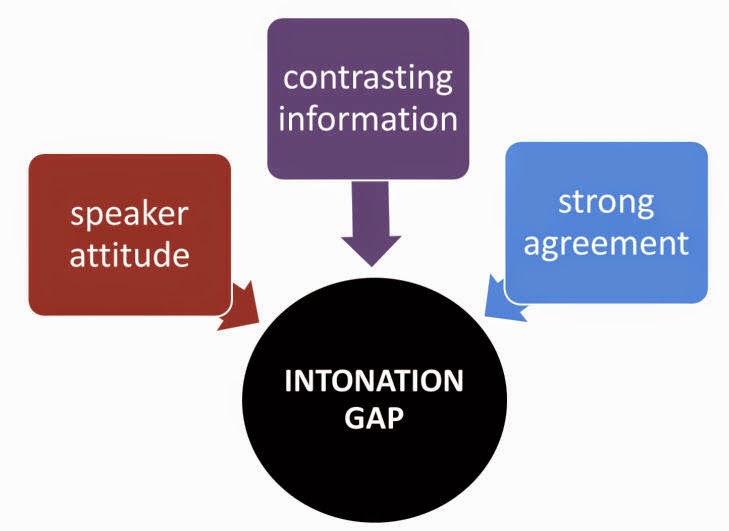
 Tamara Jones presents three interesting pragmatic functions in which intonation may have a great role for students to be made aware of.

Reed and Jones both present some great ideas to work on learners' awareness of the role of intonation in the areas above.

Some of the activities required working with "minimal pairs", so to speak, and using the same wording with a different intonation pattern. In some cases students are invited to decide if the sentences are and mean the same, or happen to different. In other cases, the same utterance is exploited to mean different things, based on the intonation. Students may also be given a number of pragmatic interpretations to see which matches the meaning intended by the speaker in the context. (And no, I am not going to talk about the problems with the notion of "speaker intention" here, so don't frown!)

Changing the nucleus according to the meaning intended

Matching utterances to their meanings
This is a TOEFL-based activity on what Jones called "emphatic surprise" (I would probably use it to deal with rise-fall in GB, or high key)


Some activities require that students see the patterns in the real word by conducting "field work", that is, getting native speakers to read these sentences to them:
Some interesting production and also awareness raising activities proposed by Jones were related to prediction and inference work. By relying on intonation, students can be asked to predict what will come later, or what happened earlier.

This is one of the moments in the presentation where I think the speakers were not dealing with "implication" as they said, but rather, "deaccentuation". It may have been a slip, though!

An activity by Judy Gilbert


Jones presented a few tips on how to help students produce prominent words/syllables. She referred to Gilbert's use of the rubber band (which you stretch every time you accent an item), and its alternatives: opening or closing your hand, raising your eyebrows, closing your eyes. And a very interesting alternative was presented, as inspired by Linda Grant: the use of yo-yos!
Many of the activities above encourage peer work, and the following activity is quite interesting, and can be used to exploit several functions of intonation in context. Jones presented this activity to deal with corrections and contrast, thus:

(Student A has B's card:)
A: 'My favourite colour is \blue. 
B: Your favourite colour is /purple?
A: \No, my favourite colour is \bluuuuue. (Wide range, and high key, I suppose? Sorry, I am transcribing the prosodic aspects I think I heard when Tamara read the activity)

I think this activity can also be used to exploit the fall-rise, probably leading into more polite corrections. Something like:
A: So your favourite colour is \red.
B: 'My favourite colour is \/not red, I am afraid,  it's \blue. 


Another activity which also engages metacognition and prediction is the marking of dialogues. Students can be given a script, they predict possible accents, and compare with the scene. Jones suggested the following Seinfield scene:


Very interesting scene to deal with deaccentuation, contrastive focus AND counterpresuppositionals as well, though to be honest, I would have made different nuclei choices myself!
And this one from Friends:


***
Marnie Reed concluded that all aspects of pronunciation should be integrated into core classes, and they should be part of regular lessons in much the same way other areas and skills are. (Yay!). I think both Marnie and Tamara have shown to us attendees that intonation is essential for meaning in English, that meaning does not reside in words alone, and that students need to be made aware of that. I believe their activities are really engaging, and easily integrated in the language classroom.

In my personal opinion, "theory" is very important when it comes to the teaching of intonation, much to my students' dislike. Because in our own language tones may have a different role, we cannot always rely on our ears when it comes to the communicative values of intonation in a different language. That is another argument against the teaching of attitudinal values of intonation, in my humble view. Our "it's not what they said, but how they said it" radar may work perfectly well in our L1, but we may miss the point in our L2. So teaching intonation in a realistic context, be it within a specific speech genre, or in micro-contexts of conversation like the ones in this presentation, needs to be part of the English lesson if communication is the aim.


***

The session was recorded for PronSIG members. If you want to know more about IATEFL's PronSIG and join, visit their website.
The bibliographical references included in the presentation have been posted at the PronSIG Facebook page here.