Mostrando entradas con la etiqueta accents. Mostrar todas las entradas

sábado, 8 de julio de 2017

Brief review: Manchester Voices exhibition

This week I got my PhD confirmation (that is, I passed my first year, which means that I am now a confirmed PhD candidate at York, yay!), and I rewarded myself with a short trip to Manchester, to see the Manchester Voices exhibition (because my love for accents still is alive and kicking!). I will be reporting on what I have seen, very briefly, and informally. (And as usual, any misunderstanding or error is entirely my own!)

This exhibition stems from the Manchester Voices research project on "the accents, dialects and people of Greater Manchester" (see webpage link above), and it has been developed by Dr. Rob Drummond and Dr. Erin Carrie, from Manchester Metropolitan Uni.

The exhibition can be found in the very centre of the Manchester Central Library, and it consists of a huge panel that has as its major division the different boroughs of Greater Manchester: Bury, Bolton, Manchester,  Oldham, Wigan, Tratford, Tameside, Stockport, Rochdale, and Salford.  The exhibition is based on a collection of views in the form of video interviews, whose snippets you can access by scanning the QR codes in the poster with your phone. 

Note: The current division and unification of Greater Manchester as it is is quite recent (1974, if I understood correctly), and this historical division that included parts of Cheshire, and Lancashire, for example, still sports a great deal of dialectal, and accent variation, as the exhibition fantastically attests. 

Tip! If you make it to the exhibition, make sure you have your headphones ready, a QR reading app, and enough battery life (the library's got you covered with the Wifi). I must have stayed there reading the poster and watching snippets for at least a full hour, if not longer!

(Forgive the quality of the pics!)


I understand that the interviews were collected through a direct recruitment method. In late August and early September 2016, participants were invited to get into a van parked in central areas in each borough, and they were asked questions by a computer. Some of the questions are related to how they see their own accent and dialect, how representative they believe their dialect is of where they are from, and of what they are and do. Other questions invited them to offer expressions or pronunciations they considered typically local. (I do not have access to all the questions, but the video snippets available featured some of them.)

Maps and speech bubbles illustrate several of the contributions by the participants recorded for the project, and for each borough you have a purple box that summarises some of the pronunciations and lexical items that have been reported to be used in the area. 
Bury.

Northern girl.


the Manc twang.

All in all, the exhibition illustrates different individual viewpoints as to how locals view their membership to Greater Manchester, and how they see their own accent, and others, as markers of their local identity. Some participants reported their own identification with their own local borough as strongly related (or not) to Mancunian identity, others confessed to a closer association to Lancashire (in the western areas), or even Yorkshire (in the eastern areas). It was great to see non-linguists reflect on their own "repertoire of accents" and while talking about their accents, to notice how they also made adjustments to what they were saying, and how they were saying it. I personally got the feeling that some participants were going far "broader" than they would normally go in their everyday life, but that's just an unjustfied claim of mine in the shape of a "hunch". 

One of my favourites! Several participants reported having different accents for different settings, some called it a "posh voice", or a "telephone voice", versus the accents they would use at home, or with friends.

I found this exhibition really insightful, and as as a former EFL teacher trainer who once tried to help my trainees understand the social and political role of accents in the UK, I honestly enjoyed the fact that I got to see lots of invaluable testimonials as to how accent issues are always latent in everyday life (even for non-linguists!), and how accent is, indeed, a great part of the way people "categorise" each other, and even themselves, in different speech situations. 

If you want to learn more about the project:
Manchester Voices Website: http://www.manchestervoices.org/
Twitter hashtag #McrVoices

domingo, 15 de mayo de 2016

Pronunciation Integration #4: Selecting your pronunciation content

After some blogging silence caused by writing deadlines, burnout and a lot of belated grading, I  am back! I would have liked to write a more complete post today, but I thought I might put down a few lines on how to select the pronunciation features to teach in your lesson. I am currently covering this topic with my teacher trainees, and I believe it is a good moment to allow these experience-based reflections of mine to reach the written form! I guess I will be writing a more academic, citation-filled, aesthetically pretty post in the future. 

What do we need to consider when planning what pronunciation content to include in our lessons?

Well, a huuuge number of questions are in order (as usual!). Even though I expect to provide teachers with a somehow friendly guide as to how to make a responsible, yet effective decision, I would not want to trick them into believing that making this choice is an easy matter. So here we go!

When we say pronunciation content we are, in fact, referring to a large number of features, which I have tried to summarise in the chart below:


a) First, there's the pronunciation goals question (see previous posts on this): is your institutional/class setting aiming at  low accentedness, or  mutual intelligibility? 
If your group requires that your learners' accent reveals little of their L1 because they need to communicate in professional settings with native speakers of English and you need to do accent reduction, for example, then you have a longer list of things to consider, perhaps, as you will see below, since the inventory of features of teach may be larger. 
If you are doing English for International Communication, that is, English as the means to interact with other non-native speakers of English, the initial selection of features to teach may, in part, be inspired by Jenkins' (2000) Lingua Franca Core (see the blogs by Patsko & Simpson, and the site by Robin Walker to learn more about this). Note: in my very humble opinion, I would not treat the LFC as a conclusive list, because given your students' needs and starting point, you may want to introduce other features as well. Plus, there is always the question of what makes mutual intelligibility, as different L1s may perhaps pose different challenges regarding intelligibility with each other in English as a FL. (In this respect, you may remember the project by Nobuaki Minematsu I discussed in my PTLC15 report here)

b) Next, there's the most important source of information to consider, your students! Carry out a needs analysis (which may make you reconsider your answer to a) ) and/or a set of diagnostic tasks (if possible, recorded as an audio file), that may help you see where your students' areas of difficulty lie. Diagnostic tasks can give us a lot of information regarding our students' starting point, but they need to be designed carefully. You may want to make sure you do so by considering these points:
  • in order to have a more global view of your learners' strengths and weaknesses, you need to design a task that will enable you to test the same skills/content across the board, for example a reading-aloud task of a well-prepared passage (Note: Careful! Reading skills pose their own challenges), or a guided questionnaire with words/expressions you expect your students to use. You can write a dialogue or short passage (dialogues work better, in my opinion, as chunking is less problematic and situations are easy to perform) with enough variety in spellings, clusters, word stress or sentence accent examples to make sure you can even somehow "quantify" your results and test what you really want to test (validity). (It is essential that you go over the list of difficulties that learners of your L1 may have when using English to make sure you test the right things. See: "Contrastive Analysis" below, and check Ashton and Shepeherd, 2012; Kelly, 2000; Mott, 2011). You can then design a table/grid to see how each of your students tackled the problem areas or "traps" in their reading.
  • a semi-spontaneous speaking task is unbeatable when it comes to testing what our students' starting point is. We can ask our learners to introduce themselves by following guiding questions, or telling an anecdote, or reacting to a picture or stimuli. These less controlled tasks will give you clear a indication of their interlanguage errors and already-acquired features. As a result, you should have a more or less accurate snapshot of your learners' starting point, individually.
  • and/or you may want to carry out interactive tasks for pairs of students to role-play. Working with a partner helps students to lower their affective filters and may, to a certain extent, also soothe "recording anxiety". These tasks allow you to see how students  interact by employing their interlanguage accents and communicative competence.
(Of course, you should always be aware that your task and the recording activity themselves may induce shyness, as well as other performance difficulties or disfluencies.)

c)  Then, naturally, you will need to take a look at your (pre-set) syllabus and textbook. No, I am sorry to say  I am not implying that your textbook will in any way help you decide. With just a few exceptions, pronunciation tasks in textbooks (sorry, authors and publishers), are very poor, IMHO. But your textbook may have a lovely Word List at the end with the key lexical items you will be teaching . It will also list the grammar you will have to present. It has a tapescript section with the material your students will hear in spoken mode. It presents a number of reading materials with structures and vocabulary your students will be working on.

If you work at one of those places where the syllabi are "imposed", you may have been provided with a tentative syllabus, which will surely list the lexico-grammatical features to be attained by your class (and hopefully, if you are very, very lucky, perhaps some reference to what pronunciation features to teach). And if you take all the lexical and grammatical content, comb your reading and listening texts, and check the oral genres and spoken functions you will be covering....you will have an awful lot of information as to what pronunciation features you will encounter, albeit indirectly, lesson by lesson!

How do we use this information?

Now that you know what features your learners as a group may need to cover, and what individual challenges you need to work on, as well as what linguistic content you will have to teach, you can start making further decisions, which will depend on a number of factors, listed below in no particular order:
  • Contrastive Analysis: even though it has been undermined, the Contrastive Analysis Hypothesis (Lado, 1957) does provide us with a good way of anticipating which areas may bring about trouble for our learners, given the differences between English as L2/FL, and their own L1. For instance, in Spanish /p/ is not taxing at all, as there is a match in the place and manner of articulation in both accents. However, aspiration does need to be taught for this sound. So making a contrastive analysis of features will already narrow down the list of features you may need to tackle.
  • Similarity-Dissimilarity: the Speech Learning Model (Flege, 1992) also helps us re-visit our list of features by aiding us in the identification of those features that may perhaps take longer to acquire by L2 learners of English and may get fossilised, and thus, may require constant recycling and remedial work. For instance, sound /d/ in English may be perceived as similar to Spanish by learners, and as a result, fossilisation of Spanish [] for English may be more common than for other sounds. 
  • Frequency of occurence: I am not necessarily here considering the frequency of occurrence of the features in English (though it does certainly help to select what to spend time on!), but the frequency at which a certain pronunciation feature appears on your syllabus of linguistic content and skills. E.g.: Weak and strong forms are inevitably related to all tenses in English, since auxiliaries are ubiquitous. The velar nasal /ŋ/ is everpresent in continuous tenses. (See other posts on pronunciation integration here). Scanning your textbook's word list per unit will also give you an idea of what sound, spelling-to-sound rule, or suffix appears more often. Looking at what linguistic actions and functions you will be teaching (e.g. requesting, giving advice, etc), may help you see what intonation patterns can be of use.
  • Functional Load: The concept of functional load (Catford, 1987) can also contribute to our decision as to what features should be taught for intelligibility purposes based on contexts where they are contrastive . We know, for example, that sounds /ʃ,ʒ/ are only distinguishable in a really small number of words (just 4 minimal pairs?), which is why this combination in contrast has a low functional load. Word Stress, on the other hand, is to be prioritised (Derwing and Munro, 2015), as its functional load in distinction is important. Note: even though the theory claims that pairs like /d,ð/ have a low functional load, Spanish speakers, because of the allophonic split in comparison to English, will definitely need to be made aware of the distinction. So this particular criteria, in my humble opinion, needs to be taken with a picnh of a salt.
  • Systematically, incidentally or "collocationally"? The previous criteria may help you decide what features you may want to systematise properly and in detail, following a set of stages (ear training --> presentation--> guided and feer practice), and which features you may want to teach or correct "in passing" as a result of  mispronunciation or miscommunication while carrying out an activity. You will also need to decide if you want to teach the feature for students to start applying across the board, that is, by teaching the right spelling-to-sound rules, or pragmatic functions of intonation, for instance, or if you want to present it as a "collocation": that is, the feature accompanying the word or phrase (see my post on the intonation of viewpoint adjuncts).  For example, we know /ʒ/ is not a very ferquent sound in English, which is why you may teach it when you teach the word "usually" (which we introduce quite early in elementary courses when teaching the Present Simple!). You can always extend the application of this new feature by referring back to the previously-taught collocation; e.g: so when you find the word "visual", you remind students of "usually"
  • For perception or for production purposes (or both)? As we know, thanks to Richard Cauldwell, perception and production need different models, and the way we handle phonetics is indeed different in both models. We need to decide what we want to help our students to produce, and what we need to teach to train their perception and enhance comprehension. We may have to systematise some processes of linking, co-articulation, assimilation and elision for students to produce, but these elements will definitely find a better home in our listening lessons.
  • Teachability: this is the most difficult criterion to define. I believe that teachability needs to be defined by the group of students we have (age, motivation, phonetic coding ability, previous exposure and instruction) and our teaching context (time constraints, possibilities for extra practice, possibilities for further exposure...). We do know, however, that everything can be made teachable if we are creative enough and if we do enough research (sometimes based on our own trial and error experiences in the classroom).
***
Some final remarks:

I generally tell students that we have a sort of "moral duty" to teach pronunciation. Our instructional context may not always demand that we do, but if we are teaching the language, and we are training users of the language (and not just "writers" of the language), we have to teach the phonological features accompanying the lexico-grammatical content we introduce. Otherwise, we are somehow cheating our students. Or so I believe.

Teaching pronunciation effectively is about being selective. I have listed a set of criteria to choose what to teach, and when planning our lessons we need to take a "leap of faith", and decide to leave a few features out for next years' teacher to handle (hopefully!). We cannot cover it all (as we don't do with lexis, or grammar), and we shouldn't either. Decide what to be "incidental" or "collocational" about, and what to systematise in greater detail.

If you are selective, and make the most of integration techniques and choices, then you should not have any excuse not to do pronunciation work! You are doing pronunciation as you do grammar, vocabulary, reading or listening! (And you keep your coordinator, parents, and international exams happy as well as fulfilling your "moral duty" as a language teacher!)

Finally (for now, at least), success in pronunciation -this wonderful motor-cognitive skill-, is dependent on continuous practice. We need to provide constant prossibilities of recycling, re-noticing pronunciation features in new and old contexts, and we have to ensure continuous remedial work. Our body has memory, indeed, but we need to reactivate it as frequently as possible. And so we need to do when it comes to spelling rules, or to the abstract meanings of  intonation, for example.

***
Once again, hope you have found this useful. (If you need to cite this article, please check the "How to Cite this Blog" tab on top). Good luck in your feature selection!


martes, 19 de mayo de 2015

Podcast-y post #2: Your accent, your Patronus - Yet another reflection in passing

Some time ago, I recorded my first podcast on accents and the"Voldemort effect". Here's another post/ramble, unedited, heart-to-mind, mind-to-heart talk, of this complex feature of attaining, sustaining, and more importantly, owning and loving your accent.

It was inspired by my teacher trainees in their last year, and the challenges I find while teaching these advanced students.

Usual pre - listening warnings (I am a teacher, after all, and I am my own teacher, as well):
I have mispronounced "Patronus". I should have probably pronounced it: /pə'trəʊnəs/. Plus, there are a few choices in word stress, nucleus placement, tone and tonality which I would have made differently. A few " dysfluencies" as well, sorry to say!

As usual, many of these posts emerge as "reflections in passing", almost through a "stream of consciousness" technique, and editing this post would have meant spoiling the spontaneity of this moment of realisation, and thought.

So here it goes. Hope you will enjoy it.


lunes, 13 de abril de 2015

#IATEFL2015 online coverage #1: Interview with David Crystal

As a Manchester, IATEFL 2015 registered blogger, I have to admit I have not had the time to catch up the way I would have liked to, but here I am, with my first report.

This time, I'll be talking about an interview with David Crystal (available here), which of course, was the obvious choice for me to start!

As usual, a bit of a report of what was said, and my own input, in a different colour.

***

The Crystals have been pretty active in this 450th celebration of Shakespeare's wonders, and they have been busy publishing materials for all our enjoyment. The illustrated Shakespearian dictionary is mentioned by David, with a few interesting tips and tricks regarding our approach to Shakespeare in the classroom:

  • Shakespearean language has to be learned in context, and we need to have the pictures in our head of what these words represent in order to make sense of the images Shakespeare so very skillfully presents!
  • Before approaching the play on paper with your students, see it on stage or watch a DVD! I looooved this bit of advice. Watching "a book" on DVD/YouTube/stage should not be a "sin" or a form of "cheating", it is yet another interpretation of the book in print through the eyes of the semiotic systems of image, sound, motion, and I agree entirely that this is a valid way of going about it!
  • Act a bit of Shakespeare in the classroom. Nothing more exciting, methinks!

Now off to my personal favourite bit: Original Pronunciation. I've written about this in my review post of the latest Crystals' book here, but I would like to write down some of the points David raises in this interview.

David reminds us that the powerful resource of rhyme in Shakespeare's sonnets (because if I remember correctly blank verse does not rhyme except in the last verses of each scene?! Do I remember my Shakespeare?!) does "not appear to work in Modern English". We all remember the lovely Sonnet 116, and the supposed rhyming pair "loved"-"proved" [lʌvpru:vd], which in OP would be something like [lɤvd - prɤvd]. You can hear more about it here:


Crystal invites us to experience Original Pronunciation (OP) here:
http://originalpronunciation.com/

The last part of the interview leads us back to the "You Say Potato" book. Apart from retelling some bits from the book, David mentions the fact that the accent issue is complex, and that in order to faithfully represent the idea of how accents change, there had to be more than one person in the book, a "young person, and a slightly less young person". He mentions the fact that there will be an audiobook version later in the year (looking forward to it!)


There is an interesting discussion in the interview regarding the notion of accents. As we have heard countless times, accents are "all over the English speaking world" and they are "mixed". We are no longer speaking about RP as the norm, but as a "mixed or modified RP", what other authors called General British, which Crystal defines as "educated, understandable". This is a complex issue as well, in my opinion. Clearly, if you read the news, what the media sees as RP is the "Queen's English" or the "Public School English" which Cruttenden (2008) called "Refined RP" and is now termed "Conspicuous General British". I think this RP they may be talking about, spoken by 2% of the population, is not necessarily what we may call "General British" and of course, "Regional General British", which I associate more with universities and the media.  So when we say "RP", what are we really talking about? I would also question the use of the term "understandable", as my students would claim that it is General American that sounds "intelligible" to them, and not really British varieties, but it may be a problem of exposure. Worth another post!

Crystal then addresses learners of English by urging them to embrace the idea of keeping traces of their native language in the accent of English, except for "spies, who are the only ones who need to be anonymous" (LOL!). He sees English as a "garden of flowers", with each individual accent making a different variety and bringing colour to it (<3). David tells teachers that the priority should be students' clarity, and an approach to flexibility, that is, not focussing on teaching every single feature of an accent to students. He mentions, for example, the features of glottalisation (as in [hɒt -hɒʔ] and GOOSE-fronting (as in [ku:l - kʉ:l]), clear examples of the changes to General British, that ought to be accepted in the English classroom. Exposure to different accents as early as possible is key. Crystal does make a point as well of "knowing how to do it", that is, having the necessary tools to teach pronunciation of the accent(s) of choice. (Worth another post! #2)

As an answer to a question on the importance of stress and connected speech over the segmentals, David believes there is more an issue of complementarity. David also mentions the fact that if we look at the different Englishes around the world, 3/4 of the speakers actually employ syllable-timed versions of their accent, which is why, in his opinion, stress-timing as a teaching priority is actually outdated. The challenges to the "stress-timing" hypothesis have been going round since the early 1980s, including some papers by Peter Roach and Cauldwell, among many others. Very very interesting topic, by the way.

To conclude, Crystal presents some pieces of advice for teachers to "keep up with the times" by "listening, listening, listening" to English, to young speakers of English in the media, especially social media, in the understanding that the young speakers of the language are the ones pushing the language forward, the future parents of the future generations. He reminds us that we should not underestimate the power of Internet, as these generations take "screens as central, books as marginal".

All in all, a short, yet enjoyable interview, with that lovely accent of Crystals' (IMO) and his smooth, "surfable" intonation patterns (really worth teaching!), but first and foremost, with a very engaging discussion of hot topics which may at times be a bit "thorny" for teachers.

I expect to be able to report more on the online coverage of IATEFL 2015 soon!


sábado, 21 de febrero de 2015

Conference Report #3: "Accentuate: Bringing Pronunciation to the Fore" Part 1

"Accentuate: Bringing Pronunciation to the Fore" event by IATEFL's PronSIG and NATECLA.
Read the programme of the event here.

As an anticipation to my next blog post with my views and takes on the presentations I have managed to watch live, find a taster of the talks and the Twitter discussion below:


Crystal & Crystal: "Dealing with Accents"


Hancock: "Doing things with sounds Practical pronunciation activities for your classroom"


Young: "The Silent Way approach to teaching pronunciation, illustrated using French"
Messum: "What to Teach Before you Teach Sounds"


Underhill: "Proprioception in learning new sounds, words and connected speech"


Concurrent Sessions
Tatiana Skopintseva "Pronunciation Gymnastics for Non-Native Presenters in English"
Simon Andrewes "Accentuate the positive: positive approximation and the lingua franca core"
Linda Ruas "Radical phonology": protest chants - a meaningful context for improving sounds and suprasegmentals
Paul Carley:   "An UnhappY Vowel: Is our Transcription Fit for Purpose?"
Cornee Ferreira "What to imitate? Between the native-speaker model and the lingua franca core."
Charlotte Haenlein "Ideas for embedding pronunciation work in everyday classroom topics at lower levels"
Judy Kirsh & Karen Dudley "Pronunciation for integration: stress, rhythm and intonation"
Catarina Pontes "Putting sounds together: practical pronunciation activities for the English classroom" 
Wayne Rimmer "Designing pronunciation materials"

miércoles, 11 de febrero de 2015

Reflections in passing #3: Why emulating a native-like accent may not (always?) help


Over the last few days I have been talking to colleagues from my own "environment" (that is, Argentinian teachers of English), and some have told me that they saw themselves reflected in some of my posts, particularly the "Voldemort" one. And yes, I completely understand why these friends and colleagues feel the way I do, and the rest of the world feels this is sheer craziness: our training, our Argentinian spirit (always looking up to Europe, for some reason) makes many of us want to "sound native" (whatever that is!). Some other Argentinian colleagues teaching French and Italian have told me they feel the same way about their own accents.

***
Now, the more I travel, the more I realise that my relentless efforts to "sound native" may not "help" in the streets. All right, my accent has helped me gain a certain position of "acceptance" (or something of the sort) in some academic circles. I know that there are certain things I say in certain places which are "taken seriously" because of my close attempt at an SSBE accent and my fluency in English. In academic environments, I have to admit that, sadly, some some people appear to have "respected" my views because of my accent, and this overruled the "disadvantage" (sic) that being a Latin American, Spanish-speaking teacher of English (and phonetician in the making, go figure!) would entail (and these last few words are not, unfortunately, mine!).

On the other hand, I won't lie. I do like the occasional "where in the UK are you from?" or "You don't sound Argentinian!" thing. I think it is my best introduction card in, at least, the ELT world.


***
As usual, disclaimers: these are opinions, reflections and anecdotes from someone obsessed with pronunciation, and carry no "scientific value". You read these at your own risk!
(♪♪ It's my blog, and I cry if I want to, I ramble if I want to! ♪♪)

***

Anyway! Going back to how sounding native may *not* help, I have a number of personal anecdotes which may illustrate the point:

-On a train to London from York, I ordered coffee. As I was being served, the steward -with a lovely Northern accent- asked me a question which I did not get, and after embarrasingly saying "Sorry?" three times, he just put the coffee on my tray and grunted. I shrugged, and the person sitting next to me, who had seen I was reading a book in Spanish, said that the man had thought I was making fun of him.

-The bus from Whitby to Scarborough I was on one day, broke down. Twice. (Yes, it happens in the UK, too! Don't despair, fellow Argentinians!). I was sitting towards the back of the bus, reading my book, and two lads  were talking about how awful the whole journey had been, and a few other things which I found dreadfully difficult to understand. At a certain point, one of them addresses me, and says what I decoded as: "Got a penner?". I replied "Sorry, come again?", to which I got a similar answer. The other man looks at me, as if I was silly or something, and says, really slowly "Got-a-pen-or-something?". "Ah, yes, here you are!", I said, and retreated to my Spanglish, to save face.

-The other thing that I find a bit embarrassing is the fact that my English is pretty "bookish" (I need a serious vocab refresher course!) and as a Latin American young lady, I'm all gestures and emotion, so British people who know me do generally comment on this sort of "mismatch" between my accent, and my wording. I love my Latin American blood, and my Italian hystrionism, and I am not planning to change that. But people say the "overall impression" is somehow "weird". My tutor once told me that when she was younger a very well known phonetician advised her: "Do you want to sound English? Then hire an English lady who can teach you how to sit, have tea, walk, and express your emotions as an English lady. Then you will sound English. Otherwise, you are more than fine as you are!". (LOL!)

(Linguistic digression: I think that my trips have also confirmed to me that I should never underestimate question tags, and phrasal verbs (believe me, students, they are used ALL the time!), and more importantly, street, everyday, language, if I want the "full package". As I told my Language teacher during my last year of college, "I feel all my language courses have "crippled" my language, I can't face the streets with my English but I can write 200-page-long papers!".)

-I think that what at times makes me feel worse than not being able to understand, is getting the comment "why do you want to sound posh?". Or I once even got "You sound Victorian!". I would feel a bit offended in my own Spanish if someone said I sound "cheta" or "old as the hills", but that's just because I don't see myself as such. My British friends tend to make fun of this accent choice of mine, and I have had "informal" sessions on glottalisation and a few other "tips and tricks" to "give my accent a lifting". I worry,  and I try to be truly aware of this when teaching my students. After all, I wouldn't want them to use slang and sound as if they were rehearsing to have tea with the Queen.

(BTW, any phoneticians out there? It would be wonderful to have oral practice materials with more updated accents! Ship or Sheep 3rd Edition has a few interesting voices, and so do some of the activities in the "...in Use" series, but I would be happy to have further practice material to focus on sounds with more "modern" accents. Apart from the  YouTube vids and British Council recordings of conversation I may find, having some updated pronunciation stuff for practice would be totes fabs!)

-Another Argentinian colleague told me that a UK immigrations officer, after stamping his passport,  jokingly told him, "Why do you speak like that, then? Are you a spy?".

***
Whenever I write my blog posts, I always think about my students and my practice. I am, by far, the most severe critic of my work. I know some of my ideas have changed over the last three or four years, and some others have not, and may not. I know some people may use these "thoughts in passing" to their own advantage and may misunderstand the meaning of my words as well. It has happened.

All in all, I think that my accent works fine in academic and work settings and it has made a difference, but it may not do the job in "street" settings. But I think that this realisation has really helped me reconsider language teaching, and more than anything else, what I should do in a General English language classroom. It has made me think about goals for both pronunciation and other areas of ELT: grammar, vocabulary, listening comp.
***
You may agree with this, or find it terribly "preposterous". I believe I am not "academically mature" still to voice certain ideas, to give them shape, and at times, to face some deeply-rooted beliefs. So for the time being, I'll just keep to my "reflections in passing" and to my books, and to my blog! (♪♪ It's my blog, and I ramble if I want to, I ramble if I want to! ♪♪)

lunes, 2 de febrero de 2015

Book Review #2: You Say Potato: A Book about Accents, by David and Ben Crystal


The book I'll be talking about is You Say Potato: A Book about Accents, a really entertaining, yet serious review of issues regarding accents and their role in everyday life, particularly in contexts where people may be self-conscious about them the most. In this short post, I would like to review the book in my own personal style.
This would be me in Trinity College Dublin, reading the book on a beautiful sunny morning.

***

The first appealing thing about the book is the fact that its style is conversational, and as a reader I felt I was actually at the Crystals' dinner table (and I have to say, after reading the book, I would defo love to be invited to have supper with them!). With David providing the historical background and the technical aspects of the discussion and Ben leading us through the world of the performing arts and illustrating his points with his anecdotes, this book is a great introduction for those people who have never pondered on the role of accents, or for those who have and need further evidence that accent does matter (but for what?)...

In this respect, as I read the opening chapters, I couldn't help thinking of the classic "Does Accent Matter?", by John Honey. I would be tempted to say the Crystals' book, in many respects, is an update of some of the chapters of Honey's material, and goes beyond it, by analysing accents in four sections, called: Accent Passions, Accents Present, Accents Past and Accents Future.

***

You Say Potato explores attitudes to accents on a first-hand basis -mostly through the anecdotes shared by Ben in his voiceover, acting and lecturing work - and through a great number of references to the media, including articles, surveys and TV shows, and extended to historical documents, films and advertising. The authors have taken to even retelling cases where forensic phonetics -with our lovely Jack Windsor Lewis - has a role to play!

The initial exploration of some basics of accents starts with a brief, simple explanation of the articulatory processes involved in the production and classification of sounds, and some comments regarding the acquisition of accents.  A more daunting endeavour later in the book is the making of an "Accent Map" that attempts to place all the accents discussed. This map proves to the reader how intricate the accent issue is, at least for, but not exclusively, Britain, where there are more accents per area than anywhere else in the English-speaking world.

David Crystal provides a really reader-friendly description of different accent groups, with plenty of examples for the non-specialist to have an idea of what a certain accent sounds like. One of the sections I found most useful is the "how to tell....from..." section, where David provides a few tips and tricks to distinguish Americans from Canadians,  New Zealanders from Australians, among other groups.

Issues of accent and identity, including historical and present "gut feelings" regarding accents are described through numerous quotes, including some mythical and prejudist views on Brummie (the old "ugly city, ugly speech" prejudice) in previous centuries (yes, including the 1990s....and probably still at present?) and a reivindication of regional accents in the media by those trying to explain why these prejudices are a mere "stupidity" (sic). It is true that we are all, to a certain extent, biased towards a particular accent group, so even though I am not a native speaker of English myself, I have to admit I felt a bit ashamed of having nodded in agreement when reading a few of these "stupid remarks" on accents.

As I have found in many current articles on accents (see my collection here), the book also goes over some of the issues we regularly see commented on the media and that non-specialists also pick out, like Brit pop and rock musicians using American accents, and Hollywood villains going for posh RP-like accents, and the role of accents when targetting certain audiences in advertising. Current phenomena worth exploring further, such as Uptalk, and Mockney, and notions of sound symbolism (what is known as "Phonesthesia") are also referred to briefly.

Another interesting thing about the book is the way accents are referred to in the different anecdotes retold by Ben, with notions like "blue", "rough", "smooth", words that refer to other senses and still help us picture different accents and voices (if I am not mistaken, this is called "synesthesia"). I particularly adored the definition of accents as "clusters of snowflake-unique sounds" (p.37). If you scroll below and hear Ben's rendering of a Shakespearean sonnet in original pronunciation, you will surely come up with your own adjectives and accent-resemblances as well.

It was, to me, so lovely to read about the reconstruction of Shakespeare's Original Pronunciation (OP) again, which is also described in such a lively manner in the book Pronouncing Shakespeare. When you read the accounts by both Ben and David, and you see this video, you clearly feel the power of accent, the power of voice quality and articulatory settings, and somehow, you go back to that wonderful setting of Elizabethan theatre.


All in all, I have to say I loved the book, as I felt I was reading many books into one, and I would love to see many of the points raised  developed into further work. I got a thrill out of reading historical documents and quotes, since probably the current views are more easy to trace on the Internet nowadays. Until the Time Machine gets invented, we can always read books by David Crystal, where we are sure to find the voices of times past brought into the present!

But, wait! This is by far not over. The Crystals invite us to be part of the You Say Potato experience. You can record your own "potato" pronunciation here. And if you want to see the authors at work and get a feel of the book and the issues presented there, then take a look at these videos!


And yes, the title of the book refers to this song we all know about!


 Other reviews and articles on the book:
TIME:http://time.com/3525767/you-say-potato-accents-david-crystal-ben-crystal/
CityLab: http://www.citylab.com/weather/2014/10/a-map-of-how-the-worlds-people-say-potato/381218/

martes, 6 de enero de 2015

Further thoughts on listening comprehension

This is another post in-passing on some of my observations regarding listening comprehension. This time, related to real life and on location! (Dublin, at the moment!)

I mentioned in my previous post that our expectations and knowledge may have a positive or negative effect on comprehension.  When it comes to travelling, the knowledge of what to expect in certain situations, particularly service encounters, is essential to avoid communication breakdowns. We all know the pragmatic  "scripts" for the institutional dialogues in our culture, the ropes are part of what Widdowson calls our "schematic knowledge". However, when placed in a foreign country, no matter how much you may know about the language, if you don't know what to expect, certain questions may catch you off guard.

Situation 1: Supermarket. Typical questions that I did not see coming and required extra effort:
-Would you like the receipt? (The transaction was over, and in my country they give me the receipt straightaway, which is why the question surprised me)
-Have you got a Nectar card? (Difficult to get at first,r but I thank the countless hours of English radio ads that clarified this for me. It is a kind of loyalty card for a certain supermarket.)

Situation 2: First time at Starbucks abroad. In my country, you always get the plastic cups, it's a given (and not at all ecological). But in Lotndon, after ordering my drink and taking great care to mention the size and type of drink, and feeling quite pleased with myself, I got the folliwing question: "To eat in?". If it had been, as I got in other places "To eat in or take away?", I would have surely understood at once. But this sole question in such a rush, just lost me.

Here ends my non-scientific post on list comp, in the hope that we realise that it's not all about language, that cultural conventions should be part of our language teaching practices (especially if we aim at communication), and that pragmatics has a major role in listening comp as well.

(Sorry about the typos and other atrocities, I'm writing this on my mobile)

sábado, 18 de octubre de 2014

"Non-Native" Accents and Chastisement: Reflection in passing

These last two weeks, I have been engaged in conversation with friends and with colleagues from different parts of the world who, for some reason or other, ended up discussing pronunciation issues with me. This is a post which will only take me twenty minutes to write, but I did not want these thoughts to "fly by".

I could not help noticing that in each and every of these weeks' exchanges with these colleagues, there was common feeling, a shared assessment of the whole "non-native accents" experience, which I dare call "chastisement". These are some of the situations I have witnessed to or been told about:

  • At one of the places where I work, a teacher trainee was "chastised" for using a glottal stop instead of a final /t/. I myself have been "chastised" for producing a glottal stop intervocalically.
  • A friend was in the United States and was "chastised" for attempting a "native like" accent (and a British one at that!) and not going for an "Argentinian Espanglish" instead. Another friend had a similar questioning look by someone from Israel, who was also a teacher trainer.
  • A student was "chastised" at work for not attempting a "native like" accent in his communication with North American customers and going for a "more global variety" of English, (if such a thing actually exists, beyond Jenkins' ELF Core, I mean).
  • A teacher trainer was "chastised" for upholding RP as a model. Another teacher trainer I know was "chastised" for attempting an Estuary English-like accent (no time for a debate on the "existence" of this accent here!) as a model. A group of students have "chastised" these two teacher trainers for not upholding a General American accent instead.
  • A methods teacher "chastised" a phonetics teacher trainer for not expecting an "international English" approach for her trainees. The phonetics teacher "chastised" the methods teacher for downplaying the expectations teacher trainees had for their own accents, and language proficiency in general. The teacher trainees "chastised" both teachers for not considering their expectations of a more modern variety of standard British English or American English accents for themselves.
I was wondering, having been "chastised" myself , whether the "chastisers"(myself included) had cared to ask the objects of their criticism:
  •  What type of accent they wanted, what model speakers they have got in mind. I know what accent I want, at least! and I ask my first year trainees what model speakers they have in mind (I have received answers to this question with models from Harry Potter movies, American series, even a Nigerian poet, the accents their previous teachers of English proudly "sported", and one student who said she wanted to have her mum's accent...sweet!)
  • The reasons behind their personal choice of accent: preference? imposition? didactic concerns? identity? 
I guess that in any side of the scale, we can all be "chastisers" and "chastisees" (!?). At times we read the newspapers, and we see how the British appear to react to RP as an  acrolect and to certain basilects as well, and I wonder whether we are not doing the same, whether we uphold General British, or RP, or General American, or an Australian variety of English, or even English as Lingua Franca as an approach to pronunciation. I can't help feeling a certain "guilt", given that what I do is, in a way, "accent reduction" (awful as it sounds!), but at least I try to be empowering in my teaching of Phonetics, so that in any moment of their careers, my teacher trainees can end up selecting any accent of their choice by knowing the basics of articulation and transcription (my knowledge of Phonetics, for example, has allowed me to learn French phonetics even knowing very little French!).  I introduce my teacher trainees to the complexities behind pronunciation teaching and the factors involved, and we consider in the last courses during their training what the different "accent needs" of our English learners in different scenarios might be, and what learner expectations they may encounter.

I won't stop feeling guilty, but what makes me feel a little bit better is the fact that I know my context, I know my trainees want to have a great command of the language, and I know about the limitations we may have in our teaching contexts as well when it comes to trying to cater for the linguistic needs and wants of 20-35 students per class. Which does not mean there is a lot of thinking to be done. And I've got another 30 years of teaching ahead of me, so surely a lot will change, a lot of new voices will be heard, and I hope, plenty of updates will be introduced.

I guess that just asking questions and recognising oneself both in the role of "chastiser" and "chastisee" is a great starting point for change, or at least, for some common sense.


An afterthought. I have edited this post for linguistic "horrors" (just a turn of phrase) a couple of times today, as I initially typed it in a rush at 4 in the morning.
I am currently doing in--service pronunciation training, and I am working with graduate teachers who need to improve on their accents, and being able to help a teacher who wants an American accent after being exposed to a British variety during her training has been a great challenge, and a great joy. 
As I was re-reading this post, I couldn't help thinking about my ideal Laboratory Practice classroom, one with no time concerns or technical limitations where I could have training materials for different accents and cater for different individual interests.

I would like to enter the Lab on day 1 and say, "what English accent  would you like to have as a future teacher or translator?". And then have parallel syllabi, parallel sets of training materials, time to teach a general class AND to give individual feedback....If you ask me, that is what I would like to do! 

martes, 10 de junio de 2014

Webinar Report #2: Focus on Global English - Richard Cauldwell / Katy Davies & Laura Patsko

Today I travelled to England, comfortably sitting on my Buenos Aires armchair. The British Council organised the "Focus on Global English" event and streamed it live all the way from London.

This event was aimed at exploring issues regarding the role of accent and identity in different ways. Whereas Richard Cauldwell (whose brilliant book I'll be reviewing here soon!) set out to report his experience and views on how accent, identity and prejudice are intertwined, Laura Patsko and Katy Davies have taken English as a Lingua Franca into the classroom and provided us with practical ideas to teach it.

Below you will find a sketchy summary of what was presented, with some comments of my own, and the link to the playback, once it is made available.

(Digression alert!) (Speaking of accents, by the way, the BC presenter's accent was lovely! Sorry, couldn't help it! Picked out some things such as [i:vnɪŋk, rɪ?tʃəd], worth commenting on some other day!)

The BC presenter also made a point of the British Council partnership with Google for this interesting resource: https://spellup.withgoogle.com/

(Version 2. Since its publication, some typos and minor errors have been corrected)
***

Richard Cauldwell - Accent and Identity, Prejudice and Insecurity

Richard began his talk as a "personal journey on accents", and made a point of how people's feelings about accents may affect our own self image, and in spite of the fact that we may control or overcome them, "insecurity lives inside".
He refers to Part 3 of his (brilliant!) book, Phonology for Listening, as some of the audio samples and issues raised are (thoroughly) developed there.
The talk begins with a few definitions:

Definition of accent - I particularly like the idea of "flavouring" and "colouring".... :)

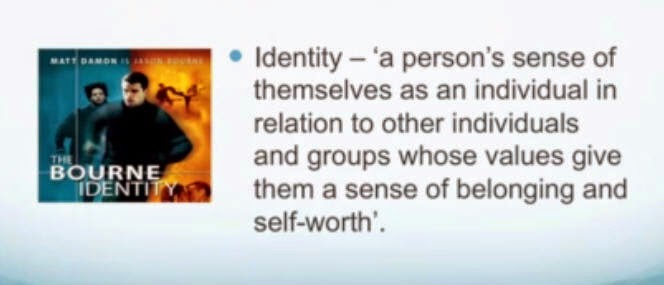
Identity - Richard's selected definition - The issue of self-worth and sense of belonging were delved into in the talk

Interesting definitions for "prejudice"
After presenting these definitions, Richard went on to re-visit his own history of accents, from his early Irish beginnings, to public school in England, to Oxford, to his current home in Birmingham. Certainly a story of accents!
There are some funny and interesting remarks in the fact that Richard's parents were born in 1926, the year of the "birth" of the BBC, as well as on the "official christening" of Received Pronunciation.

Richard's next step involved the discussion of reference models. We know about the current "embarrased" (sic) status of Received Pronunciation, all the prejudice associated with it as a prestige accent, and no wonder, given some of the (thought-provoking) quotes selected by Richard:

Richard reported a teacher's "protective" attitude towards a Scouse-speaking student, warning him of the how you may "lose marks" if you use your Liverpool accent. This type of prejudice is also taken up in a quote from the 19th century:

This idea of prejudice is ingrained and as the table below shows, which is far different from what many people may believe now, attitudes to accents and the role of accents may change and are, in fact, changing.  Richard makes a hilarious remark on this table, saying that probably the order would change if the question was "Who would you like to have on your side in a fight?"


Richard moves on to present a number of successful professionals, with a high level of proficiency in English, who may have some sort of self-loathing or a lowered self-image because of their accents, or because of the reception towards their accents. Some of these quotes show the role of accent and identity and the "perpetuation of the prejudice":


After listening to different non-native and native accents of English, and drawing on intra-speaker variation, Richard makes a point that accents are variable within the same speaker, and that they can be used for accommodation in different situations. He makes it really clear that we "should be allowed to be who we are".

The next point raised is that of reference models. Received Pronunciation does not have the "status" it used to have, particularly its "refined" version, and hostility towards RP is clear in many areas, as it reveals a "stigmatisation of privilege" (Geoff Lindsey). Richard makes a point that these models should not be attainment targets, just references to where students may want to approximate. But most importantly, "any accent of English is acceptable as long as it is intelligible"
A few other useful reminders Cauldwell has drawn our attention to:
  • English is no longer the property of the native speaker
  • attainment models are achievable learning targets, reference models are not and there are not too many native speakers of those models (Refined RP just for some Royal Family members and the Navy!)

And some thought-provoking conclusions by Richard, which I post in his own "voice":

A short Question & Answer session ensued:

1. Audience: What accent should we teach? If teachers teach with their own voices, isn't this confusing for learners? The member of the audience retells an experience of teaching with her own RP accent alongside another Irish teacher. Don't we need some sort of model?

Richard: There are lots of resources online to choose voices learners can aim to attain without having to go for a reference model. Learners can choose how to establish their identity as speakers of English.

2. Audience: To what extent can you modify your pronunciation?
Richard: It depends on own personal capacity to handle the input that comes in and moderate what comes out. But most importantly, there are some emotional filters that may give people high motivation, or maybe lead them to resist the acquisition of a target accent.

3. Audience: We have to admit there are many Englishes. So pronunciation is not very important for English at a basic level (sic).
Richard: We need to distinguish between production and perception. We have to prepare people to encounter many accents and produce something reasonably consistent.

4. Audience: Teacher working with multilingual classes. I modified my speech for my students, I don't use norhtern accents. If students change their vowels completely, that is not all right for me, that is my line. Spelling definitely affects pronunciation.
Richard: It is important to teach the issues between spelling and sound. But we should aim for intelligibility as a priority.

***
That was a brief report on Richard's talk.
You can read more on this in Richard's book and on this blog post: http://blog.britishcouncil.org/2014/06/09/what-does-your-accent-say-about-you/


***
Laura Patsko and Katy Davies: Practical ideas for teaching pronunciation and listening in an English as a lingua franca (ELF) context 

Laura and Katy introduce themselves as teachers working in multilingual context, with non-native learners of English from different L1s. English is their communicative medium of choice, and at times, their only option. They teach "English as a Lingua Franca", which represents the communicative reality of use in English accortding to statistics, and the pronunciation aspect is highlighted in their teaching as "pronunciation was biggest cause of breakdown of communication" (Jenkins, 2000)


The presenters covered the following areas in their talk:
  • How to know what to prioritise in an ELF context?
  • How can you "standardise" your teaching practice within this variation?
  • What practical ideas can you apply in the teaching of ELF pronunciation?

Establishing priorities for an ELF context
1. Conduct a needs analysis: 
  • discussion with students, knowing their needs and motivations for learning English;
  • diagnostic work:  listening to their pronunciation, identifying gap for intelligibility problems. For example: taking a dictation exercise between fellow ELF users (and not the teacher as the "authorised voice"), using sentences in the coursebook, and asking students to take down what their classmates are saying. This allows the teacher and students to identify areas of "high risk" for intelligibility.

2. With the newly-found data: Apply an ELF filter
Check the areas of the Lingua Franca Core and make decisions. The teaching techniques for pronunciation do not need to differ from those used in EFL contexts: minimal pairs, drilling, etc.

3. Come up with a syllabus, based on coursebook/teaching materials and data from the diagnosis
4. Adapting classroom practice


Some things to be considered for an ELF practice:
  • We need to help students become aware of what they are doing and why.
  • Students need to be conscious of the fact that accent is flexible, and that in an ELF context accommodation is important, and they should know how to modify their speech if necessary.
  • Students should be allowed to make choices.
  • Weak forms are not essential in the LFC but may be presented as part of receptive skills to be taught.
  • Focus on stress is important and textbook activities or tapescripts may be adapted to this end.
  • RP may not be a model in itself, but it is useful to teach spelling patterns and their connections to sounds.
  • The learners' needs are taken into consideration and not necessarily the native speaker norm. Students may be judges and models themselves, and teachers should support their choices, particularly if they are "informed" choices.
  • It is better, in a multilingual context, to encourage pairwork over groupwork, so as to enable students to improve comprehension on a particular task being exposed to one "ELF" variety at a time.
  • It is important to teach learners different chunks of language to ensure a smooth negotiation of meaning, request of repetition, or reformulation. 
Use of authentic materials

"Authentic" defined as "materials which have been created in English but not for the purpose of learning English".
These may be used to look for proficient users of English as a Lingua Franca and try both productive and perceptive skills:
Using scripts of these materials may help learners assess intelligibility over the native speaker norm.

Some conclusions by the presenters, inviting us to reconsider and revisit some assumptions:
Laura Patsko rounds off the session by quoting Robin Walker, and the need to re-think goals and the role of error, rather than modify classroom practices. 

Some questions ensued:

Audience: You said you only teach the "bird" vowel, do you teach diphthongs? 
L & K: Key thing on the LFC is length, even for diphthongs. Achieving a particular quality for a vowel sound is not important, but a particular consistent quality is, as well as to preserve length.

Audience: Brazilian speakers learn /θ/ by imitating "th" from speakers with a lisp.
L&K: Even though /θ/ is out of the LFC as it may be replaced by other consonants, it is true that we may get "models" and "tips" from unconventional places. It is also important to consider and question notions of "correctness" and focus on "variation". We ought to remember LFC is a set of features, not a model or variety.

Audience: How can we continue improving our pronunciation after finishing a course?
L & K: An example of a good resource, BC ESOL Nexus website. Watching snippets from videos may also help. 

Audience: Some learners still expect the native speaker norm.
L & K: Respecting students' choices is part of our job, and asking them why they are making the choices they are making is important to see if their choices are informed. Presenting statistics is important. Those "ELF moments" we have in the classroom can also help us to make a point.


***
This was my brief report on Laura and Katy's Talk.

***
Hope you have enjoyed this summary of the sessions.
No time for my own input on these today, but I promise a follow-up on this. I think that all the speakers in this session mentioned the reality of English today, but also considered the fact that attainment targets are to be planned by the teacher based on the expectations of the students, and the contexts of use students will be applying their English to. As a teacher trainer, this is a very important point, and I was truly hoping to hear these views made explicit.

Replay link available HERE.
Thanks for reading me!