Mostrando entradas con la etiqueta sociophonetics. Mostrar todas las entradas

miércoles, 25 de octubre de 2017

Brief colloquium report: The Phoneme: new applications of an old concept

Today I poked my head out of my screen to take a break and attend this very interesting talk by Dom Watt, whose Advanced Phonetics student I'm lucky enough to be at the moment.
Here is the abstract:

And below is my own summary, written in one sitting (as usual!). As always, any inaccuracy or misapprehension of what was presented is entirely my fault. Hope this all makes sense to you!

The talk had the notion of phoneme at the centre, and all the debates existing around its "existence". The first minutes of the talk were a nice overview of the "phoneme" and related notions and ideas leading to it through time: from the contributions of the sanscrit author Patañjali in the 2nd century recognising abstract categories of sound that present variability at the physical level, and the first Icelandic grammarians in the 12th century, to the writings of Sapir in the 1920 and the "phoneme slices" that people claim to have in their languages.

More modern discussions ensued of what the phoneme came to be understood as have been developed by Duriche-Desgenetes (1873), Luis Havet, Badoin de Courtenay (1871) with psychophonetics and physiophonetics, and of course, Henry Sweet in the 1870s and Daniel Jones already in 1911.  In the US in the early 20th century, the notion of phoneme came to surface thanks to Bloomfield.

A few definitions of phoneme were revisted by Watt, especially those by Jones (1957), Watt (2009), and a very quote by Pike (1947): "Phonetics gathers raw material. Phonemics cooks it".

A very useful metaphor to discuss phonemes and allophones was recalled by Dom, that of Clark Kent and Superman as being in complementary distribution, and Superman and Spiderman for example being two different allophones of two different phonemes. (It reminded me that I used to refer to phonemes as any of us, and allophonic variants as us in our roles and attires: at school, at a party....Lately I've turned to Johnny Depp as the phoneme, and his million characters as his allophones, his "realisations" in films...)
Other interesting comparisons were introduced, such as the grapheme-allograph relations in Arabic, or even the number of ways we can represent a certain letter, say "A", which poses a very interesting question: what is the boundary that makes a certain sound no longer the same, how much can variation be stretched, what is the boundary?

Alternative analysis of the phoneme included Trubetzkoy's (1939) phonemic oppositions grounded in phonetics, formal notions of phonemes as bundles of features, as those put forward by Jakobson, Fant and Halle in 1952, based on acoustic analyses of instantaneous "time slices" (somehow looking for the centre of events in the signal). Watt also mentioned a game-changer, the work of Chomsky and Halle (1968), that abandons binarity and allows for phonetic gradation with the introduction of articulatory features in their description.

Watt continued the presentation by referring to the debates on the nature and existence of the phoneme that included quotes from Ladd (2013:370) and Dresher (2011:241). The work by Fowler, Shankweiler and Studdert-Kennedy (2016), who revisit a paper they themselves wrote in 1967, was given special attention, since it provides nine forms of evidence of the existence of the phoneme as an entity, including issues like phonemic awareness, adult visual word recognition, the presence of systematic phonological and morphological processes, the existence of speech errors (spoonerisms), and the fact that co-articulation, as was previously claimed, does not really eliminate the presence of a phoneme.

Of course, as Dom remarks, when we look at MRIs, spectograms and waveforms, we may not so easily be able to see discrete units, but machines seem to be programmed to see the signal as composed of chunks. It was interesting to see a cochleargram, because as Watt pointed out, it does show perhaps more continuity than a wide-band spectogram, for instance.

The second part of the talk discussed phonemes in phonetic work done through speech technology, for forensic and also sociophonetic purposes. It discussed some of the findings by (the absolutely brilliant!) PhD student Georgina Brown, who has adapted the ACCDIST programme by Mark Huckvale in UCL into Y-ACCDIST as part of her PhD research. One of the achievements of Y-ACCDIST is the use of the software for speaker comparison even when the data are not necessarily comparable (ACCDIST works well when all speakers have read the same text). I cannot fully do justice to this part of the talk because there are some technical bits that I am not familiar with, and I don't have a head for statistics, but I'll report on what I could follow:
Some examples of the use of the programme were presented, which include the measurement of distance between possible pairs of phonemes through what is known as a Feature Selection process, in which several features are left out to focus on the ones which are most relevant or less redundant, and that helps modelling.
Comparisons across speakers were run through the programme, and Y-ACCDIST was able to assign speakers to a particular accent with almost 90% accuracy. It was interesting to hear that the programme was more accurate when particular features (and not the whole) set was compared, and also when human intervention in the filtering of features to be compared was added to the speaker accent allocation process.
All in all, Watt concludes, the discoveries of the application of tools like Y-ACCDIST and the evidence provided in Fowler et al suggest that it is too premature to declare the demise of the phoneme.
The question period was interesting, and it included comments on issues like the fact that perhaps many approaches to speech analysis begin from the notion of the phoneme but fail to see what happens in naturalistic speech and what participants themselves feel is relevant, and that there is considerable phenomena that cannot be explained through the notion of the phoneme. There is always a search for robustness in experimental settings that fails to see that what should be more robust is what is actually done in natural situations.

All in all, a fascinating talk, with a lot of food for thought. If you ask me, does the phoneme exist? I would say that it's like magic, you feel it's there but at times you cannot pinpoint the actual trick that makes it work.

sábado, 8 de julio de 2017

Brief review: Manchester Voices exhibition

This week I got my PhD confirmation (that is, I passed my first year, which means that I am now a confirmed PhD candidate at York, yay!), and I rewarded myself with a short trip to Manchester, to see the Manchester Voices exhibition (because my love for accents still is alive and kicking!). I will be reporting on what I have seen, very briefly, and informally. (And as usual, any misunderstanding or error is entirely my own!)

This exhibition stems from the Manchester Voices research project on "the accents, dialects and people of Greater Manchester" (see webpage link above), and it has been developed by Dr. Rob Drummond and Dr. Erin Carrie, from Manchester Metropolitan Uni.

The exhibition can be found in the very centre of the Manchester Central Library, and it consists of a huge panel that has as its major division the different boroughs of Greater Manchester: Bury, Bolton, Manchester,  Oldham, Wigan, Tratford, Tameside, Stockport, Rochdale, and Salford.  The exhibition is based on a collection of views in the form of video interviews, whose snippets you can access by scanning the QR codes in the poster with your phone. 

Note: The current division and unification of Greater Manchester as it is is quite recent (1974, if I understood correctly), and this historical division that included parts of Cheshire, and Lancashire, for example, still sports a great deal of dialectal, and accent variation, as the exhibition fantastically attests. 

Tip! If you make it to the exhibition, make sure you have your headphones ready, a QR reading app, and enough battery life (the library's got you covered with the Wifi). I must have stayed there reading the poster and watching snippets for at least a full hour, if not longer!

(Forgive the quality of the pics!)


I understand that the interviews were collected through a direct recruitment method. In late August and early September 2016, participants were invited to get into a van parked in central areas in each borough, and they were asked questions by a computer. Some of the questions are related to how they see their own accent and dialect, how representative they believe their dialect is of where they are from, and of what they are and do. Other questions invited them to offer expressions or pronunciations they considered typically local. (I do not have access to all the questions, but the video snippets available featured some of them.)

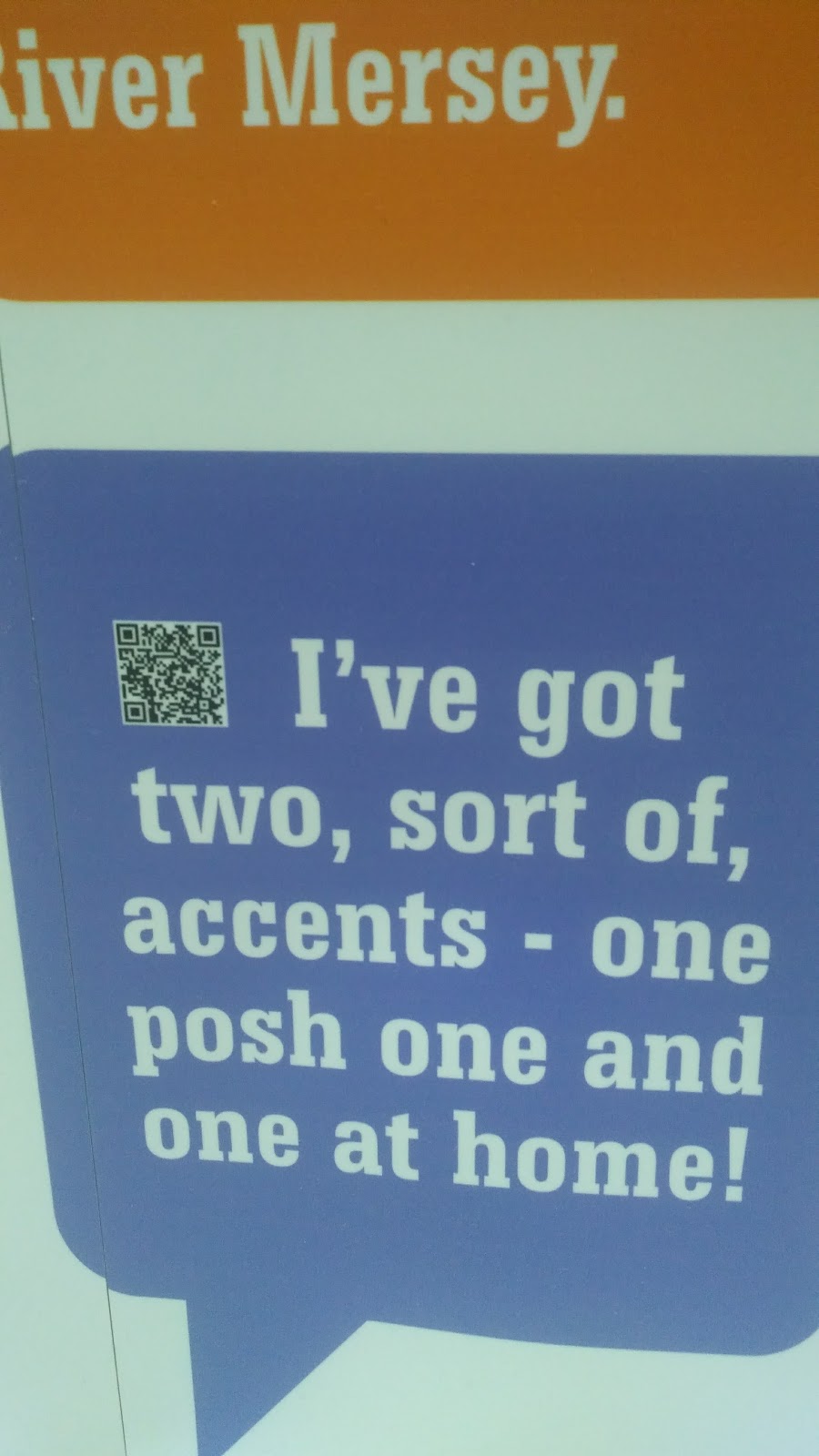
Maps and speech bubbles illustrate several of the contributions by the participants recorded for the project, and for each borough you have a purple box that summarises some of the pronunciations and lexical items that have been reported to be used in the area. 
Bury.

Northern girl.


the Manc twang.

All in all, the exhibition illustrates different individual viewpoints as to how locals view their membership to Greater Manchester, and how they see their own accent, and others, as markers of their local identity. Some participants reported their own identification with their own local borough as strongly related (or not) to Mancunian identity, others confessed to a closer association to Lancashire (in the western areas), or even Yorkshire (in the eastern areas). It was great to see non-linguists reflect on their own "repertoire of accents" and while talking about their accents, to notice how they also made adjustments to what they were saying, and how they were saying it. I personally got the feeling that some participants were going far "broader" than they would normally go in their everyday life, but that's just an unjustfied claim of mine in the shape of a "hunch". 

One of my favourites! Several participants reported having different accents for different settings, some called it a "posh voice", or a "telephone voice", versus the accents they would use at home, or with friends.

I found this exhibition really insightful, and as as a former EFL teacher trainer who once tried to help my trainees understand the social and political role of accents in the UK, I honestly enjoyed the fact that I got to see lots of invaluable testimonials as to how accent issues are always latent in everyday life (even for non-linguists!), and how accent is, indeed, a great part of the way people "categorise" each other, and even themselves, in different speech situations. 

If you want to learn more about the project:
Manchester Voices Website: http://www.manchestervoices.org/
Twitter hashtag #McrVoices

lunes, 2 de febrero de 2015

Book Review #2: You Say Potato: A Book about Accents, by David and Ben Crystal


The book I'll be talking about is You Say Potato: A Book about Accents, a really entertaining, yet serious review of issues regarding accents and their role in everyday life, particularly in contexts where people may be self-conscious about them the most. In this short post, I would like to review the book in my own personal style.
This would be me in Trinity College Dublin, reading the book on a beautiful sunny morning.

***

The first appealing thing about the book is the fact that its style is conversational, and as a reader I felt I was actually at the Crystals' dinner table (and I have to say, after reading the book, I would defo love to be invited to have supper with them!). With David providing the historical background and the technical aspects of the discussion and Ben leading us through the world of the performing arts and illustrating his points with his anecdotes, this book is a great introduction for those people who have never pondered on the role of accents, or for those who have and need further evidence that accent does matter (but for what?)...

In this respect, as I read the opening chapters, I couldn't help thinking of the classic "Does Accent Matter?", by John Honey. I would be tempted to say the Crystals' book, in many respects, is an update of some of the chapters of Honey's material, and goes beyond it, by analysing accents in four sections, called: Accent Passions, Accents Present, Accents Past and Accents Future.

***

You Say Potato explores attitudes to accents on a first-hand basis -mostly through the anecdotes shared by Ben in his voiceover, acting and lecturing work - and through a great number of references to the media, including articles, surveys and TV shows, and extended to historical documents, films and advertising. The authors have taken to even retelling cases where forensic phonetics -with our lovely Jack Windsor Lewis - has a role to play!

The initial exploration of some basics of accents starts with a brief, simple explanation of the articulatory processes involved in the production and classification of sounds, and some comments regarding the acquisition of accents.  A more daunting endeavour later in the book is the making of an "Accent Map" that attempts to place all the accents discussed. This map proves to the reader how intricate the accent issue is, at least for, but not exclusively, Britain, where there are more accents per area than anywhere else in the English-speaking world.

David Crystal provides a really reader-friendly description of different accent groups, with plenty of examples for the non-specialist to have an idea of what a certain accent sounds like. One of the sections I found most useful is the "how to tell....from..." section, where David provides a few tips and tricks to distinguish Americans from Canadians,  New Zealanders from Australians, among other groups.

Issues of accent and identity, including historical and present "gut feelings" regarding accents are described through numerous quotes, including some mythical and prejudist views on Brummie (the old "ugly city, ugly speech" prejudice) in previous centuries (yes, including the 1990s....and probably still at present?) and a reivindication of regional accents in the media by those trying to explain why these prejudices are a mere "stupidity" (sic). It is true that we are all, to a certain extent, biased towards a particular accent group, so even though I am not a native speaker of English myself, I have to admit I felt a bit ashamed of having nodded in agreement when reading a few of these "stupid remarks" on accents.

As I have found in many current articles on accents (see my collection here), the book also goes over some of the issues we regularly see commented on the media and that non-specialists also pick out, like Brit pop and rock musicians using American accents, and Hollywood villains going for posh RP-like accents, and the role of accents when targetting certain audiences in advertising. Current phenomena worth exploring further, such as Uptalk, and Mockney, and notions of sound symbolism (what is known as "Phonesthesia") are also referred to briefly.

Another interesting thing about the book is the way accents are referred to in the different anecdotes retold by Ben, with notions like "blue", "rough", "smooth", words that refer to other senses and still help us picture different accents and voices (if I am not mistaken, this is called "synesthesia"). I particularly adored the definition of accents as "clusters of snowflake-unique sounds" (p.37). If you scroll below and hear Ben's rendering of a Shakespearean sonnet in original pronunciation, you will surely come up with your own adjectives and accent-resemblances as well.

It was, to me, so lovely to read about the reconstruction of Shakespeare's Original Pronunciation (OP) again, which is also described in such a lively manner in the book Pronouncing Shakespeare. When you read the accounts by both Ben and David, and you see this video, you clearly feel the power of accent, the power of voice quality and articulatory settings, and somehow, you go back to that wonderful setting of Elizabethan theatre.


All in all, I have to say I loved the book, as I felt I was reading many books into one, and I would love to see many of the points raised  developed into further work. I got a thrill out of reading historical documents and quotes, since probably the current views are more easy to trace on the Internet nowadays. Until the Time Machine gets invented, we can always read books by David Crystal, where we are sure to find the voices of times past brought into the present!

But, wait! This is by far not over. The Crystals invite us to be part of the You Say Potato experience. You can record your own "potato" pronunciation here. And if you want to see the authors at work and get a feel of the book and the issues presented there, then take a look at these videos!


And yes, the title of the book refers to this song we all know about!


 Other reviews and articles on the book:
TIME:http://time.com/3525767/you-say-potato-accents-david-crystal-ben-crystal/
CityLab: http://www.citylab.com/weather/2014/10/a-map-of-how-the-worlds-people-say-potato/381218/