Mostrando entradas con la etiqueta webinar. Mostrar todas las entradas

sábado, 15 de agosto de 2015

International Conference of Phonetic Sciences (#ICPhS2015) - Glasgow, August 10-14th.

ICPhS. For any phonetician, this conference is just THE conference. Unfortunately, I could not attend (don't get me started on why because I'll start sobbing), but all the live-tweeting, the online conference proceedings and the Periscope streaming of some of the plenaries made all the 12,000 km distance somehow shorter.

This post is aimed providing you with a "hub" or "central station" of links you can consult if you want to catch up with what happened at the conference. (I will try to keep this list up with new stuff that I may find under the tag "ICPhS2015" in my Scoop.it collection of web resources)

-Official Conference Website:
http://www.icphs2015.info/
-Book of Abstracts
http://www.icphs2015.info/upldrctry/book_of_abstracts.pdf
-Programme at a glance (includes links to the proceedings! Just click on the presentation that interests you and...voilá! You get access to the paper!) 
http://www.icphs2015.info/pdfs/detailedprogramme.htm

-Official Tagboard - Collection of all social media citing #ICPhS2015 (this is a very dynamic and entertaining way of keeping up with what is going on in all fronts!)
https://tagboard.com/icphs2015/236834

-(Unofficial) Instagram collection for #ICPhS2015
http://pinsta.me/tag/icphs2015


-Official Storify collections, day by day
Day 1:
https://storify.com/mariawolters/icphs-glasgow-day-one-oral-sessions
https://storify.com/mariawolters/icphs-day-one-discussant-sessions
https://storify.com/mariawolters/icphs-glasgow-day-one

Day 2
https://storify.com/ICPhS2015/day-two-of-icphs-2015-poster-sessions
https://storify.com/ICPhS2015/day-two-of-icphs-oral-sessions

Day 3
https://storify.com/ICPhS2015/day-three-of-icphs-oral-and-satellite-session

Day 4
https://storify.com/ICPhS2015/day-four-icphs-2015

Day 5
https://storify.com/ICPhS2015/day-5-icphs-2015

Plenty of stuff to catch up with before Melbourne 2019!


lunes, 20 de abril de 2015

#IATEFL2015 Online Coverage #2: Interview to Luke Meddings

Part of the IATEFL Manchester Conference 2015 online experience included interviews with many delegates and presenters. In a previous post, I reviewed an interview with David Crystal. I would like to briefly comment on the 6-minute conversation a British Council presenter held with Luke Meddings this time. As usual, my own input, in a different colour.

Being 12,000 km away, I did not get to see Meddings' talk, which I was told was hilarious, but I would be happy to hear or read about it online, if anyone out there wants to report on it! (There's a brief reference to his talk and other pron talks in Mark Hancock's blog, BTW)

The interview with Luke Meddings, available here, begins with some points of reflection about the way we feel when we speak another language, the idea of being "frozen up", filled with anxiety, fearful of making mistakes. As the interviewer points out, at times it is this fear or anxiety that may lead us to focus on form, and forget meaning. This is something I generally notice with my advanced students at College: they are so concerned with sounds, or even with their own intonation patterns, that it just sounds as if they are reading "patterns" (as one of my colleagues says), reading a set of marks on the page, totally devoid of meaning. I was just thinking of David Brazil's (1980, 1997) notion of oblique orientation here. And not because my students, necessarily, use many level tones, but because their approach is oblique, even when using fall-rises, or rises! Their concern with form and accuracy is stronger than the expression of meaning and the need to address an audience. Moreover, I generally notice many learners making appropriate choices of tone and nucleus in their reading aloud experiences who fail to get the message across! And this, again, is connected to some features that I sometimes fear we may neglect when teaching pronunciation, and even when teaching speaking skills in general: the contribution of paralinguistic features to the overall meaning, and mood, of a text. 

The approach that Meddings suggests appears to address some of these paralinguistic concerns, as he takes up the idea of "impersonation" through body language and gesture, as well as breath and volume control, as a "key" to pronunciation. From what the interview shows, Meddings appears to have got the "hang" of voice quality and articulatory setting features of different people, like the Queen, or John Lennon, and even makes use of chewing gum to aid his impersonation. I remember students talking about impersonation techniques for English learning used in some English institutes in Buenos Aires. Students were asked to pick a celebrity they liked on their very first day, and they adopted this "second personality" throughout their studies. So one of my students was "Ginger Rogers", and that is what she was called by her teachers during her lessons, for six good years! In spite of the fact that this student did not entirely approve of the method, she said that this approach made her feel safe, as it was "Ginger" who was making mistakes, and not herself. Interesting.

Part of Meddings' premise is that we should learn to "let go", as pronunciation is physical and feedback can get on our skin. Once again, there is an invitation for learners to "find their own way of speaking English their own way". I have been thinking about these issues for quite some time, issues related to the "ownership of your interlanguage accent", to the challenge of "finding your own voice", and I have decided to put some of these ideas into a podcast-like post, coming soon, called "Your Accent, Your Patronus" (Yes, another Harry Potter reference! <3).

All in all, the interview gives us a taste of Luke Meddings' style, and it is always enriching to see other ways of doing pronunciation work in the classroom.

lunes, 13 de abril de 2015

#IATEFL2015 online coverage #1: Interview with David Crystal

As a Manchester, IATEFL 2015 registered blogger, I have to admit I have not had the time to catch up the way I would have liked to, but here I am, with my first report.

This time, I'll be talking about an interview with David Crystal (available here), which of course, was the obvious choice for me to start!

As usual, a bit of a report of what was said, and my own input, in a different colour.

***

The Crystals have been pretty active in this 450th celebration of Shakespeare's wonders, and they have been busy publishing materials for all our enjoyment. The illustrated Shakespearian dictionary is mentioned by David, with a few interesting tips and tricks regarding our approach to Shakespeare in the classroom:

  • Shakespearean language has to be learned in context, and we need to have the pictures in our head of what these words represent in order to make sense of the images Shakespeare so very skillfully presents!
  • Before approaching the play on paper with your students, see it on stage or watch a DVD! I looooved this bit of advice. Watching "a book" on DVD/YouTube/stage should not be a "sin" or a form of "cheating", it is yet another interpretation of the book in print through the eyes of the semiotic systems of image, sound, motion, and I agree entirely that this is a valid way of going about it!
  • Act a bit of Shakespeare in the classroom. Nothing more exciting, methinks!

Now off to my personal favourite bit: Original Pronunciation. I've written about this in my review post of the latest Crystals' book here, but I would like to write down some of the points David raises in this interview.

David reminds us that the powerful resource of rhyme in Shakespeare's sonnets (because if I remember correctly blank verse does not rhyme except in the last verses of each scene?! Do I remember my Shakespeare?!) does "not appear to work in Modern English". We all remember the lovely Sonnet 116, and the supposed rhyming pair "loved"-"proved" [lʌvpru:vd], which in OP would be something like [lɤvd - prɤvd]. You can hear more about it here:


Crystal invites us to experience Original Pronunciation (OP) here:
http://originalpronunciation.com/

The last part of the interview leads us back to the "You Say Potato" book. Apart from retelling some bits from the book, David mentions the fact that the accent issue is complex, and that in order to faithfully represent the idea of how accents change, there had to be more than one person in the book, a "young person, and a slightly less young person". He mentions the fact that there will be an audiobook version later in the year (looking forward to it!)


There is an interesting discussion in the interview regarding the notion of accents. As we have heard countless times, accents are "all over the English speaking world" and they are "mixed". We are no longer speaking about RP as the norm, but as a "mixed or modified RP", what other authors called General British, which Crystal defines as "educated, understandable". This is a complex issue as well, in my opinion. Clearly, if you read the news, what the media sees as RP is the "Queen's English" or the "Public School English" which Cruttenden (2008) called "Refined RP" and is now termed "Conspicuous General British". I think this RP they may be talking about, spoken by 2% of the population, is not necessarily what we may call "General British" and of course, "Regional General British", which I associate more with universities and the media.  So when we say "RP", what are we really talking about? I would also question the use of the term "understandable", as my students would claim that it is General American that sounds "intelligible" to them, and not really British varieties, but it may be a problem of exposure. Worth another post!

Crystal then addresses learners of English by urging them to embrace the idea of keeping traces of their native language in the accent of English, except for "spies, who are the only ones who need to be anonymous" (LOL!). He sees English as a "garden of flowers", with each individual accent making a different variety and bringing colour to it (<3). David tells teachers that the priority should be students' clarity, and an approach to flexibility, that is, not focussing on teaching every single feature of an accent to students. He mentions, for example, the features of glottalisation (as in [hɒt -hɒʔ] and GOOSE-fronting (as in [ku:l - kʉ:l]), clear examples of the changes to General British, that ought to be accepted in the English classroom. Exposure to different accents as early as possible is key. Crystal does make a point as well of "knowing how to do it", that is, having the necessary tools to teach pronunciation of the accent(s) of choice. (Worth another post! #2)

As an answer to a question on the importance of stress and connected speech over the segmentals, David believes there is more an issue of complementarity. David also mentions the fact that if we look at the different Englishes around the world, 3/4 of the speakers actually employ syllable-timed versions of their accent, which is why, in his opinion, stress-timing as a teaching priority is actually outdated. The challenges to the "stress-timing" hypothesis have been going round since the early 1980s, including some papers by Peter Roach and Cauldwell, among many others. Very very interesting topic, by the way.

To conclude, Crystal presents some pieces of advice for teachers to "keep up with the times" by "listening, listening, listening" to English, to young speakers of English in the media, especially social media, in the understanding that the young speakers of the language are the ones pushing the language forward, the future parents of the future generations. He reminds us that we should not underestimate the power of Internet, as these generations take "screens as central, books as marginal".

All in all, a short, yet enjoyable interview, with that lovely accent of Crystals' (IMO) and his smooth, "surfable" intonation patterns (really worth teaching!), but first and foremost, with a very engaging discussion of hot topics which may at times be a bit "thorny" for teachers.

I expect to be able to report more on the online coverage of IATEFL 2015 soon!


sábado, 21 de febrero de 2015

Conference Report #3: "Accentuate: Bringing Pronunciation to the Fore" Part 1

"Accentuate: Bringing Pronunciation to the Fore" event by IATEFL's PronSIG and NATECLA.
Read the programme of the event here.

As an anticipation to my next blog post with my views and takes on the presentations I have managed to watch live, find a taster of the talks and the Twitter discussion below:


Crystal & Crystal: "Dealing with Accents"


Hancock: "Doing things with sounds Practical pronunciation activities for your classroom"


Young: "The Silent Way approach to teaching pronunciation, illustrated using French"
Messum: "What to Teach Before you Teach Sounds"


Underhill: "Proprioception in learning new sounds, words and connected speech"


Concurrent Sessions
Tatiana Skopintseva "Pronunciation Gymnastics for Non-Native Presenters in English"
Simon Andrewes "Accentuate the positive: positive approximation and the lingua franca core"
Linda Ruas "Radical phonology": protest chants - a meaningful context for improving sounds and suprasegmentals
Paul Carley:   "An UnhappY Vowel: Is our Transcription Fit for Purpose?"
Cornee Ferreira "What to imitate? Between the native-speaker model and the lingua franca core."
Charlotte Haenlein "Ideas for embedding pronunciation work in everyday classroom topics at lower levels"
Judy Kirsh & Karen Dudley "Pronunciation for integration: stress, rhythm and intonation"
Catarina Pontes "Putting sounds together: practical pronunciation activities for the English classroom" 
Wayne Rimmer "Designing pronunciation materials"

martes, 17 de febrero de 2015

Webinar Report #3: "The Melody of English: Research and Resources for Teaching the Pragmatic Functions of Intonation"


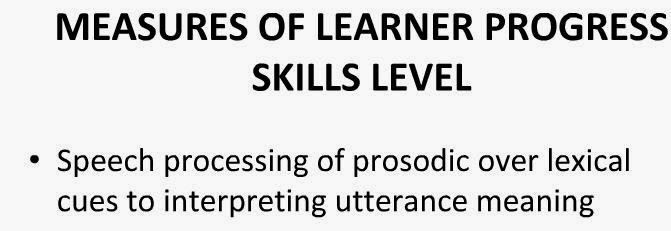
Those of you who know me well know that my favourite area within the Phonetics and Phonology field lies with the suprasegmentals. I love everything prosodic-related, and I live to find connections between the prosody-pragmatics, prosody-discourse, prosody-systemic functional linguistics, prosody-conversation analysis interfaces. And of course, I'm always looking into ways of making this "teachable". So when I saw the title of the PronSIG webinar by Tamara Jones and Marnie Reed I knew I had to make it. So the webinar I will be briefly reporting was called: The Melody of English: Research and Resources for Teaching the Pragmatic Functions of Intonation" and you can see the event poster with the speakers' biodatas, and the abstract, here.


***
I will be posting some of the presenters' views and ideas here, and in a different colour, my own input.

***
Marnie Reed began the presentation by referring to her own classroom research, and particularly, to the question "What is it that students (and teachers) don't understand about intonation?". She found that many advanced students got to pick the individual words in a message, but they "miss the point" when they do not catch the pragmatic functions of intonation, such as in this example:

Student: Can I turn my homework in late?
Teacher: You \/CAN

The use of the implicational fall-rise here may be lost (an "affirmative answer with a negative meaning") if students are not aware of the actual pragmatic potential of intonation. In this particular case, Reed quotes Wells (2006), regarding the use of the fall-rise:


(I noticed that throughout the presentation the speakers referred to the implicational use of intonation, but I believe that some things they mentioned regarding "implication" were in fact not connected to the role of the fall-rise, but to the selection of certain nuclei).

Reed makes a point of the fact that some students believe that English intonation is just "decorative", that meaning resides in words, and she makes a point of the role of intonation in English as a mechanism in terms of speaker intent, which may be different from the ones employed in other languages:
Reed makes a point that if a continuum was made between different languages, English would stand at an extreme point, when it comes to the defining role of intonation and meaning in everyday discourse, with other languages probably making the most of syntactic resources.
Reed also reminds us that intonation is esssential in communication, and in much the same way Brazil (1980, 1982, 1995) does, Reed believes intonation may not go hand in hand with grammar and the wording:
(Gotta love Wichmann!)

Contribution by Tamara Jones later in the presentation

In this respect, Jones exemplifies the importance of intonation in the speech of her local Korean grocer (I think it was!), who says "Thank you very much, come here again". In spite of how polite the choice of words may be, the prosodic pattern of it sounds more like "go away". (I guess there must be something in the pitch range, maybe too low? Maybe too high and high volume? Forgive my lack of knowledge of Korean!)


I was very happy to hear Reed insist on the role of metacognition for intonation, as at times many of my students do not easily see that theory can be empowering, that knowing about intonation use and the communicative values of the choices of intonation can really help us produce and perceive what is going on. So when asked about the role of repetition, Reed suggested working with both metacognition and skills, "quality repetition" (Jones), to allow students to "own" the intonation patterns and make it "theirs" while at the same time being aware of the "why" a certain pattern is used.


Another very very interesting finding of Reed's which would surely render the same results in my context is students' feelings towards their own production of tone patterns. Reed has heard students produce really nice native-like patterns, which students themselves reject because they feel they are "silly", "ridiculous", "dramatic", "sing-songy", "exaggerated", and they would probably not use them outside in the real world. (I can vouch to that, when I hear my own Lab students in other lessons! Sooo frustrating! )


One of the words that both presenters used and which I couldn't quite make out is the word "exaggerated". I would not personally say English intonation is "exaggerated", and I noticed that most of the examples the speakers gave to refer to this intonation was the fall-rise. I got the feeling that at times the presenters were referring to wide pitch ranges for some emphatic constructions, and in other cases, to the fall-rise itself. Maybe they just used the term to quote learners' impressions on the overall intonation of English, but I don't know. I am afraid I failed to ask about that (and I will, I'll update this section of the post here). 

It is very important then, Reed believes (and I agree!), to be aware of the role of students' beliefs in the process of awareness and successful production:


One of my favourite points was raised by both Reed and Jones, and it has to do with the criticism towards the attitudinal approaches of intonation (Yay! Great to hear other people say this, too!)


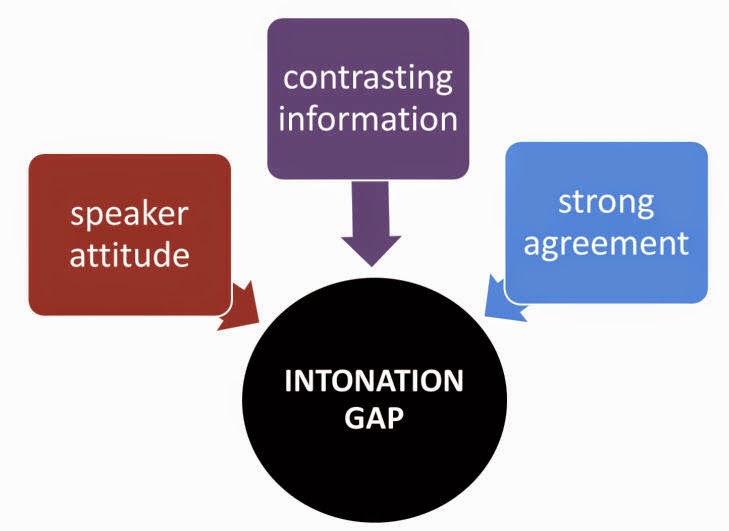
 Tamara Jones presents three interesting pragmatic functions in which intonation may have a great role for students to be made aware of.

Reed and Jones both present some great ideas to work on learners' awareness of the role of intonation in the areas above.

Some of the activities required working with "minimal pairs", so to speak, and using the same wording with a different intonation pattern. In some cases students are invited to decide if the sentences are and mean the same, or happen to different. In other cases, the same utterance is exploited to mean different things, based on the intonation. Students may also be given a number of pragmatic interpretations to see which matches the meaning intended by the speaker in the context. (And no, I am not going to talk about the problems with the notion of "speaker intention" here, so don't frown!)

Changing the nucleus according to the meaning intended

Matching utterances to their meanings
This is a TOEFL-based activity on what Jones called "emphatic surprise" (I would probably use it to deal with rise-fall in GB, or high key)


Some activities require that students see the patterns in the real word by conducting "field work", that is, getting native speakers to read these sentences to them:
Some interesting production and also awareness raising activities proposed by Jones were related to prediction and inference work. By relying on intonation, students can be asked to predict what will come later, or what happened earlier.

This is one of the moments in the presentation where I think the speakers were not dealing with "implication" as they said, but rather, "deaccentuation". It may have been a slip, though!

An activity by Judy Gilbert


Jones presented a few tips on how to help students produce prominent words/syllables. She referred to Gilbert's use of the rubber band (which you stretch every time you accent an item), and its alternatives: opening or closing your hand, raising your eyebrows, closing your eyes. And a very interesting alternative was presented, as inspired by Linda Grant: the use of yo-yos!
Many of the activities above encourage peer work, and the following activity is quite interesting, and can be used to exploit several functions of intonation in context. Jones presented this activity to deal with corrections and contrast, thus:

(Student A has B's card:)
A: 'My favourite colour is \blue. 
B: Your favourite colour is /purple?
A: \No, my favourite colour is \bluuuuue. (Wide range, and high key, I suppose? Sorry, I am transcribing the prosodic aspects I think I heard when Tamara read the activity)

I think this activity can also be used to exploit the fall-rise, probably leading into more polite corrections. Something like:
A: So your favourite colour is \red.
B: 'My favourite colour is \/not red, I am afraid,  it's \blue. 


Another activity which also engages metacognition and prediction is the marking of dialogues. Students can be given a script, they predict possible accents, and compare with the scene. Jones suggested the following Seinfield scene:


Very interesting scene to deal with deaccentuation, contrastive focus AND counterpresuppositionals as well, though to be honest, I would have made different nuclei choices myself!
And this one from Friends:


***
Marnie Reed concluded that all aspects of pronunciation should be integrated into core classes, and they should be part of regular lessons in much the same way other areas and skills are. (Yay!). I think both Marnie and Tamara have shown to us attendees that intonation is essential for meaning in English, that meaning does not reside in words alone, and that students need to be made aware of that. I believe their activities are really engaging, and easily integrated in the language classroom.

In my personal opinion, "theory" is very important when it comes to the teaching of intonation, much to my students' dislike. Because in our own language tones may have a different role, we cannot always rely on our ears when it comes to the communicative values of intonation in a different language. That is another argument against the teaching of attitudinal values of intonation, in my humble view. Our "it's not what they said, but how they said it" radar may work perfectly well in our L1, but we may miss the point in our L2. So teaching intonation in a realistic context, be it within a specific speech genre, or in micro-contexts of conversation like the ones in this presentation, needs to be part of the English lesson if communication is the aim.


***

The session was recorded for PronSIG members. If you want to know more about IATEFL's PronSIG and join, visit their website.
The bibliographical references included in the presentation have been posted at the PronSIG Facebook page here.

martes, 10 de junio de 2014

Webinar Report #2: Focus on Global English - Richard Cauldwell / Katy Davies & Laura Patsko

Today I travelled to England, comfortably sitting on my Buenos Aires armchair. The British Council organised the "Focus on Global English" event and streamed it live all the way from London.

This event was aimed at exploring issues regarding the role of accent and identity in different ways. Whereas Richard Cauldwell (whose brilliant book I'll be reviewing here soon!) set out to report his experience and views on how accent, identity and prejudice are intertwined, Laura Patsko and Katy Davies have taken English as a Lingua Franca into the classroom and provided us with practical ideas to teach it.

Below you will find a sketchy summary of what was presented, with some comments of my own, and the link to the playback, once it is made available.

(Digression alert!) (Speaking of accents, by the way, the BC presenter's accent was lovely! Sorry, couldn't help it! Picked out some things such as [i:vnɪŋk, rɪ?tʃəd], worth commenting on some other day!)

The BC presenter also made a point of the British Council partnership with Google for this interesting resource: https://spellup.withgoogle.com/

(Version 2. Since its publication, some typos and minor errors have been corrected)
***

Richard Cauldwell - Accent and Identity, Prejudice and Insecurity

Richard began his talk as a "personal journey on accents", and made a point of how people's feelings about accents may affect our own self image, and in spite of the fact that we may control or overcome them, "insecurity lives inside".
He refers to Part 3 of his (brilliant!) book, Phonology for Listening, as some of the audio samples and issues raised are (thoroughly) developed there.
The talk begins with a few definitions:

Definition of accent - I particularly like the idea of "flavouring" and "colouring".... :)

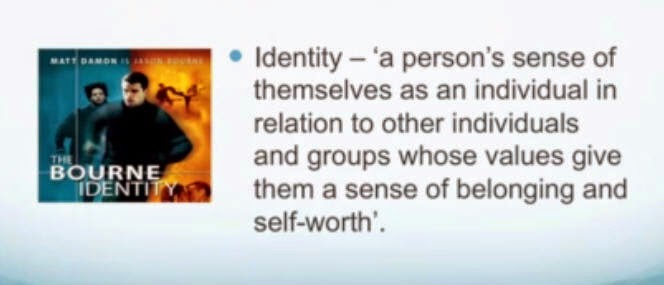
Identity - Richard's selected definition - The issue of self-worth and sense of belonging were delved into in the talk

Interesting definitions for "prejudice"
After presenting these definitions, Richard went on to re-visit his own history of accents, from his early Irish beginnings, to public school in England, to Oxford, to his current home in Birmingham. Certainly a story of accents!
There are some funny and interesting remarks in the fact that Richard's parents were born in 1926, the year of the "birth" of the BBC, as well as on the "official christening" of Received Pronunciation.

Richard's next step involved the discussion of reference models. We know about the current "embarrased" (sic) status of Received Pronunciation, all the prejudice associated with it as a prestige accent, and no wonder, given some of the (thought-provoking) quotes selected by Richard:

Richard reported a teacher's "protective" attitude towards a Scouse-speaking student, warning him of the how you may "lose marks" if you use your Liverpool accent. This type of prejudice is also taken up in a quote from the 19th century:

This idea of prejudice is ingrained and as the table below shows, which is far different from what many people may believe now, attitudes to accents and the role of accents may change and are, in fact, changing.  Richard makes a hilarious remark on this table, saying that probably the order would change if the question was "Who would you like to have on your side in a fight?"


Richard moves on to present a number of successful professionals, with a high level of proficiency in English, who may have some sort of self-loathing or a lowered self-image because of their accents, or because of the reception towards their accents. Some of these quotes show the role of accent and identity and the "perpetuation of the prejudice":


After listening to different non-native and native accents of English, and drawing on intra-speaker variation, Richard makes a point that accents are variable within the same speaker, and that they can be used for accommodation in different situations. He makes it really clear that we "should be allowed to be who we are".

The next point raised is that of reference models. Received Pronunciation does not have the "status" it used to have, particularly its "refined" version, and hostility towards RP is clear in many areas, as it reveals a "stigmatisation of privilege" (Geoff Lindsey). Richard makes a point that these models should not be attainment targets, just references to where students may want to approximate. But most importantly, "any accent of English is acceptable as long as it is intelligible"
A few other useful reminders Cauldwell has drawn our attention to:
  • English is no longer the property of the native speaker
  • attainment models are achievable learning targets, reference models are not and there are not too many native speakers of those models (Refined RP just for some Royal Family members and the Navy!)

And some thought-provoking conclusions by Richard, which I post in his own "voice":

A short Question & Answer session ensued:

1. Audience: What accent should we teach? If teachers teach with their own voices, isn't this confusing for learners? The member of the audience retells an experience of teaching with her own RP accent alongside another Irish teacher. Don't we need some sort of model?

Richard: There are lots of resources online to choose voices learners can aim to attain without having to go for a reference model. Learners can choose how to establish their identity as speakers of English.

2. Audience: To what extent can you modify your pronunciation?
Richard: It depends on own personal capacity to handle the input that comes in and moderate what comes out. But most importantly, there are some emotional filters that may give people high motivation, or maybe lead them to resist the acquisition of a target accent.

3. Audience: We have to admit there are many Englishes. So pronunciation is not very important for English at a basic level (sic).
Richard: We need to distinguish between production and perception. We have to prepare people to encounter many accents and produce something reasonably consistent.

4. Audience: Teacher working with multilingual classes. I modified my speech for my students, I don't use norhtern accents. If students change their vowels completely, that is not all right for me, that is my line. Spelling definitely affects pronunciation.
Richard: It is important to teach the issues between spelling and sound. But we should aim for intelligibility as a priority.

***
That was a brief report on Richard's talk.
You can read more on this in Richard's book and on this blog post: http://blog.britishcouncil.org/2014/06/09/what-does-your-accent-say-about-you/


***
Laura Patsko and Katy Davies: Practical ideas for teaching pronunciation and listening in an English as a lingua franca (ELF) context 

Laura and Katy introduce themselves as teachers working in multilingual context, with non-native learners of English from different L1s. English is their communicative medium of choice, and at times, their only option. They teach "English as a Lingua Franca", which represents the communicative reality of use in English accortding to statistics, and the pronunciation aspect is highlighted in their teaching as "pronunciation was biggest cause of breakdown of communication" (Jenkins, 2000)


The presenters covered the following areas in their talk:
  • How to know what to prioritise in an ELF context?
  • How can you "standardise" your teaching practice within this variation?
  • What practical ideas can you apply in the teaching of ELF pronunciation?

Establishing priorities for an ELF context
1. Conduct a needs analysis: 
  • discussion with students, knowing their needs and motivations for learning English;
  • diagnostic work:  listening to their pronunciation, identifying gap for intelligibility problems. For example: taking a dictation exercise between fellow ELF users (and not the teacher as the "authorised voice"), using sentences in the coursebook, and asking students to take down what their classmates are saying. This allows the teacher and students to identify areas of "high risk" for intelligibility.

2. With the newly-found data: Apply an ELF filter
Check the areas of the Lingua Franca Core and make decisions. The teaching techniques for pronunciation do not need to differ from those used in EFL contexts: minimal pairs, drilling, etc.

3. Come up with a syllabus, based on coursebook/teaching materials and data from the diagnosis
4. Adapting classroom practice


Some things to be considered for an ELF practice:
  • We need to help students become aware of what they are doing and why.
  • Students need to be conscious of the fact that accent is flexible, and that in an ELF context accommodation is important, and they should know how to modify their speech if necessary.
  • Students should be allowed to make choices.
  • Weak forms are not essential in the LFC but may be presented as part of receptive skills to be taught.
  • Focus on stress is important and textbook activities or tapescripts may be adapted to this end.
  • RP may not be a model in itself, but it is useful to teach spelling patterns and their connections to sounds.
  • The learners' needs are taken into consideration and not necessarily the native speaker norm. Students may be judges and models themselves, and teachers should support their choices, particularly if they are "informed" choices.
  • It is better, in a multilingual context, to encourage pairwork over groupwork, so as to enable students to improve comprehension on a particular task being exposed to one "ELF" variety at a time.
  • It is important to teach learners different chunks of language to ensure a smooth negotiation of meaning, request of repetition, or reformulation. 
Use of authentic materials

"Authentic" defined as "materials which have been created in English but not for the purpose of learning English".
These may be used to look for proficient users of English as a Lingua Franca and try both productive and perceptive skills:
Using scripts of these materials may help learners assess intelligibility over the native speaker norm.

Some conclusions by the presenters, inviting us to reconsider and revisit some assumptions:
Laura Patsko rounds off the session by quoting Robin Walker, and the need to re-think goals and the role of error, rather than modify classroom practices. 

Some questions ensued:

Audience: You said you only teach the "bird" vowel, do you teach diphthongs? 
L & K: Key thing on the LFC is length, even for diphthongs. Achieving a particular quality for a vowel sound is not important, but a particular consistent quality is, as well as to preserve length.

Audience: Brazilian speakers learn /θ/ by imitating "th" from speakers with a lisp.
L&K: Even though /θ/ is out of the LFC as it may be replaced by other consonants, it is true that we may get "models" and "tips" from unconventional places. It is also important to consider and question notions of "correctness" and focus on "variation". We ought to remember LFC is a set of features, not a model or variety.

Audience: How can we continue improving our pronunciation after finishing a course?
L & K: An example of a good resource, BC ESOL Nexus website. Watching snippets from videos may also help. 

Audience: Some learners still expect the native speaker norm.
L & K: Respecting students' choices is part of our job, and asking them why they are making the choices they are making is important to see if their choices are informed. Presenting statistics is important. Those "ELF moments" we have in the classroom can also help us to make a point.


***
This was my brief report on Laura and Katy's Talk.

***
Hope you have enjoyed this summary of the sessions.
No time for my own input on these today, but I promise a follow-up on this. I think that all the speakers in this session mentioned the reality of English today, but also considered the fact that attainment targets are to be planned by the teacher based on the expectations of the students, and the contexts of use students will be applying their English to. As a teacher trainer, this is a very important point, and I was truly hoping to hear these views made explicit.

Replay link available HERE.
Thanks for reading me!