miércoles, 16 de julio de 2014

Analysing "errors": My "shame" list


When I first considered writing this blog, I thought of it as an answer to all my quandaries during my lessons. I was thinking of my students first, in fact. But now that I've embarked on this blogging adventure, I have noticed that I find my own processes fit for analysis, and that I can forge a better path for my students if I retrace my steps as a learner. Well. To be honest, I don't think I've ever stopped being a learner, myself.

This is why this blog post is going to address another of my obsessions with pronunciation which is part of my Evernote Moleskine notebook, travelling with me in my mobile and my bag. I humorously, and dramatically, call it....

The SHAME list!


Image credit:"De Paso Arte"
My "shame-on-you!" list includes a number of words that I have mispronounced systematically (or still do, at times!) (Now, I am not going to reveal his name, but there is a friend and great colleague of mine who also keeps one of these..... ;) ). This post, then, will examine some of my versions of these words, and an attempt at an explanation for my mispronunciations.

Warning! The words "error", "mistake", "mispronunciation" will appear a number of times in this post for the purposes of discussing some of the common views on this aspect of the learning process. I try to adopt a positive view towards error, try to be analytical towards it, and that is the spirit of this article.

***
A bit of theory first. There are different categorisations of "mistakes" around, and one of the views on "error" I first found attractive while a student at College was that outlined by Julian Edge (1989), in his book  Mistakes and Correction. In a nutshell, what I particularly liked about it was this division between:
  • slips: those "mistakes" made due to lack of proper attention, which, if pointed to, the student can self-correct.
  • errors: those mistakes we make which include features that have been systematised by teachers but which have not yet been "internalised" or "appropriated" or "automatised" by us; 
  • attempts: those mistakes which involve the student's experimentation with features that have not been taught, or the overapplication of rules into other contexts.
This leads me into another view that considers the source of error. This great article from Macquairie University explains this very neatly, and I would also like to make a point of some of these categories here:
  • Transfer from L1 errors: we all know that we tend to interpret foreign sounds from the filter of our L1 phonology, and as I have discussed in previous posts, the closer to L1 we interpret a foreign sound to be, the more likely we will have more difficulty in learning it (Flege, 1987 and others). Many interlanguage mistakes, then, imply the production of an L1 sound for an L2 quality which we consider to be approximate, or just because it is the only quality we have "at our disposal".
  • Spelling-to-Sound errors: these can be fully blamed on the irregular spelling of English (especially if the student uses a transparent, phonetic language as L1), and of course, you can then curse (or enjoy!) the history of English! (I've been reading a great book by David Crystal on this, highly recommended!). Students may merely apply an L1 sound to an L2 spelling looking similar to an L1 spelling, or interpret an English spelling he/she knows about into a context where in fact it is not associated to the sound in quesiton: bʌtcher for /ˈbʊtʃə /, for example.
  • Hypercorrection errors: this consists in the overapplication of a rule that does not fit into a context the student believes it should apply to. My secondary school students, for example, apply the /ɪd/ ending in contexts with sibilants, through analogy of the third person singular suffix rule: [wotʃid] for /wɒtʃt/.
  • Performance errors: this refers to the errors that may be "instilled" by the challenges of a particular task, that is, lack of weakening by some students when reading aloud, or overchunking when producing spontaneous speech, etc.
A note on another error-related issue. The transfer vs developmental debate: This is a very interesting way of looking at errors. As we have seen before, there are many common mistakes that reveal that the student is actively making hypotheses as to what the language "sounds like", and these cannot be truly seen as transfer/interference errors. At times we are so used to hearing some of these, that we fail to see that several mistakes are actually attempts towards a sound that may bring about difficulty. Take the sound //, quite rarely at times used in Spanish as an allophone of /ʒ/ (Yes, another debate as to whether /ʒ/ can still be taken to be the phoneme used for <y, ll> spellings in Riverplate Spanish over [ʃ] or the other way round. Long story! No time to draw on this here!). The video of a local celeb, Susana Gimenez, shows different renderings of the word "you" and some (not all, though) have [dʒ]:
(Sorry about this!) Now. When our students say [ʃip] for "jeep", they are not necessarily transferring this from Spanish, as a true instance of transfer would probably be something like [xip]. This pronunciation which makes our students' rendering of "jeep" homophonous with "sheep" reveals that our learners feel this sound is different and approximate it to a quality they may be more familiar with.
A hypercorrection mistake in this respect may be our students' use of [ʒ] for /ʃ/, as when they say "shopping" as [ʒopin], for example. This is becoming a bit of a sociophonetic feature, as I can easily identify some features of the social background of those students who generally pronounce this this way.

OK. Back to my own errors, then. My own "shame list".
***
 The horror! :p  List 1: [eɪ] for /æ/
The words below stayed fossilized in my interlanguage for a long time. They surely responded to my overapplication, hypercorrection of the /eɪ/ for "a" rule:
*enmel, tpestry, bbey (!)
for General British /ɪˈnæməl̩, i-,  ə-/, /ˈtæpɪstri, -ə-/, /ˈæbi /
(Longman Pronunciation Dictionary (LPD) (Wells, 2008), English Pronouncing Dictionary (EPD, 2011) edited by Hartman, Roach and Setter )
There was a sort-of famous song by a local rap band, here, called "Abbey Road". I guess I will have to blame them (ha!) for my serious mispronunciation of this placename while in London in 2010 (felt sooo ashamed!):

In the opposite direction, I remember having problems with the word apron, which I produced as [ˈæprən ] instead of /ˈeɪprən /, and [ˈæprɪkɒt ] for /ˈeɪprɪkɒt, -rə- /  .

List 3: Word Stress
Again, I guess some of these errors stem on either the hypercorrection of the Teutonic tendency towards early stress:  ˈcoincide,  inˈnovative or the overapplication of my perception of the French tendency towards late stress: maˈssage, misˈchief, emploˈyee . I could have also "fallen pray" to the influence of American English.
The proper word stress according to the cited versions of LPD and EPD goes:  /ˌkəʊɪnˈsaɪd, -ən- /, /ˈɪnəvətɪv, -veɪ-, ɪˈnəʊvətɪv / (Wells 2008 has an interesting poll on the pronunciation of this word!), /ˈmæsɑːʒ, -ɑːdʒ /, /ˈmɪstʃɪf / (EPD accepts /tʃi:f/) , /emˈplɔɪiː, ɪm-, əm-/. In this latter case, my own version is accepted /ˌemplɔɪˈiː/ but as the last entry in both pronunciation dictionaries.

List 4: [ʌ] for /ʊ/
Another case of hypercorrection in the words mʌstache, pʌssycat  for /məˈstɑːʃ, mu-/, /ˈpʊsikæt/. In the case of "moustache", American English influence may also be "to blame".
Many of my students also struggle with the word bʌtcher for /ˈbʊtʃə / and  cʌshion for | ˈkʊʃn̩ |.

List 5: Miscellaneous
A few other words I find myself at odds with, include: tournament, handkerchief, gauge, drawer, demise.
I was relieved to see in the dictionary that the first two words also accept my versions:  [ˈtɜːn ə mənt], [ˈhæŋkətʃi:f] and I guess my perceived "error" stemmed from making a spelling-to-sound connection. In the case of the second word, I believe it is the spelling that initially led me into an /i:/ sound.
My versions for the last three words: *[gɔ:dʒ][drɔ:ə][dəmi:z] for the words /ɡeɪdʒ/, /drɔː/, /dɪˈmaɪz /. I guess these three are mispronounced due to different reasons. In the case of "drawer", I thought it was a homophone of the "one who draws", so my analogy backfired here. For "gauge", I don't remember finding another <au> spelling being pronounced in this way and its etymology does not help me at all (I should maybe check the Phonology of Old French!?), so my knowledge of spelling-to-sound connections was used logically, I guess. In the case of demise, I guess it would probably have to do with the fact that the "-ise" ending is generally /aɪz/ in verbs, not nouns, where this ending is generally  /i:z/. So, in spite of applying the rule correctly, I have not pronounced it correctly (such is...English!)

Hope that some of these items of my "shame list" have helped you wonder about the source of your own mispronunciations! (At a very high level of obsession, you'll understand!)

***
To err is human, and "native" speakers of English also engage in frequent pronunciation "errors", and these are reported in some very interesting articles. Some views are really extreme and defo beat my own personal passion, let me tell you!

"8 Pronunciation Errors that made the English language what it is today:" - The Guardian . HERE
"100 Most Often Mispronounced Words in English" HERE
"More than 80% British People Can't Speak Properly" HERE
"17 Everyday Words you may just be Mispronouncing" HERE

Any pronunciation pet-peeves out there? Post them on the "comments" box!


jueves, 3 de julio de 2014

Ideas on the go #1: Creating a mental image of tone


At one of the Teacher Training Colleges where I work, most second year trainees in their Laboratory Practice II course (the oral practice component of the Phonetics II subject)  are exposed to one of the most widely-used materials in the world of intonation: Intonation of Colloquial English, by O'Connor and Arnold. In my humble and inexperienced opinion, this classroom material works fine to allow students to become aware of pitch changes and basic English tunes but not to help trainees see how tones create or help us negotiate meaning in interaction.  Mind you, none of the teachers in the staff, as far as I know, considers the "attitudinal" aspect in depth to teach the tunes, as the theoretical framework in the Phonetics courses centers around the phonological contributions of Discourse Intonation and Systemic Functional Linguistics (You can read a great article on these ways of approaching intonation by my colleagues Lucía Rivas and Miriam Germani here) In spite of this, I have to admit I have not yet found a set of materials that so exhaustively provides models for different patterns except, perhaps, for the practice sections in the book by Wells (2006)

My experience many years after learning intonation via these materials is that the O'Connor and Arnold "experience" has conditioned by ability to hear and make sense of tunes. I have found it so hard to start "re-adapting" my perception of what is really going on in English, and the materials by Jack Windsor Lewis, and Roger Kingdon, however outdated they may seem to some people, have really helped me "break the mould" when it comes to perception of tones. However, I am a phonetics "freak" myself and I do care about phonetic and allotonic detail, but it is true that the native speaker processes the signal and assigns some meaning to it, he/she has some sort of "action-activity recognition" from a Conversation-Analysis perspective, and that is what matters in terms of the perception of intonation, I guess. An probably, this is what the teachers-to-be I am training need, so a collection of materials for oral practice and theoretical analysis of tones like the ones my colleagues have made at College does seem appropriate, as long as we don't lose touch with the real use of language "out there".
***
Anyway. Digression again, as I was not planning to get into an informal assessment of intonation materials (this deserves a better post, and I will write about this some time in the future). Today, I wanted to address a set of difficulties some students presented with the modelling of tones.

During my tutorial periods, students were given a set of drills from O'Connor and Arnold  so as to read the patterns presented in the sentences. In spite of the fact that students do have the audio files of the book at their disposal and are supposed to imitate the audio, and do so pretty systematically, many students find it difficult to apply the patterns to a new, unrecorded, drill. Away from the model, there is no mental image to link the tune to.

At times, the image of the tunes in the students' minds are associated to a drill they remember by heart, and this helps, but at times, they find the transfer to a new context difficult. In this respect, I have tried two tips:

a) For students who need a reference drill:

Inspired by the DAR-DOOBY-DIPETY classic task by Mark Hancock, which I have rediscovered thanks to his presentation at IATEFL (also by the reference to the activity Krystina Poesova has made in her great talk at Harrogate!), I have found one out of many possible ways of helping students get a reference for tones. I have asked these students to record a DAR-DOOBY-DIPETY (and a four-syllabled word) DIPETITY version of each of the tones, in a different key, on their mobile phones. This has helped some students to have a ready-to-grasp voice note, recorded in their own voices, to keep as reference for the production of the tone for a different number of syllables as tails. When faced with a sentence with tone marks to read out, students would compare their versions to the DAR language ones on their mobiles (which they can retrieve really quickly!)

Here's an example of what I have asked my students to record on their mobiles:


I believe that the use of non-words for intonation reference may work, as it keeps meaning associations away from the tunes. In many occasions, students see the content of the words and apply a tune which they feel suits the content, but it does not match the pattern written in the book. (This, of course, makes for a great opportunity to discuss the different contexts that different decisions on intonation may project, but  the purpose of the activity in question is mostly to get students to imitate or produce certain patterns in a more systematic way). I should maybe see, in the future, if getting students to use the same reference words for the tunes may backfire and lead to further confusion ( a creation of non-sense words for each different tone may turn out better), but so far, in the limited number of students I have tried this humble tip on, it appears to have worked!

b) For students that may not be aware of what they are producing or have trouble imitating the "master":

In this case, I have encouraged the creation of a sort of "attitudinal image" in the students' minds. Although I have made a point of the fact that attitudes may not always help them make an appropriate choice of tone, I have asked some students to associate an attitude, feeling or reaction to the tune in question. Some of these ideas were also related to Spanish feelings or expressions. These attitudes may or may not match what the tone is "doing" in that particular context, but the focus of this activity is to build a mental image of what the tone sounds like. So, for example, these are some of the mental attitudes that did the trick with those students who were at first unable to reproduce a tune:

High fall: complete refusal of something, as for Spanish: No! Estás loco!. Also for complete surprise: Copaaado!. (Translations: No! You must be mad! and Wicked!)
Low fall: not surprised, it was obvious it was going to happen, as in Spanish: buah. Also sequence-closing, as for an argument: Se acabó. (Translations: Yep, duh, and It's over) 
Low rise: in general, the idea of counting objects with kids works as a mental image here. In order to make students aware of the step-down to begin the rise, I sometimes ask them to remember the voice of the Addams Familiy's butler, a sort of creaky-voice beginning:

High rise: this I have found a bit more difficult to model, and I generally ask students to go for a more "falsetto", "Shakira-like" note on the last syllable of the intonation phrase, mostly asking them to worry less about the starting point of the rise, and focus more on the end-point (avoiding, of course, an unnecesary prominence in the last syllable of the tail):

Fall-rise: Though not exactly the same in Spanish, many students get to associate the idea of a non-committal, insincere Sí, or Puede ser to this tone, in a context like "do you like my dress? (it looks awful).

From these mental images, we teachers start fine-tuning the productions of tones for each student individually till students find their own way of producing the tones on the page, or the tones expected in a particular task. They will, later, with the support of the theory in their Phonetics courses, make their own choices in the un-marked texts and spontaneous speech tasks carried out in their courses.

(Of course, all these initial notions and searches for the mental images needed to produce tones are fine-tuned individually and gradually. It is by no means our intention to harm students' vocal folds in any way or to force unnatural patterns out of them. These tasks are useful for the initial stages when gaining awareness of vocal range and possible glides is necessary, and continuous feedback and follow-ups on the part of the teacher then ensure that learners find a voice and a range that suits them best.)

I have not discussed the step ups and step downs for the onsets in this post, and for this, like some of my colleagues have done, I use the piano or the harmonica apps on my mobile, and encourage learners to do the same. There are other tips "out there" which surely do the trick, so feel free to share them in the "comments" box below!

Hope you have found these tips useful!

jueves, 19 de junio de 2014

Currently reading #1: "Phonology for Listening", by Richard Cauldwell - Part 1

I am currently "mosaic reading", what with teaching, writing my MA thesis and more. But one of the books which has accompanied me since last year and which I have been reading with great care is Richard Cauldwell's Phonology for Listening. I am not only enjoying the book lots, but I have to admit it has also shaken the foundations of some of those beliefs behind my ideas of listening and speech production as well.
Plus, the book was nominated for an ELTon in Innovation in Teacher Resources, and it is both in paperback and e-book format.

Lots of people ahead of me have written very good & complete reviews of the book, such as the one by Wayne Rimmer (Available here, at the Pronsig FB page). I myself won't be reviewing the book formally, but I will be drawing upon some snippets which I feel are of major interest to me at this stage of my teaching.
***
As a self-confessed David Brazil fan (yes, when they ask you "what past historical figure would you like to interview if you had the chance?" I would most certainly choose him! I have issues!), reading a book by someone who has studied with him just makes me more than curious. Particularly, because they can tell us something about the "kitchen" of the whole system, something about the "didactic pruning" that we all engage into when teaching a topic and that may have led Brazil to make some simplification in his explanation, among other things. And also because I have not seen much developed from Brazil's time to now, at times just mere repetition of what was written in his books. So having someone taking this to the "next level", with adoptions and rejections of different bits of Discourse Intonation ideas, is more than appealing to me.

But this book exceeds the domain of Discouse Intonation, as it explores a wide range of topics, including:
  •  perception and production models of speech, 
  • changes to the stream of speech as we talk, 
  • how spontaneous speech "works" and how it is different from other forms of "careful speech"
  • what happens when we transcribe speech
  • accents, identity and emotion in speech
  • the teaching of listening.
As you can see, it's a sort of manual or handbook on a number of topics, descriptions, observations, and reflections that can inform our teaching practices.
***

The book centers around two issues, two "dilemmas":

  • "Ying's dilemma", related to the problem that we know words, but we can't catch them in spontaneous speech.
I confess myself to having had lots of "Ying moments" this year, particularly in the North of England. In spite of the fact that I'd studied the accents thoroughly, so I supposedly knew what to expect, I found myself in York, "recruited" by an Avon saleslady who was asking me questions I never got to understand. I had to say "sorry" in a Spanglish accent to make her realise I wasn't really getting it (I'd say "sorry" with a rise twice before to request repetition) and she let me go. And on a bus to Whitby, two young people sitting next to me were talking of complaining to the company of the service, and one of them addressed me saying something that sounded to me like "Got a penner?", and after apologising and looking puzzled, I got a clarification: "something to write with". He had said "Got a pen or something?".

"Anna's anger" at not being taught to really listen, at being asked to complete listening comprehension activities without having any teaching of the phenomena of the stream of speech.

I generally do some teaching of the aspects of connected speech when I do listening comp activities, but it is true that I do this particularly when students have trouble with some specific answers. I ask my students to write down what they think they hear, the orthography of what they think they heard, even if it doesn't look like a familiar word, and then we start analysing what went on in the stream of speech, the processes that were applied. But I have to admit that "Anna's anger" made me feel guilty about not doing this more often, particularly in my Lab lessons at College.

***
Some of the concepts I believe to be particularly interesting, especially because of the way they were presented, and which I have adopted immediately, are related to the "Window on Speech" framework adopted by the author, that uphholds a model that focuses on spontaneous speech with its "transient, invisible, plastic" features rather than on careful speech, the latter being the one we normally use for teaching production. I liked the notions of:
  • "acoustic blur", defined as "the way in which words in the stream of speech do not have clearly-defined beginnings or endings" (p.18),
  • "squeeze zones", those parts of speech that present non-prominent syllables and that present "squeezed" soundshapes, and that sound truly differently from the citation forms we all know too well, and which we, wrongly, expect to hear in spontaneous speech.
I found these ideas to be useful when doing dictation with my teacher trainees. I found that in the initial stages of recognition of onsets and nuclei, nuclei were not really a problem (at least, if the sentences were dictated with falls. Rises do bring about more trouble...). But the presence or lack of an onset were more difficult to spot for my learners. Drawing their attention to the "squeeze zones" in the pre-heads, and the comparison of the strong, better-defined vowels they would hear if the items were accented, has proven really effective.

These ideas by the author are futher developed in Part 2, and there is a great section on "Soundshapes" that deals with function words. Like in the rest of the book, there are a myriad audio clips exemplifying each and every point (the whole reading experience is a lesson in listening itself! Awesome!), and there is a description of these "weak forms" as we know them, together with other items which are not generally considered in other sources, except perhaps for Jack Windsor Lewis' blog (do an entry search for articles on less commonly reported reduced items!). The resources generally consulted for theory on weak forms in Phonetics/Phonology courses include the famous Gimson's... edited by Cruttenden (now in its 2014 edition!), the textbook by Peter Roach, and the "37 Weak Forms" article by Ortiz Lira. Cauldwell's description of reductions in spontaneous speech would certainly defy many of the reduced-word lists we are used to putting together, plus revealing that reduction is far more common than we would be ready to accept!

Among the many definitions in the book, I quite enjoyed the reference to tones in  careful speech as "countours of a landscape with high peaks, steep slopes and deep valleys" and the "gently rolling hills and shallow slopes of the English countryside" of spontaneous speech. This is so clear when it comes to the perception of the fall-rise by my students (and myself!) so used to O'Connor & Arnold's really steep fall-rises or rise-fall-rises, that the "shallow" fall-rises in spontaneous speech are either reconstructed because of our "theoretical expectations" or missed altogether. Another "challenge" to some long-established theoretical points, is the reference to the stress-timing theory. Though questioned from the early 1980s on by people like Roach and Cauldwell himself (click on the names for the articles), as it appears not to be a true reality of English speech, it is still a useful construct to teach English rhythm (in my humble opinion), but it is rejected if English is taught for ELF purposes, as weakening is not part of the Lingua Franca Core defined by Jennifer Jenkins.
The "Phonology for Listening" book presents cases of isochrony, but mostly claims that spontaneous speech is very rarely isochronous.

***
The second part of the book also describes the shape of spontaneous speech, particularly the drafting phenomena: filled and silent pauses, restarts, repetitions, reformulations, markers of imprecision, softeners, issues of speed and articulation rate.... It is essential to bear these issues in mind when it comes to teaching production, as well, in my opinion. There was a great talk on fluency by Alan Tonkyn in the IATEFL PronSIG PCE last April with a great discussion of what was perceived as fluent by native examiners of L2 speakers of English, and the presence of drafting phenomena was not necessarily a "threat", except for a number of specifications:


All in all, the first two parts of this manual address extremely interesting points, challenge assumptions, and fine-tune our ears. I was truly enthusiastic to read it the first time, and to review my notes for this post, after having attended two talks by Richard at IATEFL, which helped me make better sense of the book still. The key issue to start with is:


***
This ends my humble (intertextual!) review of Parts 1 and 2. I am most certainly not doing justice to the book, but you can always read it and read the reviews that are now around. Hope this piece has been enticing enough to go and have a taste!
My second part of this review, some time next week. And thanks for reading me!

***
Celeb spot! I have a pic with the author! (I have cheekily selfied him during the IATEFL PronSIG event!).

viernes, 13 de junio de 2014

Teaching Segments #1: English /ð, d/ - Part 2: Phonological Processes and "Tips & Tricks"


In one of our previous posts, we talked about the allophonic spit Spanish learners are faced with, from  [ð, ] to English /ð, d/. That is, in English, /ð/ and /d/ are two separate sounds, in Spanish, they are two variables of the only phoneme /d/, with some differences in place of articulation as well.

Interlanguage Processes in the Production of /ð, d/ for advanced learners of English with Riverplate Spanish as L1

Let's take the following phrases from the dialogue "At a Party", from Anne Baker (2006) Ship or Sheep, 3rd edition:

In the dark!
They are dancing under the stars!

The Contrastive Analysis hypothesis by Weinreich (1953) and Lado (1957) would establish that after a thorough comparison of phonemic and phonetic inventories of both L1 and L2 that defines what sounds and variants are present or missing in both languages, we can predict that my learners would apply their L1 allophones Spanish [d̪] and [ð], thus:
(Assuming that learners know about the non-rhoticity of GB)

In ððark!
ey are ðancing unðer e stars!

However, we cannot just assume that students, especially if they are advanced learners (B2, C1 level of the CEFR) will just transfer their L1 sounds to the L2.  They may have motivations to do so, and not just because the foreign sounds are not present in their L1, but also, because they may perceive them to be similar. The presence of "inaccurate perceptual targets" is described in Major’s
Similarity/Dissimilarity Hypothesis (2006), which  contends that those features of a language which are perceived as similar will be more difficult to acquire, since they are perceived and interpreted in terms of L1. As established earlier, Spanish /d/ may be heard to be similar to English /d/, as they are both plosives in nature, and the dental and alveolar articulations are not really far away from each other, and something similar may happen to the dental fricative, there being one allophonic variant of /d/ in Spanish under that description. This hypothesis may also explain why other sounds, such as //, non-existing in Spanish and only closely associated to /ʃ/ or /tʃ/ by Spanish speaking learners, may be more easily acquired or "approximated to" and sustained if students' attention is drawn to it. (I am not denying the difficulties in articulation this sound brings about, I am just contending that students can self-monitor the production of this sound or an approximate target more consistently than the /ð, d/ distinction which, in my experience, remains a consistent "mistake" even after systematised.)

I am teaching advanced learners of English, with many years of exposure to the language -at least inside the classroom-, and with a certain level of proficiency in grammar, lexis and fluency. It comes as no surprise that these students have made their own hypotheses of what the language sounds like, and many of their "mistakes" are, in fact, developmental in nature. This is in-keeping with Major's (1987) Ontogeny Model that predicts the increase of developmental over transfer processes over time.
Adapted from Mayor (1987) in Ioup and Weinberger (1987)

So this is what many of my students produce:

In ark! or In ddark!
ey are ancing uner e stars! or dey are dancing under de stars!

Most students who master the plosive and alveolar aspect of English /d/ overapply it to cover the contexts for /ð/ as well. This is known as hypercorrection, and it counts as evidence that students are actually learning and making judgements as to how the language works! :D

"Tips and Tricks" to teach /ð, d/

The obvious, first: teaching the spellings of both sounds. But the presence of spellings alone is not enough to ensure learners' self-regulation in the production. So some extra tips may be presented to correct or give feedback in order to allow students to realise they should be producing a different sound:

Hand gestures + articulatory tips and tricks: I like using two gestures to represent these sounds (These gestures are not offensive in my culture, but they may be in yours or your learners', so please check beforehand! No offence intended here!)


This is to ask students to produce an interdental sound rather than dental, since in this way, my students manage to produce a better defined /ð/ sound, and they become aware of the "tickling" sensation the friction produces. (It may always backfire, since some students pull their tongues out too much and this obstaculises a smooth articulation, but all in all, the interdental option works pretty well). I have also found it that with all voiced fricatives I needed to help my students to breathe "properly", encouraging diaphragmatic breathing over their usual "chest-lifting" (needed a word for it!) breathing. Many of my students improved on their production of /ð/  and other voiced fricatives when adopting a straight posture, and pulling the upper part of their "bellies" (just below their ribs) outwards when they produced the sound, somehow increasing the amount of air employed for a smooth friction to take place in the mouth organs. This, in turn, allowed them to loosen some unwanted tension on the neck and jaws, as their attention was placed onto the actual breathing process.

This is to remind students of /d/. I have chosen to focus on either keeping the teeth "softly clenched" or the back molars for the production of /d/. In spite of the fact that the transition from Spanish dental to English alveolar merely implies placing the tip and blade of the tongue further back in the mouth (going from just behind the teeth to the "balcony of the mouth", the alveolar ridge), I have found that the more I ask my students to focus on the tongue for this sound in particular, the more the tongue "reacts" by getting into the dental position. So I have found that asking my students to build a "fortress" in the mouth with the teeth or the molars prevented them from "going dental". (This is not a tip I may exploit with all students, as many students have a very stiff jaw due to stress or tension, and this slight "teeth-clenching" may "spoil" their overall performance and create some distortion in sounds. I'll talk about "stiff jaws" and "flabby tongues" and their effect on articulation and voice quality in some other post)

Some other common tips for /d/ include (sorry if I could not trace the sources here):
  • Exploration: exploring the teeth ridge area, playing with the tip of the tongue in different positions from the back of the teeth to the post alveolar area, and attempting different sounds till the right alveolar articulation is found. It allows students to become familiar with the alveolar area, a bit "underused" in Riverplate Spanish. It would sound something like this:

  • Marking the territory: I remember reading somewhere about the suggestion that students could define the alveolar area by either putting a finger or pencil or straw behind their teeth (maybe not too hygienic!) to make sure students' tongues produce contact with the alveolar ridge only, or a piece of chewing gum on the right articulatory point (this is a contribution by my colleague Andrea P.) to identify the "right spot". Some people would say this is a bit "invasive", but if treated as a game and in the right conditions, it should be all right.
Now a few tips for /ð/:

  • The "tongue" greeting": my trainer always presented this tip which is useful in kinder or primary classes. It involves travelling to an imaginary country, where people greet each other by showing the tip of their tongues, and students walk around the classroom saying "th" as a means of saying "hi" to each other.
  • The "tickling" competition: students may be asked to pull the very tip of their tongue between their upper and lower tip and blow slowly, producing a "tickling" sensation. After a short while, this feeling begins to "bother" the lips, the friction and the vibration it produces at times makes students drop the sound. So the competition involves trying to "put up" with the tickling for as long as you can. This is just to draw students' awareness of friction, and what it involves.
There are some videos and tutorials on the web for this sound:

  • Two home-made videos I made for my students: /d/ and /ð/ (used to looking ridiculous on the web by now! Sorry about the sound quality!)


Plus:
  • BBC Learning Tips, /d/ and /ð/
  • Some other videos for Spanish speakers (here and here). Some may be more "effective" and "accurate" than others. You will decide!
Hope you have found this post useful!


References
  • Quilis, Antonio (1993). Tratado de Fonología y Fonética Españolas. Madrid: Gredos
  • Mott, Brian. (2012) English Phonetics and Phonology for Spanish Speakers. UB: Spain.
  • Moyano, G. (1996) A Comparison between English and Spanish consonants. Buenos Aires.
  • Major, R.(1987) A Model For Interlanguage Phonology. In Ioup and Weinberger (1987) Interlanguage Phonology. The Acquistion of a Second Language Sound System.Cambridge: Newbury House Publishers
  • Monroy Casas, R. (2001) Profiling The Phonological Processes Shaping The Fossilised Il Of Adult Spanish Learners Of English As Foreign Language. Some Theoretical Implications. University of Murcia
  • Finch, D. and Ortiz Lira, H.(1982) A Course in English Phonetics for Spanish Speakers.London: Heinemann
  • García Jurado, María Amalia y Arenas (2005) La fonética del español: análisis e investigación de los sonidos del habla. Buenos Aires: Quórum
  • Ioup, G., & Weinberger, S. (1987). Interlanguage phonology: The acquisition of a second language sound system (Vol. 8). Newbury House.

martes, 10 de junio de 2014

Webinar Report #2: Focus on Global English - Richard Cauldwell / Katy Davies & Laura Patsko

Today I travelled to England, comfortably sitting on my Buenos Aires armchair. The British Council organised the "Focus on Global English" event and streamed it live all the way from London.

This event was aimed at exploring issues regarding the role of accent and identity in different ways. Whereas Richard Cauldwell (whose brilliant book I'll be reviewing here soon!) set out to report his experience and views on how accent, identity and prejudice are intertwined, Laura Patsko and Katy Davies have taken English as a Lingua Franca into the classroom and provided us with practical ideas to teach it.

Below you will find a sketchy summary of what was presented, with some comments of my own, and the link to the playback, once it is made available.

(Digression alert!) (Speaking of accents, by the way, the BC presenter's accent was lovely! Sorry, couldn't help it! Picked out some things such as [i:vnɪŋk, rɪ?tʃəd], worth commenting on some other day!)

The BC presenter also made a point of the British Council partnership with Google for this interesting resource: https://spellup.withgoogle.com/

(Version 2. Since its publication, some typos and minor errors have been corrected)
***

Richard Cauldwell - Accent and Identity, Prejudice and Insecurity

Richard began his talk as a "personal journey on accents", and made a point of how people's feelings about accents may affect our own self image, and in spite of the fact that we may control or overcome them, "insecurity lives inside".
He refers to Part 3 of his (brilliant!) book, Phonology for Listening, as some of the audio samples and issues raised are (thoroughly) developed there.
The talk begins with a few definitions:

Definition of accent - I particularly like the idea of "flavouring" and "colouring".... :)

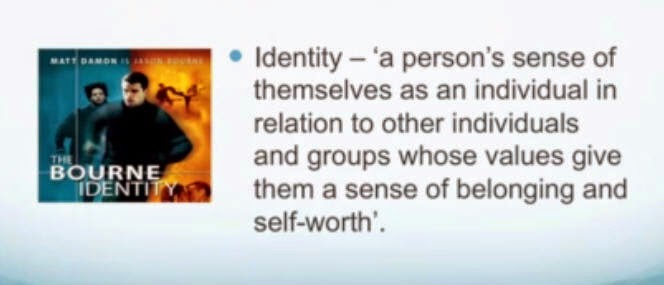
Identity - Richard's selected definition - The issue of self-worth and sense of belonging were delved into in the talk

Interesting definitions for "prejudice"
After presenting these definitions, Richard went on to re-visit his own history of accents, from his early Irish beginnings, to public school in England, to Oxford, to his current home in Birmingham. Certainly a story of accents!
There are some funny and interesting remarks in the fact that Richard's parents were born in 1926, the year of the "birth" of the BBC, as well as on the "official christening" of Received Pronunciation.

Richard's next step involved the discussion of reference models. We know about the current "embarrased" (sic) status of Received Pronunciation, all the prejudice associated with it as a prestige accent, and no wonder, given some of the (thought-provoking) quotes selected by Richard:

Richard reported a teacher's "protective" attitude towards a Scouse-speaking student, warning him of the how you may "lose marks" if you use your Liverpool accent. This type of prejudice is also taken up in a quote from the 19th century:

This idea of prejudice is ingrained and as the table below shows, which is far different from what many people may believe now, attitudes to accents and the role of accents may change and are, in fact, changing.  Richard makes a hilarious remark on this table, saying that probably the order would change if the question was "Who would you like to have on your side in a fight?"


Richard moves on to present a number of successful professionals, with a high level of proficiency in English, who may have some sort of self-loathing or a lowered self-image because of their accents, or because of the reception towards their accents. Some of these quotes show the role of accent and identity and the "perpetuation of the prejudice":


After listening to different non-native and native accents of English, and drawing on intra-speaker variation, Richard makes a point that accents are variable within the same speaker, and that they can be used for accommodation in different situations. He makes it really clear that we "should be allowed to be who we are".

The next point raised is that of reference models. Received Pronunciation does not have the "status" it used to have, particularly its "refined" version, and hostility towards RP is clear in many areas, as it reveals a "stigmatisation of privilege" (Geoff Lindsey). Richard makes a point that these models should not be attainment targets, just references to where students may want to approximate. But most importantly, "any accent of English is acceptable as long as it is intelligible"
A few other useful reminders Cauldwell has drawn our attention to:
  • English is no longer the property of the native speaker
  • attainment models are achievable learning targets, reference models are not and there are not too many native speakers of those models (Refined RP just for some Royal Family members and the Navy!)

And some thought-provoking conclusions by Richard, which I post in his own "voice":

A short Question & Answer session ensued:

1. Audience: What accent should we teach? If teachers teach with their own voices, isn't this confusing for learners? The member of the audience retells an experience of teaching with her own RP accent alongside another Irish teacher. Don't we need some sort of model?

Richard: There are lots of resources online to choose voices learners can aim to attain without having to go for a reference model. Learners can choose how to establish their identity as speakers of English.

2. Audience: To what extent can you modify your pronunciation?
Richard: It depends on own personal capacity to handle the input that comes in and moderate what comes out. But most importantly, there are some emotional filters that may give people high motivation, or maybe lead them to resist the acquisition of a target accent.

3. Audience: We have to admit there are many Englishes. So pronunciation is not very important for English at a basic level (sic).
Richard: We need to distinguish between production and perception. We have to prepare people to encounter many accents and produce something reasonably consistent.

4. Audience: Teacher working with multilingual classes. I modified my speech for my students, I don't use norhtern accents. If students change their vowels completely, that is not all right for me, that is my line. Spelling definitely affects pronunciation.
Richard: It is important to teach the issues between spelling and sound. But we should aim for intelligibility as a priority.

***
That was a brief report on Richard's talk.
You can read more on this in Richard's book and on this blog post: http://blog.britishcouncil.org/2014/06/09/what-does-your-accent-say-about-you/


***
Laura Patsko and Katy Davies: Practical ideas for teaching pronunciation and listening in an English as a lingua franca (ELF) context 

Laura and Katy introduce themselves as teachers working in multilingual context, with non-native learners of English from different L1s. English is their communicative medium of choice, and at times, their only option. They teach "English as a Lingua Franca", which represents the communicative reality of use in English accortding to statistics, and the pronunciation aspect is highlighted in their teaching as "pronunciation was biggest cause of breakdown of communication" (Jenkins, 2000)


The presenters covered the following areas in their talk:
  • How to know what to prioritise in an ELF context?
  • How can you "standardise" your teaching practice within this variation?
  • What practical ideas can you apply in the teaching of ELF pronunciation?

Establishing priorities for an ELF context
1. Conduct a needs analysis: 
  • discussion with students, knowing their needs and motivations for learning English;
  • diagnostic work:  listening to their pronunciation, identifying gap for intelligibility problems. For example: taking a dictation exercise between fellow ELF users (and not the teacher as the "authorised voice"), using sentences in the coursebook, and asking students to take down what their classmates are saying. This allows the teacher and students to identify areas of "high risk" for intelligibility.

2. With the newly-found data: Apply an ELF filter
Check the areas of the Lingua Franca Core and make decisions. The teaching techniques for pronunciation do not need to differ from those used in EFL contexts: minimal pairs, drilling, etc.

3. Come up with a syllabus, based on coursebook/teaching materials and data from the diagnosis
4. Adapting classroom practice


Some things to be considered for an ELF practice:
  • We need to help students become aware of what they are doing and why.
  • Students need to be conscious of the fact that accent is flexible, and that in an ELF context accommodation is important, and they should know how to modify their speech if necessary.
  • Students should be allowed to make choices.
  • Weak forms are not essential in the LFC but may be presented as part of receptive skills to be taught.
  • Focus on stress is important and textbook activities or tapescripts may be adapted to this end.
  • RP may not be a model in itself, but it is useful to teach spelling patterns and their connections to sounds.
  • The learners' needs are taken into consideration and not necessarily the native speaker norm. Students may be judges and models themselves, and teachers should support their choices, particularly if they are "informed" choices.
  • It is better, in a multilingual context, to encourage pairwork over groupwork, so as to enable students to improve comprehension on a particular task being exposed to one "ELF" variety at a time.
  • It is important to teach learners different chunks of language to ensure a smooth negotiation of meaning, request of repetition, or reformulation. 
Use of authentic materials

"Authentic" defined as "materials which have been created in English but not for the purpose of learning English".
These may be used to look for proficient users of English as a Lingua Franca and try both productive and perceptive skills:
Using scripts of these materials may help learners assess intelligibility over the native speaker norm.

Some conclusions by the presenters, inviting us to reconsider and revisit some assumptions:
Laura Patsko rounds off the session by quoting Robin Walker, and the need to re-think goals and the role of error, rather than modify classroom practices. 

Some questions ensued:

Audience: You said you only teach the "bird" vowel, do you teach diphthongs? 
L & K: Key thing on the LFC is length, even for diphthongs. Achieving a particular quality for a vowel sound is not important, but a particular consistent quality is, as well as to preserve length.

Audience: Brazilian speakers learn /θ/ by imitating "th" from speakers with a lisp.
L&K: Even though /θ/ is out of the LFC as it may be replaced by other consonants, it is true that we may get "models" and "tips" from unconventional places. It is also important to consider and question notions of "correctness" and focus on "variation". We ought to remember LFC is a set of features, not a model or variety.

Audience: How can we continue improving our pronunciation after finishing a course?
L & K: An example of a good resource, BC ESOL Nexus website. Watching snippets from videos may also help. 

Audience: Some learners still expect the native speaker norm.
L & K: Respecting students' choices is part of our job, and asking them why they are making the choices they are making is important to see if their choices are informed. Presenting statistics is important. Those "ELF moments" we have in the classroom can also help us to make a point.


***
This was my brief report on Laura and Katy's Talk.

***
Hope you have enjoyed this summary of the sessions.
No time for my own input on these today, but I promise a follow-up on this. I think that all the speakers in this session mentioned the reality of English today, but also considered the fact that attainment targets are to be planned by the teacher based on the expectations of the students, and the contexts of use students will be applying their English to. As a teacher trainer, this is a very important point, and I was truly hoping to hear these views made explicit.

Replay link available HERE.
Thanks for reading me!