domingo, 10 de abril de 2016

Pronunciation Integration #3: Word Stress & Word Formation

We all have our pet peeves as teachers. I have always dreaded international exam mock sessions, myself. I found those lessons to be endless, with my students filling in sheets and sheets of tasks piling up on my desk. Automatism in all its glory. (Mind you, I have tried for years to make exam preparation fun, significant, relevant, but when the moment for "exam rehearsal" came....it was just sheer torture for me). 

Anyway. One day, some six years ago, while browsing through exam sheets, something really, really obvious hit me: there is so much work on pronunciation we can do with our Use of English paper! I just realised this was my big chance to mix my two greatest sources of "suffering", and overcome this annoying feeling: I decided I would take those word formation exercises (Part 3 of FCE 2015 exam, for instance) to introduce Word Stress to my students. Oh, yes, English word stress! *sigh*

In other words, when we teach affixation (one of the many features of vocabulary), we can introduce, we should introduce, some features of word stress. In particular, we may plunge into the stress-fixing, -neutral or -attracting features of English suffixes. Affixation is one of the many links between pronunciation and vocabulary teaching, as was made explicit in a few pronunciation teaching books, like the volume edited by Jones (2016), and the beloved manual by Celce-Murcia, Brinton and Goodwin (1996, 2010). 

****

Important detour. A little bit of theory. Before we go any further, let's discuss  one of the ways in which we can define levels of stress/unstress in words. Cruttenden (2014) and Ortiz Lira's  "Word Stress and Sentence Accent" (1998)  define four levels of prominence that we can represent through inerlinear "tadpole" notation:
Levels of prominence. Based on Ortiz Lira (1998) and Cruttenden (2014) 
Tadpole interlinear notation.

(Note 1, elementary, Watson!: Stressed syllables are generally characterised by a change in pitch, and by generally being louder, and longer. These syllables obviously have a full and  strong vowel.)

(Note 2: Ortiz Lira (1998) has done a great job of explaining the differences between three tricky terms: stress, accent, and prominence. It is interesting to note that both him and Cruttenden include in their description a level of unstressed syllables treated as  "minor prominences"  only because of their full vowel quality, but not fully "prominent" in other ways ...though perhaps quantity may also be of interest here....)

This "word stress mess" that English is subject to is, in part, a result of the several linguistic "invasions" that have shaped the English language through history. There are two main tendencies operating in English word stress, one towards early stress (Germanic, Anglo-Saxon) and one towards late stress (Romanic, Latin). These two forces are always in tension, and etymology does not always help. As a result of this, in English we have secondary, and even, tertiary stresses early in the word when the main or primary stress falls on the last two or three syllables of the word: 
prəˌnʌnsiˈʃn, ˌɪnfəˈmeɪʃn
As you can see, there is also another important tendency in English  to avoid "stress clash" and keep an alternation of stressed and unstressed syllables whenever possible. At times, as in "pronunciation" and "information", this alternation is pretty mathematical: 1234, 1234, but this is not always the case. (See Ortiz Lira 1998 for a comprehensive list of stress patterns in polysyllabic words). So English word stress is a mess, yes, but there are a few rules we can cling to.

Now, as it happens, we can, to a certain extent, predict word stress in derivations (note that inflected forms are not subject to changes in stress). We can divide suffixes into three groups:


So if we know the stress pattern in the root, we can have an idea as to where the primary and secondary stresses may fall once a certain suffix has been appended to the root by knowing the behaviour of the suffix and also considering the tendency for alternation. (For a extensive discussion of affixation and stress, check Cruttenden, 2014 and Teschner and Whitley, 2004, and one of the appendices in Ashton and Shepherd, 2012). 

When we approach the teaching of word formation in the classroom, then, we should help our learners to become familiar with the rules associated to each suffix. What is more, we also need to aid them in creating a sort of "auditory template" for different word stress patterns. The last part of this post addresses this last point.
****

Around the same period of my "integration" discovery at secondary school, two of my colleagues were working in their Lab 3 courses with this great book series by the great Brita Haycraft, called English Aloud. Among many creative tasks, there are a few brilliant songs aimed at teaching word stress and suffixation, like the one I post below:

From: Haycraft, B.(1992)  English Aloud. Heinemann.

You can see the that Haycraft has included a "shSHsh..." pattern in the song (which is a sort of Bossa Nova, in fact!) to illustrate the stress pattern at the end of -ATION words. You can build our own battery of "noises" to "musicalise" the pattern. You can tap your feet on the floor, nod your head, clap hands or snap fingers to mark the different levels of stress. You can train your learners to hear the "beats" in their minds, the sort of "ringing effect" that stress has in our heads. 
You can also devise your own language, as Hancock (1996) has brilliantly done with his "DAda" language game (which we all love!). 

You can also resort to other Total Physical Response (TPR) activities to represent levels of stress, in what I like to call the "Equalizer game":
Credit: http://orig15.deviantart.net/7602/f/2011/054/f/0/f05bbbb5e1b31309a1a514c748f8ea5a-d26kux4.jpg
  1.  Make a row of chairs, one for each syllable in the words you are going to produce. 
  2.  Each student adopts the identity of a syllable, and stands in front of a chair. 
  3. When you produce a polysyllabic word, students representing unstressed syllables should sit down, and those who are on "stressed" chairs, should stay up. 
  4. Then each student produces the syllable that corresponds to them (and this makes a good opportunity to reflect on weak and strong syllables, by the way!)
  5. All students produce the word in unison.

This game can also be used for peer-assessment for both perception and production skills: you can ask a student to read out a word, and you can get the students by the chairs to represent the pattern produced by this student. The student's version can be compared to the teacher's, or to an audio version of the file, and corrected, if necessary.

Apart from representing the words you have uttered, you can work on melody-to-word perception by providing students with lists of words to be associated to certain patterns. You can hum or DAda word stress patterns for students to fill with actual words, so a possible task question could be:


Visual reinforcement and manipulation of objects tends to be very helpful as well to make these features "tangible". Many of you may be familiar with Judy Gilbert's "rubber band" technique to mark vowel length, which is useful to mark stress in some contexts (careful with pre-fortis clipping, though!). You can use the "tadpole" notation, or consider other ways of graphically illustrating stress patterns in words, such as plasticine balls or bars, or  an abacus:
Credit: https://upload.wikimedia.org/wikipedia/commons/8/8a/Abacus_34437.jpg
If you are feeling insecure about your own placement of stress as a teacher (no worries! we all feel that way!), you can use the recordings in the two most popular pronunciation dictionaries (LPD or EPD), or any online dictionary with sound recordings, for that matter. Forvo and YouGlish may also come in useful, though you may need to do some fact-checking first.

Finally, there are many songs in English that exploit rhyme with different suffixes, and you can also use them to teach word stress, since they can contribute to the building of auditory memory or images of these patterns. One of the most entertaining songs I have found is "When you are Old", by Tom Lehrer, very useful to discuss -ity endings:


***
These are some basic ideas to integrate the teaching of word stress to the introduction of word formation patterns in the English lesson. I hardly need to stress the importance of word stress, but if you need convincing, Gilbert (2008) has included this wonderful quote in her booklet on her Prosody Pyramid approach:
The stress pattern of a polysyllabic word is a very important identifying feature of the word . . . We store words under stress patterns . . . And we find it difficult to interpret an utterance in which a word is pronounced with the wrong stress pattern – we begin to “look up” possible words under this wrong stress pattern. (Brown 1990:51 as cited in Gilbert 2008)

Checking a word formation activity from an international exam mock in your class may turn out to be a fantastic opportunity to do pronunciation work, so I hope you, like me, will find a way out of boredom or fear by trying these tasks with your students!.

***
A Note on References: If you wish to learn more about the books I have referred to, click on all the authors' names on this post. The only material I do not have a link to is:
Ortiz Lira, Héctor (1998). Word Stress and Sentence Accent. Monografías Temáticas No. 16. Universidad Metropolitana de Ciencias de la Educación. Santiago de Chile.

lunes, 21 de marzo de 2016

A quick reflection on what this blog is about

Hiya! Sorry I have not been blogging lately. Life is a bit too hectic these days.

I have received a few private comments on my blog posts regarding the lack of "scientific rigour" of a few of the tips and tricks and ideas that I have posted, and I wanted to make a few things clear, at least in terms of how I see this, my own, blogging space.

First of all, I think we all agree on the fact that pronunciation is still neglected in the ELT classroom. Worldwide. Even the latest books on pronunciation teaching I have read (Grant, ed, 2014; Derwing and Munro, 2015; Jones (ed), 2016) acknowledge that. One of the reasons listed for this is precisely the fact that teachers are either given too scientific and technical explanations regarding pronunciation teaching (essential, in my opinion, I don't disagree) but then are not guided towards making these "teachable". So teachers either fail miserably in their systematisation of features, or leave pronunciation aside altogether.

In my context, Phonetics as a subject is "feared". There are a myriad of reasons for this, and I am not going to mention them here. I see many graduate teachers see Phonetics with "fear" and "respect", and that is the reason they feel unable to introduce pronunciation in their lessons. Many teachers believe that pronunciation teaching needs to be done "properly" (that is, in their own words, "in the fashion of Lab or Phonetics lessons at College"), and that appears to be impossible in the regular ELT classroom. The question is, should it really be done in this way? My answer, in each and every post, is "not necessarily" ("no", I would say, even).

So what can I say regarding these two facts? How can I, from my own Teacher Trainer perspective, address this? Well, I teach my trainees all the "hard-core" Phonetics bits, I try to be persuasive as to the need to actually know the theory, and why this is necessary in our own training, in the tough task of diagnosing and correcting learner errors and difficulties. I try to instill in teachers the need for constant reading, and permanent professional development. Then, I try to show them these "silly" (if you wish), "un-scientific" tips, which are the ones that can ground the theory onto our everyday classroom practice. So there IS matter in my madness.

Then there is the other problem. The "scientific" problem. Well, Teacher Training is but just starting to develop a more research-based approach, and it will take time (decades, perhaps!) before we can actually give our trainees all the tools they need to get started in research. Plus, in my context, Teacher Training is a tertiary level qualification, and it is, by many, seen as just the development of "teaching skills". It is, of course, not the spirit of the training you get at the places where I personally work, but that is the overall view, the "collective misconception" of what Teacher Training is. We all know that teachers are pretty much looked down on, and let's be honest, at least in my country, the working conditions for teachers are appalling. I honestly cannot blame a teacher who is just looking for "recipes" to handle a class of forty 13-year-olds who just want to get away. I cannot blame a teacher who needs a "hands-on" approach because she/he does 40-50 hours of teaching every week and needs to do all the planning and grading at home in their free time (me, for example).

Then there's the other reality. There are fantastic teachers out there doing great things in their classrooms, and they never get any credit for it. Why? Because they cannot make their voices heard in the wider academic communities. Lacking experimental research tools (which, by the way, I myself lack to some extent), these classroom experiences "get lost". At times, I see, in many conferences, that some presentations  get accepted  because of the "form", rather than the "content". And teachers that do not get trained in the "form", because Tertiary level institutions hardly get the time or the resources to train in research, are left out.  And teachers may not have time or opportunities to join university life, or start a Masters'. So this huge "black hole" is created, a "gap" that leaves the real, everyday classroom apart from what gets published, that is, what people at universities do in more controlled environments. (Truth is, most of the research I've read is conducted at unis in countries where English is the native language and subjects have the chance to speak English outside the classroom....definitely not our case at all).

I cannot blame, hard as it may sound, others who look down on events for teachers. In many cases, some presentations stay at the "edu-tainment" level, and hardly any theory, or research, is found.  I have seen presentations with no "References" slides, even. For some teachers, conferencing is the only kind of "training" they can afford, time and money wise. So then again, are we going to leave these teachers out? Are we going to "settle for less"?

So some people lack the "academic awareness" that we may, perhaps, take for granted. Others believe it is not necessary. What is my approach here, my choice? To balance reading and creativity, research and down-to-earth classroom techniques, the voices of the experts and the voices of my "local experts", those teachers I train who are really well-versed in their own classroom contexts. I have tried hard to quote specialists in my posts, to keep apart those reflection posts from book review ones, the bits of theory from the bits that express my own personal views.

I want my posts and Facebook page to cater for those teachers who know very little about Phonetics, and for those who know an awful lot about it; I want to reach those teachers who fear pronunciation, who do not know what to do in the classroom, and those who do a lot of pronunciation work and just need a few more ideas. I wish I could have the time and resources to make a serious, complete, well-rounded research paper out of every post, but I cannot, and I do not wish to do so here. My job is done if I can inspire at least one teacher to do some reading, to want to learn further, while at the same time help him/her get a clear idea of how to make pronunciation teachable. 

/maɪ tuː sents/

martes, 16 de febrero de 2016

Pronouncing....Sign Language - Report on a Lecture on Sign Language Phonology

I have not gone crazy. Well, perhapsI have, but I am certain that after reading this post you will understand.

This week I am really lucky to be able to attend the first summer school in Linguistics in Buenos Aires (ELBA), organised by a group of young linguists from the University of Buenos Aires. One of the courses has truly fascinated me, and it is on the linguistics of Sign Language. Today we discussed the Phonology of Sign Language, and yes, this is exactly what this post will be about. I will be discussing a few issues that were presented on the lesson, and also refer you to a few reading materials and links I have found interesting.

***
The course I am taking is "Current Issues in Sign Language Linguistics", and it is led by Josep Quer, from ICREA & Universitat Pompeu Fabra, Barcelona. Among the interesting things I suspected regarding Sign Language (SL) before this course, and which I can now confirm, I could mention that SLs are not "pantomime systems", they are not generally based on the spoken languages in their communities, they are neither sign systems nor manual alphabets (which are just secondary representations of language), and they have really complex (and interesting!) structures, which are even open to sociolinguistic variation. Fascinating. 

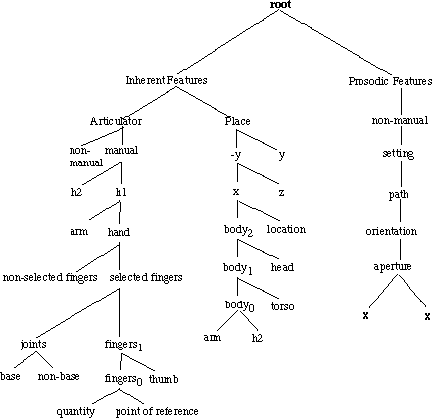
Now to Sign Language Phonology. The study of SL Phon started in the 60s with William Stockoe. He found that in SL there are three categories (or parameters) that can bring about differences in meaning and are combined according to language specific-constraints (thus leading to the creation of minimal pairs): handshapes, locations (or place of articulation) and movements. Each "phoneme", in fact, each segment, has got an internal structure made up of at least one handshape, one orientation (direction), and one location . Optionally, it may present movement (sometimes repeated), and non-manual components. The simultaneous and sequential combination of these parameters makes up the usually monosyllabic signs. (BTW, you can see some minimal pairs here)

The articulators that signers use include hands (dominant, and non-dominant) and arms, but also the head and trunk with their parts. Signs can be one-handed, or two-handed. Two-handed gestures are constrained by the conditions of symmetry and dominance (Sandler, 2002, clearly explained here). There may be mouthings (derived from spoken language), and also mouth gestures.

The features making up handshakes include the description of which and how many fingers are active, and whether these are "straight, bent, flat or curved" (Brentari, 2012), that is, the selection, quantity and joints of the fingers. The features within place of articulation or location are connected to where in the body the signs are placed (head, arm, torso, cheeks, eyebrows, etc), and the plane (horizontal, vertical, midsagittal). The features of movement include orientation (towards the speaker or interlocutor with the wrist or forearm), path (displacement of hand in space), setting (high, low, ipsi, contra, distal, contact), aperture of finger joints. The status of transitional movements between signs is a problematic issue, as is the establishment of what features could be deemed linguistic and which, paralinguistic, in some circumstances. 
Brentari's model. Credit: http://www.sign-lang.uni-hamburg.de/intersign/workshop2/brentari/brentarim.gif

Beyond the segment, we learned that a syllable in SL is made up of the combination of a location + movement + location. Sentence accent and intonation in connection to foreground and background information can be marked with a change in the dominant hand (keeping the background information with the non-dominant hand, or H2 and moving on with the dominant one!), and specific intonational meanings can be expressed with facial expressions. Non-manual gestures with the use of eyebrows or the lips, for example, however, may also be part of specific signs. Changes in "volume" may be effected through the use of wider or narrower, bigger or smaller signs, which could resemble shouting or whispering qualities in spoken languages. The combination of signs, and even processes of compounding, exhibit very interesting cases of assimilation and deletion! (Some examples of some of these issues here)

Sign Language Phonology appears to be a fascinating field, and I hope you have found it as appealing as I have!

***

A few references recommended by Prof. Quer:
  • Sandler, W. & D. Lillo-Martin. 2001. Natural Sign Languages. In The Handbook of Linguistics, eds. M. Aronoff & J. Rees-Miller, 533-562. Oxford: Blackwell. 
  • Brentari, D.. 2012. Phonology. In Sign Languages (Handbooks of Linguistics and Communication Science, HSK), eds. R. Pfau, M. Steinbach & B. Woll, 21-54. Berlin: Mouton de Gruyter. 


A few links I have found interesting:
Enjoy! (In American Sign Language - Font downloadable from here)


viernes, 12 de febrero de 2016

Podcast-y reflection #3: Pronunciation Teaching and Mindfulness

This is a very brief reflection, recorded in a slightly mindful moment, about the contributions that mindfulness could make to pronunciation teaching, or at least, why I believe it is important to consider including this practice of "being present" in our lessons.

It is just a "reflection in passing", perhaps presenting more questions than answers, and inviting you to come up with your own tips and conclusions. For me, this is just the beginning of a huge number of thoughts and ideas that go round and round in my head (endlessly, like a Mary-go-round...).


Note #1: I have misplaced the stress in the word "concrete". It should be /ˈkɒŋkriːt/ (LPD, 2008). I have also mispronounced a very, very important word, "proprioception". It should be /ˌprəʊp ri‿ə ˈsep ʃən, ˌprɒp-, -əʊˈ•-/ (LPD, 2008).
(There must be a few more "errors", but I noticed I was not getting these correctly the moment I uttered them....mindful?)

Note #2: In the recording I mention Adrian Underhill and William Acton. Click on the names to access their websites and hear what they have to say regarding pronunciation teaching!.

Note #3: There are lots of resources on the Web regarding Mindfulness. These are just two links you may consult just to get started:
https://www.psychologytoday.com/basics/mindfulness
http://www.mindfulnet.org/page2.htm


Have a nice week!

domingo, 24 de enero de 2016

Review #3, Part 3: "Pronunciation Myths", edited by Linda Grant

Hi! My two previous posts (Part 1 - Part 2) reviewed the first four pronunciation myths, debunked by well-known pronunciation and phonetics specialists in the book "Pronunciation Myths", edited by Linda Grant. This post will mark the end of the review of this enriching, thought-provoking, book. Remember this is an informal review, with a few intrusive observations and reflections of my own.

(Warning! This is a very long post, so you may want to bookmark it for later reading.)
***
Myth 5: Students would make better progress in pronunciation if they just practiced more - Linda Grant

This chapter begins with a reference to the film "The King's Speech", and an "inconvenient truth" : "long term speech characteristics can become an integral part of who we are" (Grant, 2014, "In the Real World", para. 5), which is why many people decide, consciously or unconsciously, not to introduce any changes to their accent. Citing Dalton and Seildhofer (1994:72), Grant reminds her readers that  there is no "one-to-one relationship between what is taught and what is learned" when it comes to pronunciation. (And yes, we know that too well!)

The next section discusses aspects which have always been present in the debate around second language pronunciation, such as the role of age. Different studies are described which prove and also refute the effects of the Critical Period Hypothesis (Lenneberg, 1967) as far as the issue of accentedness is concerned. Grant believes the research in fact shows that it is social and psychological factors rather than neuro-biological changes that make the utmost difference in the end.
Another construct reviewed in this chapter is Lado's Contrastive Analysis Hypothesis. Some studies reported found that students whose L1 was similar to English had more English-like accents, but it was also reported that L1-L2 differences sometimes promote learning (in-keeping with Major's Similarity-Dissimilarity Hypothesis), since these are at times more perceptually salient than similarities. Grant finishes this section by revisiting the concepts of positive and negative transfer, both presented as inevitable processes in L2 pronunciation acquisition.

Grant later examines the role of exposure and use of L2 as a positive contribution to a learner's pronunciation achievement, especially in terms of fluency and comprehensibility. The other big factor was length of residence, though it was proven that it was not as effective as the actual frequent use of L2 outside the classroom. 

The following aspect reviewed by Grant is the role of psycho-social factors in the attainment of L2 pronunciation. Issues of identity, motivation, attitude and inhibition are discussed in this section. Studies reported include those examining the roles of intrinsic and extrinsic motivation, issues of allegiance to their own L1 ethnic group, and identification. I personally believe this is THE issue to consider when it comes to success in pronunciation learning.

The author recaps then some of the most important factors related to the attainment of an L2 pronunciation, but concludes that research has not yet established what is the relative impact of each of these variables: "age at the onset of learning, similarities between L1 and L2 phonologies, extent of exposure to and use of the L2, and affective factors (...), aptitude and natural talent". The research reviewed, however, does give teachers some basic information as to what aspects affecting L2 pronunciation can be addressed, and need to be tackled. (See my post on pronunciation goals for my own take on this) 

Grant draws her chapter to a close by providing some practical suggestions: a) set realistic goals in partnership with our learners, giving more room to intelligibility over accentedness, and engaging students in setting their own personal goals; b) set interim goals to sustain student motivation throughout the course. This second point refers to what Wong (1987:8) has found regarding pronunciation achievement: "dramatic changes in student speech in 3 to 6 months are rare". (Well, I would personally have to read the study, because in my context this does not hold true at all. I guess this is true for a particular number of contexts with a specific set of characteristics...But I do grant them that my lessons are entirely pronunciation-based...). I do agree, however, that short-term goals, clear focus on specific features and assessable targets are a great "carrot and stick" for students not to give up. Suggestion c): increase student engagement by individualising assignments. Oh, yes. As I always say, "pronunciation teaching is a craft". There is a lot we can do with our students as a group, but there is an awful lot we need to do with our students on an individual basis. In this respect, Grant includes self-assessment sheets and rubrics for students to grade their own recorded assignments, for example. Suggestion d): ask students to maintain pronunciation logs. Even though Grant mentions examples that affect learners in which learners can use English outside the classroom, it is true that keeping track of the changes, breakdowns and challenges one encounters in the process of learning pronunciation is a great way to see how the process unfolds. I would have loved to have a diary for my Lab 1 course, I would have loved to see how I personally felt about having to "unlearn" my Spanglish accent and my own mental view of what English was like to get to the less Spanglish accent I have now (I have been listening to my Lab 1 cassettes, though...). Suggestion e): Maximise student exposure to English outside the classroom. This set of ideas includes ways in which we can introduce home practice as well using websites.

A final observation includes the importance of giving considerable amount of time to pronunciation instruction in the classroom, thus the need for integration for it to be an  everpresent priority.

***
Myth 6: Accent reduction and pronunciation instruction are the same thing. By Ron Thomson.

This chapter warns the readers of the dangers of falling into advertising traps when it comes to selecting your tutors for accent reduction clinics or courses. By means of a few anecdotes, Thomson clarifies that many immigrants fall prey to deceit because they erroneously believe it is their accent that impedes successful communication and/or integration, whereas "L2 learners' perceived need for accent reduction is often the result of factors unrelated to pronunciation".


The premise to this chapter is that accent reduction and pronunciation instruction are different things, and for this, Thomson quotes Derwing and Munro (2009) with their description of three approaches to characterise programs as following a a) business, b) medical or c) educational model. Accent reduction is generally associated with the business model, accent "modification" with the medical approach, and pronunciation instruction with the latter.

The rest of this chapter reviews a considerable number of Google searches and website descriptions of the language used and the underlying assumptions of a few services offering pronunciation instruction or accent reduction services, some of which are compared to programmes that offer "miracle diets" (Lippi Green, 2012), and go unregulated. The review of programmes includes details of materials, costs, instructor qualifications and claims, which show how vast the offer is, and how confusing advertising could be in some cases. The chapter ends with a few proposals, including the need for provision of "ethical pronunciation instruction" that shows understanding of psycholinguistic, social and personal dimensions of foreign accent. Another major suggestion is that teachers "give more attention to pronunciation instruction as part of English language classes" and also to propose language programs to hold "stand-alone" pronunciation courses if possible. The discussion of this section ends with a set of practical tips as to how to avoid "charlatans".

This chapter left me thinking about a huge number of things. I find myself in a context in which I would say we do "accent modification" or "accent reduction", even, but our model is educational in nature, as we train teachers-to-be. Instruction in our context is carried out by specialised professionals, and the focus is mostly towards a native-like accent (pretty much in the same way other subjects attempt to help students to reach a native-like grammar or use of lexis...), while also training teachers to teach for different purposes (or so I hope). I guess we are all truly aware of the claims to the impossibility of reaching a native-like accent -we, pronunciation teachers, I think, are the best pieces of evidence for that, however obsessive we might be about our accents-, but even so, in our teacher-training context, we have many students who want to reach native-like proficiency (and many who do not, of course), and we work with them towards this goal (yes, there is a lot I could say and be critical about regarding this and a million other issues, but not today!) . I have to say I am lucky to be in a group of institutions in which I have the opportunity to do serious pronunciation instruction work and provide one-to-one moments of feedback, in spite of large classes.  As I always say, pronunciation teaching is a craft, it cannot follow a "one-size-fits-all" model, since what works for one student may not work for the other. We can provide tools to the whole group of students, but feedback and fine-tuning practices need to be individualised and I hope this is something I can pass on to my students with my own feedback practices.

***
Myth 7: Teacher Training programs provide adequate preparation in how to teach pronunciation, by John Murphy.

This particular chapter is closely related to my current context, as I am a teacher trainer myself. For some reason, I never seem to find a book on pronunciation that will keep me "happy", though there are some good materials out there (my personal favourite being Celce-Murcia, Brinton and Goodwin, 1996, 2010) There is always something "missing" in these materials, something that drives my teacher trainees to be good, creative task designers, but at times "poor systematisaters". I try to make it my job to train teachers to actually make the presentation of features right, since after all, no matter how creative a task can be, if the teaching of the feature is not successful or well planned, the whole class plan will very likely fail anyways.


Now, off to the chapter. Murphy begins by retelling a personal experience teaching at a MATESOL course. One of the findings Murphy made in this journey is that pronunciation needs to be taught "within a framework of spoken communication". The author's account serves to introduce the question of confidence and knowledge that teachers may or may not feel they have when it comes to pronunciation teaching.

The research cited by the author includes issues of "teacher cognition" as a fundamental part of what should be the knowledge base for teaching, which includes, of course, knowledge about language, knowledge about second language acquisition, and specialist recommendations about pronunciation teaching. I think Murphy introduces a very important point here, that of the need to dive into teachers' beliefs, perceptions and understandings in order to help them build effective pronunciation teaching practices.

The author includes a table of research reports carried out by different experts and authors in different countries using different instruments, which in turn inform the report Murphy is introducing in this chapter. Some of the key points reviewed regarding teacher cognition include: a) teachers feel unprepared to teach pronunciation because of lack of training; b) there should be a clear focus on the pedagogical aspects of pronunciation teaching; c) previous experiences learning foreign languages have a bearing on the way teachers approach (or not) pronunciation teaching; d) teachers should be introduced to ways of teaching assessing pronunciation for intelligibility, introducing modern technologies and working on integration to the general ESL lesson.

I need to digress again, since this touches directly into my context. I lecture at three Teacher Training Colleges, and in all three, trainees are exposed to a minimum of two, and a maximum of seven (!) periods a week purely devoted to Phonetics and pronunciation, and in the last two years of the course of studies, also to pronunciation teaching. In two of these colleges, teachers have stand-alone pronunciation courses in all four years of training. That is an awful lot (and I am grateful, because it does show in most of trainees' pronunciation), but I sometimes fear these students may not still know how to approach pronunciation in their lessons in spite of all the input. At times, it is just a matter of giving teachers a few tricks and principles to "light the match", (and see the sparks in their eyes appear! Oh, joyful moment!), together with some consciencious reading of pedagogy and acquisition, and a "trip down memory lane" to their own experience learning the accent, but in some other occasions, I find teachers still get really "petrificus totalus" (yes, another HP reference) about this whole pronunciation teaching business. So much to think about....Anyway.

Murphy quotes Borg (2003, 2009) and eight findings on teacher cognitions, which is worth direct citation since they are spot on, in my opinion:
Murphy (2014) in Grant (ed). Amazon Kindle Edition: Position 3272 of 4350
There is another interesting reference, to Gregory (2005) this time, which describes the fact that teachers are rarely given the chance to immediately apply in real classrooms, or even among peers, all the declarative knowledge they attain.

The last sections of  this chapter contain  fantastic remarks for us, non-native speakers of English who have trained as FL teachers. Murphy reminds us that our training in pronunciation as learners will help us understand what our learners are going through. Our own learned accent can be interesting and relevant models for our students, as long as it is intelligible, comprehensible, and only if the teacher is "aware of what some of the more prominent accented characteristics of his or her own speech could be" (oh, yes, I have my own list!)

The chapter presents a few suggestions as to what can be done in training programmes, and also a review of resources for pronunciation teaching and practice which are worth exploring, also listed as an appendix. A second appendix describes sample topics and syllable tasks that can be applied at graduate level. (Not to be missed!)


***
Epilogue to the Myths: "Best Practices for Teachers", by Donna Brinton

Brinton opens the epilogue by referring to a personal anecdote that supports her belief that we interpret the stream of speech in the foreign language by referring to our L1 and other languages we may have learned; and also that learners tend to process lexical chunks at the level of syllables/words/phrases, rather than phonemes.

This final section also introduces a very interesting list of "core knowledge and skills needed for L2 teachers to address pronunciation in the classroom", collected by Chan, Goodwin and Brinton in 2013. The list includes conceptual, descriptive and procedural knowledge, and it is truly worth reading (there is a copy of this list, presented by the authors at CATESOL 2013, here).

A second gift to the reader by Brinton: A summary of ideas and "best practices", including: a) the connection and separation of the concepts of intelligibility and accentedness, and a list of features contributing to the former that need to be trained in the classroom; b)  the fact that not all pronunciation features have the same relevance for intelligibility;  c) the finding that segmentals are critical building blocks of the sound system, but they need to be taught in terms of intelligibility needs, and also guided by functional load concerns; d) the tendency that claims that L2 adult learners may not reach an "accentless", native foreign accent; e) the fact that pronunciation learning is different from the learning of grammar or vocabulary, as it involves other modalities; e) the need to recognise the relation between perception and production, which is why it is important to introduce awareness raising activities to build new perceptual categories; f) the awareness that explicit and targeted feedback is truly beneficial; g) success in pronunciation learning depends on a myriad of factors, including age, motivation, identity, exposure, opportunities for real practice outside the classroom , and these need to be considered in our planning; h) L1 does have an influence on our acquisition of L2 pronunciation; i) exposure to authentic language is essential, including an analysis of processes of connected speech, that show the reality of speech "out there".

***
And so my review ends. My verdict? Pronunciation Myths  is... a really insightful book, with discussions that probably describe pronunciation teaching issues worldwide, and a few other points and claims that can be questioned if seen from different locations and instructional contexts. A wealth of ideas, tips and tricks. And more importantly, in my opinion, a huge reference list of experimental, bibliographical, educational and also informal research that does not only "preach to the converted" (as a friend always says), but which may also, hopefully, persuade the sceptics, and the fearful.

miércoles, 30 de diciembre de 2015

Some "inconvenient truths" of pronunciation teaching

2015 is coming to an end and once again, I wanted to thank you for following, reading and/or criticising this blog. 

This post is a very brief reflection on some of the many lessons I have learned this year, out of reading good books, interacting with my experienced colleagues, but also, and more importantly, after considering the feedback and success or failure of my best teachers, my students. I don't want to elaborate on these ideas at length, since there is a lot to say about each, but at least I wanted to list them here today. Who knows, I might write a few posts on these thoughts in 2016.

These are some of the "inconvenient truths" that I believe every EFL teacher needs to embrace when it comes to pronunciation teaching:

  • Pronunciation is a "messy" matter. Things may definitely go awry, discipline-wise, when we do pronunciation work. Pronunciation tasks may turn out to be "ridiculous" for students, and they will most certainly be "noisy".  The development of these activities requires a lot of control and attention on the part of the teacher, a lot of moving around the classroom to monitor what students are doing; keeping your eyes open for possible peer bullying or ridiculing, and yes, it may be tiring. We may need to decide very carefully on our timing (the last few minutes before the bell goes?) if we have a difficult group, we may need to change seating arrangements, or establish a "safe" routine. We, of course, also need to make sure our students understand why they need to work on their sounds and intonation in the first place. All in all, pronunciation "chaos" is an issue we have to anticipate, but it should not scare us away from integrating pronunciation to our lessons regularly.
  • Non-native teachers of English can be good models and instructors. This is something I heard Robin Walker state many times. I think we should never underestimate the process that each of us, non-native speakers of English, has actually been through to build our accents. We can use all this knowledge of our L1 and of what it takes to learn a foreign accent to our and our students' advantage. At times I get a bit cross at teachers systematising sounds only by introducing videos or animations of native speakers producing the sounds. I think that our presence and constant input in the classroom can be a great asset to our students as well, and we can demonstrate the production of the sound ourselves, "live", in many different ways (see my "tips and tricks" post), apart from the introduction of native speaker voices (or other voices, if you are using other L2 speakers as models, which you can read about in the ELFPron blog). There is also a corollary: perception and production may go hand in hand, though we need to ensure exposure to a number of different accents and voices, while perhaps selecting one variety for perception (already a tough issue!).
  • Student success depends a lot on psycho-social aspects. As I listed on my post on pronunciation goals, and on my review of the book "Pronunciation Myths", motivation, feelings about the foreign language, rapport with the teacher and fellow students,  they all have a major bearing on student performance. This is something that needs to be acknowledged from the very start, and the more we get to know about students' expectations and views on this, the better. Students need to appropriate the process and the new articulatory moves to make sure there is progress. This is a tough and very complex issue, and I personally need to work it out still.
  • Pronunciation is a matter of the mind...and the body (and the heart, given the previous bullet point...). This is quite obvious, you might think. But indeed, we need to remember the implications of working with people's bodies. We are, metaphorically speaking, the "fitness instructors" of our students' speech muscles and organs, perhaps their "physiotherapists", in a way. We teach our students how to become aware of what their organs do, and how to make changes to their speech with different exercises, different "dance" or "fitness" routines to develop their proprioception abilities (You can read a lot about this on Adrian Underhill's blog, by the way!). Plus, giving students feedback on their performance is not the same as making corrections on a written composition, and this requires great care and kindness; it's a skill I personally have been trying to learn for years, and I have not always succeeded in.
  • Proper pronunciation teaching resembles the work of a tailor or a craftsman. I have recently realised there is no "one-size-fits-all" approach to pronunciation. Part of the systematisation process can be carried out with the group as a whole, but the ultimate fine-tuning processes need to be developed on an individual basis, and this requires getting to know our learners individually, testing different approaches and strategies, giving lots of personalised feedback, and this, means investing quite some of our own time, yes. And it is also a craft for us to learn; I have been doing this for years and still have a lot of questions, I keep discovering a lot of new ways to approach things, and I pretty much suspect that as times change, practices will have to change. So all in all, pronunciation teaching and learning make up a very personal process of discovery, of constant reflection, and as such, it only works if we help our students become aware of the inner workings of their speaking body, help them create different mental images of what the foreign language and its accents sound like, and invite them to ask themselves the right questions to be able to keep up with the times.

And some of my beliefs, omnipresent in this blog:

  • Pronunciation can be seamlessly integrated to other areas, content and skills in the ELT classroom.
  • Pronunciation work can be fun.
  • We need to teach intonation, and do so communicatively, and in context.
  • Teaching pronunciation requires, as with other content areas of language, some serious research and study on the part of the teacher.


Finally, two new discoveries I've been trying to develop into coherent thoughts:
  • Success in a foreign language pronunciation is partly dependent on our ability to be mindful.  (A podcast-y reflection on this coming up very soon)
  • Learning a foreign accent is in a way a process of appropiation. The big challenge is finding and loving our own L2 voice. (Some Harry Potter-inspired reflections on this here)

In summary, I think pronunciation teaching is by far, a greater learning experience for the teacher than it might be for the learner in the long run. I honestly thrive in all the lessons I keep learning, and I hope I can still continue asking myself questions to improve on my practices. And to keep blogging, of course (BTW, it does feel like this...)
Image from: https://missglayiii.files.wordpress.com/2011/07/hp4_17.jpg

I want to wish you all a lovely start of 2016. 'kiːp 'kɑːm ən prə'naʊns 'ɒn

miércoles, 2 de diciembre de 2015

Review #3, Part 2: "Pronunciation Myths", by Linda Grant.

On my previous post I briefly reviewed the Prologue and the first chapter of the Kindle book version of Pronunciation Myths: Applying Second Language Research to Classroom Teaching. (BTW, I am trying to come to grips with the way of citing Kindle books....the lack of pagination can be maddening! So I hope you will excuse the lack of page numbers for the quotes. I will, in the future, try to adopt the approach in the APA guidelines (that is...counting paragraphs and all that jazz!): http://blog.apastyle.org/apastyle/2009/09/how-do-i-cite-a-kindle.html)

This time, I will be discussing the research reviewed in the book to debunk Myths 2, 3 and 4. These chapters were written by Beth Zielinski & Lynda Yates, John Field, and Judy Gilbert, respectively. 
(Warning: It is quite a long post!)

***


Myth 2: Pronunciation Instruction is not appropriate for beginning-level learners - Beth Zielinski and Lynda Yates.

I was particularly interested in this chapter, since I remember with great shame my very first class in Italian, and my first lesson in French. I was already a graduate teacher of English and I was in awe at both my new teachers, who spent the first half hour or more discussing the sounds of the languages I was about to embark on learning. The same thing happened to my colleagues learning Portuguese. Why is it that most teachers overlook this very important first introduction to the pronunciation of English language during the first lesson? Isn't this the perfect moment to plant the seed of curiosity and to start drawing students' awareness of the noticeable differences between their L1 (Spanish, in my case) and English?

The very first point the authors make is that pronunciation does indeed affect both intelligibility and confidence to speak, as previous research has found, at least in a context where English is spoken outside the classroom. It is claimed that beginnning learners do care about pronunciation, and that the later students are introduced to it, the more limited their improvement will be. Zielinski and Yates favour both the introduction to metaphonological knowledge and awareness, and incidental teaching and correction. They underline the fact that instruction also enhances on other, less "assessable" skills, such as confidence and understanding, and this was found in the action research projects in Springwall (2002).

The authors of this chapter propose following a systematic approach to instruction following four stages: a) listening and awareness, b) control, c) practice, d) extension.

I want to highlight the essential remark made in this chapter, which is that pronunciation is a spoken skill, and however obvious this may sound, we at times forget about this when we carry out reading aloud tasks and select texts to that end. Lexico-grammatical and discourse-semantic choices differ greatly in the spoken-written mode continuum, as those of us who do Systemic Functional Linguistic work very well know.

A few other reminders are made on this chapter, regarding the use of different "modalities" (i.e.: learning styles); provide targeted feedback, immediately or in a delayed form, depending on the task at hand; have one pronunciation goal in every lesson, in combination with other areas and skills; introduce a variety of activities. The authors suggest that readers consult the AMEP Research Centre in Australia website for ideas.

***
Myth 3: Pronunciation Teaching has to establish in the minds of language learners a set of distinct consonant and vowel sounds - John Field

John Field addresses a very interesting topic, and begins with a number of thought-provoking questions: "a) What is it that we expect learners to store in their minds during ear training? (...) b) How confident are we that storing a phoneme in the mind in some way enables the learner to recognise it when it is heard again in connected speech?". Apart from recognition, Field also questions how much of this "storing" of sounds actually contributes to production as well.

The research review reports on some truths we sometimes forget about: phonemes do not have a "standard" form because of the multiplicity of allophones they may be realised with, and because of all the phenomena involved in co-articulation. This is why training via minimal pairs does not always work as a form of enabling the later recall of phonemes. A clear implication of this is the need to expose learners to the sound in different contexts and in different word positions.

The rest of the chapter unfolds under the scrutiny of two theories that present assumptions in the ESL world:

"A- Although phonemes vary a great deal, any example of a given phoneme has characteristics that distinguish it from all others."

Field notes a first very important truth "the raw speech reaching the listener's ear is not a string of phonemes but a series of acoustic cues that the listener has to match to phonemes". The author reports studies carried out by Liberman in Yale in 1957 that attempted to somehow find "quintessential" (my own interpretation of the study) characterising features of English phonemes, but did not find features which were unique or exclusive to each. Plus, they found that speed had an effect on the perception of phonemes. The perception of consonants was found to be categorical, whereas perceiving vowels requires a distinction between three formants. There are no "constant" values to identify vowels, as we know. So this first theory in a way appears to be quite weak, since as Field concludes, "there is no simple one-to-one match between a group of acoustic cues and a phoneme".

"B - We store a set of 'ideal' phonemes in the mind, against which to match what we hear."

This assumption is related to the belief that our mind cancels out unusual features in the perception of sounds so as to match them to the closest "ideal" phoneme around. This view is related to  the notion of "prototype" (Rosch, 1975) or "template" against which all other manifestations of a word or phoneme are contrasted, and this makes for an economical view of the work the mind carries out in perception. However, Field argues that research by neuroscientists has proven that the mind is capable of more complex forms of storing, and that individual variation of phonemes due to coarticulation also acts counter to the "template" rule. 

(BTW, these two very interesting questions are currently being addressed by Richard Cauldwell in his "Listening Cherries" blog, and in his book "Phonology for Listening (2013)".)

Therefore, three alternative theories are put forward, which claim that a) the phoneme is not the unit of representation we use when we listen; b) the phoneme is just one of the clues used, perhaps not the most important; c) our minds store many variants of the phoneme heard in different contexts and voices.

Regarding a), Field reports studies that have found that listeners need to access the word, the "demi-syllable" (Dupoux, 1993) or the syllable in order to identify the number of phonemes. In this respect, the author believes that teachers should focus on high-frequency syllables as units of perception.

As to theory b), Field notes that phenomena such as ambisyllabicity shows the complexity existing in the recognition of syllable boundaries, and extends the list of cues employed by listeners to include phonemes, words and lexical chunks, and these are supplemented by contextual and co-textual elements. Research by Marlsen-Wilson 1975 has revealed that apparently we "process speech as we hear it at a delay of about a quarter of a second" and that we are actively making hypotheses as to what we believe we have heard, fine-tuning our perception unit by unit. Studies on L2 perception have found that learners "do not trust their perceptual skills in relation to smaller units of language", and they use a more "constant" unit, the word. However, as we know, words also vary, as Cauldwell (2013) states, by adopting different "shapes" in the stream of speech. So Field believes that perception should be trained at the level of the syntatic and lexical chunk as well.

The remarks made by Field regarding the last theory are quite fascinating. It seems that we store in our minds a large number of versions and examples of phonemes and word shapes, and we activate our memory of these items. The teaching implications that Field mentions include the need to expose learners to different realisations and accents, and reviews studies by Pisoni, Lively and Logan (1994) in which this kind of variable ear training was found to be effective. 

Field suggests that teachers should work at the level of the syllable, by working on common syllable patterns and recognition of syllable boundaries, as well as for stress. Later, instruction should be driven into larger units, by proposing "word activation" tasks to predict lexical items to be encountered, as well as "gap fill" activities with typical lexical chunks and their reductions and variation (Field introduces an interesting appendix on this). Focus on function words also acts as a good training exercise to identify changes in speech. The author also proposes exposing learners to many accents, voices and contexts following a gradual progression, in order to create "memories" of different sound and word shapes.

I found this chapter particularly fascinating and thought-provoking. I think it also bears great implications for production, since at times our students attempt to produce these "ideal" phonemes in contexts that in fact require a number of variations due to co-articulation. Even though we may teach allophonic and phonemic rules for different processes, students at times only produce strings of "ideal" phonemes, as if they were putting together a puzzle of individual sound shapes instead of making all the changes and adaptations that the surrounding environment of neighbouring sound requires. A lot to continue pondering on...

***
Myth 4: Intonation is hard to teach - Judy Gilbert

Those of you who know me will have guessed that this is one of the chapters that drove me into buying the book. There is such a huge gap in intonation teaching (for a huge number of reasons, some of those listed in the chapter), and there is so much that could be done in this respect....Anyway.

Judy Gilbert begins with the retelling of a few anecdotes regarding misunderstandings and intonation. She believes that one of the problems with intonation teaching is that it is filled with "too many abstract concepts.....that tend to blur the specific teaching point". Studies by Kang and Pickering (2011) on comprehensibility highlight the role of intonation for listeners to "confirm if an item is new or one that they are already aware of, to track important information, and to predict when one topic is ending and another is beginning" (2011:6). A stronger focus on prosody in the language lesson is also recommended by Derwing and Rossiter (2003) in order to make students' English more understandable. 

Gilbert reminds her readers that the "basic signals of rhythm and melody specific to one's first language are generally learned by the time a child is one year old". This affects the way we may produce our L2 intonation, and the way we perceive other people's intonation, which could lead to cultural misunderstandings, as well as communication problems, especially when it comes to inaccurate stress choices.

The author discusses some of the reasons behind teachers' uneasiness when it comes to intonation teaching, such as the lack of "friendliness" of intonational descriptions. The first "discouraging approach" is the set of technical rules based on grammar; the second relates to "technical rules based on pitch levels" drawn by phoneticians who cannot establish an agreement when it comes to "meanings" . Gilbert also nots that in these models, the different manifestations of pitch levels which are at times presented as absolutes, instead of as gradient. The third approach seen as "uninviting" is what Gilbert calls "subjective rules based on intuitions about attitude", which is "anxiety-inducing" (Roach 1991:165) Gilbert makes a point of the fact that attitudes are "culturally or contextually dependent", and that most attitudinal descriptions of intonation have applied conflicting values to different pitch levels and emotions. It is also establised that attitude is never expressed by intonation alone.

Gilbert moves on to present different proposals for the teaching of intonation. The first suggestion is to draw students' awareness as to how their L1 and English differ in terms of information delivery, since English uses specific prosodic signals (change in pich, lengthening and "extra clarity" of the vowel in question), and other languages may perhaps employ other non-prosodic features, such as word order. Another suggestion includes the teaching of intonation as a priority, done contextually in dialogues. The next idea is related to the teaching of "listener-friendly" intonation, intonation that helps the listener "follow" what the speaker is saying in the belief that "time spent helping students concentrate on the major rhythmic and melodic signals of English is more importnat than any other efforts to improve intelligibility". However, Gilbert warns teachers that learners may not believe the teacher when it comes to the introduction of intonation, and that they may feel silly trying intonation tasks, which in a way implies that the teaching of prosody is also an act of "persuasion" (and I agree entirely!). Creating activities that may focus on miscommunication or ambiguity, and which require immpediate communicative feedback, may help to debunk this view. Gilbert reminds her readers that one of the clearer benefits of intonation teaching include the fact that suprasegmentals fit nicely into communicative settings. 

Next, Gilbert makes a point of the features which she considers to be "main", and "most teachable". These include forms of highlighting new information and the separation of the message into thought groups. Gilbert puts forward her model of the "Pyramid of the musical signalling system", which goes from a peak vowel to a stressed syllable, followed by a focus word embedded in a thought group. The attention given to the production the peak vowel in the stressed syllable of the most important word in the thought group is an essential component of communication, and thus makes the delivery of the mssage more "listener-friendly".
Prosody Pyramid - Gilbert (2008)


Gilbert also suggests a holistic presentation of intonation, using template sentences through "quality repetition" so as to "get a clear image of what the flow" should feel like and thus not sacrifice fluency. The author believes that students should get an "acoustic impression" of a short chunk as a whole, and then focus on their individual components through repetition. The presentation of the template should be done through listening first, many times, before actually producing it, respecting the rhtyhm and intonation of the thought group (or larger unit) selected. Students can then be invited to analyse the inner workings of the tought group which has now been internalised.

I particularly liked Gilbert's defence of repetition as a strategy to "produce a long-term memory resource that they (students) can access when they need to remember how it went", since "cells that fire together wire together" (Shatz, 1992:65). The value of group practice to "overcome individual pyschological inhibitions" is also highlighted. 

The inclusion of other styles, such as kynesthetic reinforcement, or the use of gadgets (such as a kazoo or a wide rubber band) to introduce pitch patterns, stress or lengthening is an interesting addition to the teacher's kit that Gilbert proposes.


This is a great chapter, full of ideas, but the most fantastic inclusion to my mind is this quote, drawn from an unnamed teacher trainee Gilbert once met: "teaching pronunciation without prosody is like teaching ballroom dancing, only the students must practice standing still, without a partner, and without music".

I believe that the points made by Gilbert are definitely true. However, I need to point out that when it comes to intonation teaching, the "native speaker gut" is very useful, especially to give feedback or make associations between intonation and "meanings" or "interpretation". But the truth is that us, non-native teachers of English, struggle when trying to understand how the intonation of English works, and many of the theories reviewed and slightly criticised in this chapter have actually proven useful to many of us to get an idea of what patterns to use. In fact, I think that the development of metaphonological awareness and constructs when it comes to understanding -and later teaching- the intonation of English really works, if done conscientiously, and within the study of pragmatics and discourse.

***
Thank you for bearing with me till the end of this long post. Part 3 of this review will discuss the remaining "myths" in this fabulous collection by Linda Grant. See you soon!

jueves, 12 de noviembre de 2015

Book Review #3: Pronunciation Myths, edited by Linda Grant - Part 1

I am now back on my "commuting reading" mode, since by November my whole body hurts and I don't engage in those usual 45-minute long walks to work. I decided to make the journeys productive, so I got hold of the Kindle version of the book "Pronunciation Myths: Applying Second Language Research to Classroom Teching", edited by Linda Grant, and wtih conributions from Donna Brinton, Tracey Derwing and Murray Muro, John Field, Judy Gilbert, John Murphy, Ron Thomson and Beth Zielinsky and Lynda Yates.

The book is structured around seven myths related to pronunciation teaching and learning, some of which sound all too familiar for my Argentinian context. The discussion of each myth is carried out through an adequate balance of personal anecdotes that illustrate the points in question, and what the research has found. Each chapter also presents a number of practical tasks or advice to deal with the matters described.

In this review, I would like to briefly comment on each myth/chapter, and add my own humble take on what is said, and how it relates to my context.

As usual, I will piece this review into parts for your (and my!) sake!

***
A few comments: this volume is mostly written by researchers who have done a lot of work in English in an L2 environment, that is, many of the experiences shared refer to students who learn English in instructional settings and have to use English outside the classroom. At times, there are explicit references to non-L2 environments, but I think it is important to keep this in mind when reading the book. 

***
Prologue, by Linda Grant

Grant discusses four interesting aspects of pronunciation teaching and learning as part of the prologue. The first part discusses the last four decades of pronunciation teaching, reviewing some of the tenets identifying different movements, such as audiolingualism, and communicative language teaching, all ascribing different roles and goals to pronunciation teaching in L2. Grant claims that current approaches draw from both traditions mentioned in terms of techniques and goals, and discusses the need for integration of pronunciation work to other areas of the curriculum.  The author describes a shift from concern with native-likeness to intelligibility, and the separation of ideas of accentedness from those of intelligibility, as two different phenomena, also separated from degrees of comprehensibility, based on the research by Derwing and Munro. A very interesting addition to this discussion is the explicit acknowledgement of the listener in this process of interaction.

The second aspect that Grant reviews in her prologue includes the definition and scope of pronunciation, based on Fraser's (2001) contribution, which establishes three categories: peripheral and global features, suprasegmentals and segmentals. The review of these features includes references to research and published materials that describe the complexity of these categories, and the difficulties in language teaching when it comes to the selection of features to teach. 

I particularly enjoyed the "bulls-eye" analogy: 

"in the circle or ring around the eye are all of the acceptable variants of the target sound as they occur in spoken English. So variants diverge from the target more than others, but all of the sounds falling within that first circle are acceptable pronunciations" (Grant, 2014)

Through this comparison, I think many things can be encompassed, and I celebrate Grant's mention of allophonic variants, since these appear to be neglected in pronunciation books, and after all, it is the production of allophones which in fact allows learners to leave the "ideal", "isolated" phoneme and place it around others, to ease co-articulation and thus, together with phonemic processes of connected speech, to produce fluent speech. The comparison with the bulls-eye also goes beyond segment into the production of words, and the variations from "citation forms" to other forms in real speech (in the "jungle", as Cauldwell, 2013 rightly claims!). 

The next feature described in Grant's prologue is related to the levels of pronunciation teaching: motor or physical, perceptual, cognitive and psycho-social. I found this classification so neat and so true, and I can't help thinking that it is the psycho-social that really defines what my students end up reaching. So much to think about!

***
Myth 1, debunked by Tracey Derwing and Murray Munro: "Once you have been speaking a second language for years, it's too late to change your pronunciation"

This chapter discusses issues of fossilization. Some interesting remarks that the authors make include the fact that this phenonmenon is not only restricted to L2, as it can happen in L1 with a few specific linguistic forms. 

Munro and Derwing begin by analysing some of the reasons pronunciation work is not (effectively) addressed in the lesson: a) the belief that explicit instruction cannot possibly be effective; b) the influence of communicative language teaching tenets, that leave learners to their own devices when it comes to pronunciation; c) lack of training in pronunciation teaching. 

Regarding the first reason, the authors quote research findings that prove that explicit instruction does make a difference in learners' performance. These studies appear as a response to the claim that most pronunciation changes are to be made during the first year of residency in the foreign country (remember that this is an English as L2 context), as this is the period where fossilization could become decisive.

A very interesting study reported is that of Derwing, Munro and Wiebe (1998), in which three groups of learners received differentiated instruction: 1) suprasegmental; 2) segmental; 3) no training. The first group rated higher in fluency and comprehensibility, but got no improvement in accent ratings. The chart below by Derwing and Munro (in Grant, 2014) discusses the dimensions for L2 evaluation that they propose:
Derwing & Munro (in Grant, 2014)
One of the most interesting features, I believe, that these authors address is the interdependence of these variables. In my context I struggle with advanced students who could rate perhaps high in accentedness and still render unintelligible speech. I also see fluency problems in advanced students, even when their control over segments appears to be pretty native-like. As a pronunciation instructor, I do wonder at times whether I may be overlooking some of these aspects in my teaching of pronunciation for speaking and reading...especially since my teaching context values accentedness as a goal over perhaps other variables....

Another interesting question that the authors address is related to what makes pronunciation instruction effective.  Apart from the usual perception-production relation already reported in the research, the authors highlight the proper selection of features to teach, following an intelligibility criterion, and they also make a very important point of corrective feedback. This may not come as a surprise to those of us who have been doing this for years, but it is clear to me that correction may be seen as many teachers as an "intrusion" into learner space. This is, I guess, because of the physical nature of pronunciation, whereas all other skills that can be corrected "on paper" do not seem to suffer the same fate. Most teachers would not object to picking a red pen or pencil and giving corrective feedback on the page. This opens up a whole new debate, of course, when it comes to feedback on something which is so physical and so personal as one's accent (worth a million blog posts!)...

Another study included in this chapter was related to student success in de-fossilising speech towards better comprehensibility and intelligibility, even after a long time of residence (10 years, even) in the foreign country.

This chapter finishes with a few suggestions. I would like to quote a very interesting point made by the authors to shed light on what they propose to solve this issue:

"years of input from their (L2) own speech patterns contributes to fossilization because the learners come to establish their own perceptual categories for segments and for prosodic phenomena. These deeply engrained representations make it difficult to change pronunciation patterns" (Derwing & Munro in Grant, 2014)

The first thing these researchers believe should be done in the classroom is, precisely, draw students' attention of their own version versus other more intelligible forms, and train their perception. This is a key aspect of what we do in Lab 1 at College, as we need to teach students to "de-automatise", "de-fossilize", and "un-learn" past habits and targets towards new perceptual and also motor habits. It's indeed a "painful" process, and at times tinted by psycho-social aspects as well. Quite a challenge, methinks!

The second invitation the authors make is, of course, give explicit corrective feedback, not only from teachers, but also from peers. Another suggestion in the conclusion includes choosing the right focus, deciding on pronunciation priorities based on the course and students being taught (which I have addressed in these posts on pronunciation goals: part 1, part 2). One way of approaching this includes considering the relative functional load of pronunciation features, based on the list of criteria drawn by Catford (1987). The next tip for effective pronunciation instruction relates to the use of authentic language over focus on citation forms, and working both on shadowing and mirroring techniques. The use of technology is also put forward, though the presence of the teacher as a judicious guide and feedback-provider needs to be highlighted whenever technological resources appear. The last piece of advice by Derwing and Munro warns teachers against the presence of early fossilization, that is, teachers need to act before fossilization has a chance to seize our students!

***

Hope you have found these comments useful, and interesting.
The next posts will review the chapters that follow. Stay tuned!


martes, 13 de octubre de 2015

Pronunciation Integration #2: Intonation and Viewpoint Adjuncts

As I may have hinted in previous posts, my greatest passion within the world of Phonetics and Phonology is intonation. At times, I read blog posts and articles that stress the fact that intonation appears to be "unteachable" or "unnecessary", and it really makes me fiery (Yes, I have Italian genes, so at times "I cannot keep calm", as the meme goes). I personally believe that in order to make something "teachable", you need to read about it, listen to people using the feature, question the half-truths in textbooks at times, and think about your learners' L1 and their possible difficulties with that particular L2 pronunciation feature (check out my post on "tips and tricks" to read more about this). 

I honestly think that intonation does have a very strong bearing on the teaching of grammar for spoken communication, and today's post will focus on one of the many areas we can connect grammar, vocabulary and intonation. (You can find a first attempt at a connection between these on my previous integration post, by the way!)

***
This blog post will discuss one of the possible contexts for intonation integration: the intonation of expressions to preface your opinion: viewpoint adjuncts. I insist on this quite a lot in my pronunciation courses, and this is because of two main reasons. The most interesting thing about this linguistic context is that it enables immediate use in the classroom, as it is an essential component of speaking proficiency and everyday interaction, not to mention the fact that we teach these expressions to train students for international examinations. The second aspect to bear in mind is that most of these expressions have a fixed intonation pattern, and we can actually teach them as "collocations", drilling the repetition of the melody as attached to the phrase, as if we were learning a line from a song.


***


Viewpoint Adjuncts are forms of expressing one's opinion, stance or take on something. They could appear in any part of the clause, but because of their saliency, this post will focus on the presence of these elements in thematic -that is, initial- position. In Systemic Functional Linguistics, these are seen as Modal Adjuncts (Halliday and Mathiessen, 2014:109), when these are introduced in initial position they act as  a sort of frame, a preparatory condition, a filter, through which to look at the upcoming opinion. The following point of view, which is of course the core of the message, may present content which may threaten the participants' face (Linguistic Politeness theory, see Brown & Levinson, 1987), the social image they may be trying to uphold for themselves. Therefore, the presence of these modal/evaluative adjuncts act as a form of "preparation", at times, a "disclaimer", even, for the message which is about to be presented. In other words, you make it clear to the listener that what is coming is not to be taken as the truth, but as a point of view, and that you are leaving the door open to discussion or disagreement. On the other hand, these expressions may act as a sort of "insurance policy" for you, a means of saying, "don't say I haven't warned you" if the opinion that follows is somehow too radical, or offensive.

Now, why such a long preface to the topic? Well, it is important to understand the effects of the introduction of these expressions from a pragmatic perspective to understand the contribution that prosody makes. Another strong belief of mine is that in order to teach intonation, you have to really understand the functional aspect of language, and Pragmatics and Discourse and Conversation Analytical approaches are most helpful in this respect.

***

In General British, most of these viewpoint expressions tend to be presented with a fall-rise tone (I may be wrong, but I have heard rises on them more widely used in General American accents). As you may know, the fall-rise is generally implicational (Wells, 2006 and earlier work by other phoneticians), and from a social perspective, it creates convergence, by building solidarity, togetherness and intimacy between participants (Brazil and Sinclair, 1982 and others), favouring an "us"-perspective to the matter at hand, instead of an authoritative take on it. So from the point of view of the development of the argument, an initial opinion adjunct includes an unspoken assumption (or implicaton) that what you are introducing just holds true as a point of view, and that it may, perhaps, introduce a position which others may find debatable. It is a means of hedging your message (and thus, orient to the Cooperative Principle) and thus, in a way, softening the imposition of your opinion.

The most interesting effect, however, is not the use of the fall-rise, but the choice of nucleus. More often than not, these expressions take the nucleus on the pronominal element: "I", "me", "my". As you may remember, the accentuation of pronouns tends to make for a strong contrast (except, perhaps in cases of fixed or idiomatic tonicity, see Wells, 2006, chapter 3). Part of this disclaimer we introduce through opinion expressions is, in fact, built by the accented pronoun.


In our Riverplate Spanish, we may use truncated rise-falls in this leading position. This tone, although processed as a referring tone (Granato, 2005) by us native speakers in this position, may sound slightly divergent to L1 speakers of English (added to the fact that according to many British and Americans, we "porteños" do sound quite imposing most of the time to their ear!).

***

In order to present this topic in the EFL lesson, we may carry a thorough search for these expressions in our listening passages or textbook materials (also check the resources below), draw our students' attention to the "roallercoastery" (i.e. fall-rise) intonation employed in them, and introduce it as a sort of melody to be repeated, or sung along. Even though we know we may not so readily "feel" intonation, as we may do for segments, we may play with extremes and feel our larynx going up and down for the higher and lower points in the fall-rise. We may play with the expressions, singing the different notes and levels making up the contour in slow motion, one by one before speeding up and linking the notes. We may use a piano app on our mobiles, or on our PC (http://virtualpiano.net/), and play the notes! (I am grateful for this idea to Prof. Perticone and Prof. Zabala, who I first saw use the piano for intonation teaching)


We may, of course, first elicit the "highlighted" words, the words someone being "hit", the words that we feel echoing in our mind after listening to the expression, that is, the nucleus, the last and most important accent in the intonation phrase (mostly presented as louder and longer, at times, depending on the pitch movement attached to it, it could be higher, but this is not always the case, of course).

These are a few resources online that teach opinion expressions (without, perhaps, the necessary focus on intonation which you as a teacher can add to them!). In some of these videos, as the expressions are presented in a vacuum, more oblique renderings than those we expect may be found.


After the presentation of expressions, we may create contexts for use, which is not difficult to do. We may give students some thought-provoking quotes, shocking headlines, or puzzling images, and elicit their opinion, asking them to use the phrases. Other students may act as "monitors", trying to assess whether the patterns are being used properly on the task. Similarly, we can ask students to apply these expressions may on debates and mock exams, and if your school allows it, students may record their production, play it back, and self-assess their intonation patterns. It may also help to ask students to record the expressions in isolation on their mobiles, and play them as a sort of reminder when they need a "model" of the auditory image to imitate.

***
Disclaimer #1: As with everything, linguistic rules are always open to variation, and this is, of course, due to a number of factors, including social, geographic, situational, even stylistic. Oblique renderings of a text may introduce different tonality, tonicity and tone choices than those we expect. That is, we may find speakers accenting "opinion" in "in my opinion", we may even hear people using falls on these expressions, not to mention the frequent presence of the level tone.
So rules like the use of the fall-rise and the accentuation of the personal pronoun could be presented as one way of helping learners cope with the chaos of speech so as to produce a "safe choice", which is, after all, that is what we try to do as EFL teachers when we teach speaking.

***
Disclaimer#2: There are, of course, other forms of introducing opinion which may not take pronouns, or which may perhaps not even highlight the "us" aspect of the relationship, such as the use "of course" (see Brazil, 1997), mostly heard with a fall (or of course, with a level tone). The divergent use of these expressions needs a separate kind of analysis and has to be handled with care, as phrases of this kind may perhaps make students sound a bit too imposing ....unless, of course, we are teaching them ways to argue, or quarrel in English, in which case you may freely do so!

***
Hope you have found this humble post useful, and that you can apply the ideas in it as early as....tomorrow!

***
References
Wells, J.C. (2006) English Intonation. An Introduction. Cambridge: CUP.
Brazil, D. and J. Sinclair (1982). Teacher Talk. Oxford: OUP
Brazil, D (1997). The Communicative Value of Intonation in English. CUP: Cambridge
Halliday, M.A.K and C. Mathiessen (2014). An Introduction to Functional Grammar. 4th Edition. Routledge.
Brown, P and S Levinson (1987). Politeness. Some Universals in Language Use. Cambridge: CUP.