martes, 17 de febrero de 2015

Webinar Report #3: "The Melody of English: Research and Resources for Teaching the Pragmatic Functions of Intonation"


Those of you who know me well know that my favourite area within the Phonetics and Phonology field lies with the suprasegmentals. I love everything prosodic-related, and I live to find connections between the prosody-pragmatics, prosody-discourse, prosody-systemic functional linguistics, prosody-conversation analysis interfaces. And of course, I'm always looking into ways of making this "teachable". So when I saw the title of the PronSIG webinar by Tamara Jones and Marnie Reed I knew I had to make it. So the webinar I will be briefly reporting was called: The Melody of English: Research and Resources for Teaching the Pragmatic Functions of Intonation" and you can see the event poster with the speakers' biodatas, and the abstract, here.


***
I will be posting some of the presenters' views and ideas here, and in a different colour, my own input.

***
Marnie Reed began the presentation by referring to her own classroom research, and particularly, to the question "What is it that students (and teachers) don't understand about intonation?". She found that many advanced students got to pick the individual words in a message, but they "miss the point" when they do not catch the pragmatic functions of intonation, such as in this example:

Student: Can I turn my homework in late?
Teacher: You \/CAN

The use of the implicational fall-rise here may be lost (an "affirmative answer with a negative meaning") if students are not aware of the actual pragmatic potential of intonation. In this particular case, Reed quotes Wells (2006), regarding the use of the fall-rise:


(I noticed that throughout the presentation the speakers referred to the implicational use of intonation, but I believe that some things they mentioned regarding "implication" were in fact not connected to the role of the fall-rise, but to the selection of certain nuclei).

Reed makes a point of the fact that some students believe that English intonation is just "decorative", that meaning resides in words, and she makes a point of the role of intonation in English as a mechanism in terms of speaker intent, which may be different from the ones employed in other languages:
Reed makes a point that if a continuum was made between different languages, English would stand at an extreme point, when it comes to the defining role of intonation and meaning in everyday discourse, with other languages probably making the most of syntactic resources.
Reed also reminds us that intonation is esssential in communication, and in much the same way Brazil (1980, 1982, 1995) does, Reed believes intonation may not go hand in hand with grammar and the wording:
(Gotta love Wichmann!)

Contribution by Tamara Jones later in the presentation

In this respect, Jones exemplifies the importance of intonation in the speech of her local Korean grocer (I think it was!), who says "Thank you very much, come here again". In spite of how polite the choice of words may be, the prosodic pattern of it sounds more like "go away". (I guess there must be something in the pitch range, maybe too low? Maybe too high and high volume? Forgive my lack of knowledge of Korean!)


I was very happy to hear Reed insist on the role of metacognition for intonation, as at times many of my students do not easily see that theory can be empowering, that knowing about intonation use and the communicative values of the choices of intonation can really help us produce and perceive what is going on. So when asked about the role of repetition, Reed suggested working with both metacognition and skills, "quality repetition" (Jones), to allow students to "own" the intonation patterns and make it "theirs" while at the same time being aware of the "why" a certain pattern is used.


Another very very interesting finding of Reed's which would surely render the same results in my context is students' feelings towards their own production of tone patterns. Reed has heard students produce really nice native-like patterns, which students themselves reject because they feel they are "silly", "ridiculous", "dramatic", "sing-songy", "exaggerated", and they would probably not use them outside in the real world. (I can vouch to that, when I hear my own Lab students in other lessons! Sooo frustrating! )


One of the words that both presenters used and which I couldn't quite make out is the word "exaggerated". I would not personally say English intonation is "exaggerated", and I noticed that most of the examples the speakers gave to refer to this intonation was the fall-rise. I got the feeling that at times the presenters were referring to wide pitch ranges for some emphatic constructions, and in other cases, to the fall-rise itself. Maybe they just used the term to quote learners' impressions on the overall intonation of English, but I don't know. I am afraid I failed to ask about that (and I will, I'll update this section of the post here). 

It is very important then, Reed believes (and I agree!), to be aware of the role of students' beliefs in the process of awareness and successful production:


One of my favourite points was raised by both Reed and Jones, and it has to do with the criticism towards the attitudinal approaches of intonation (Yay! Great to hear other people say this, too!)


 Tamara Jones presents three interesting pragmatic functions in which intonation may have a great role for students to be made aware of.
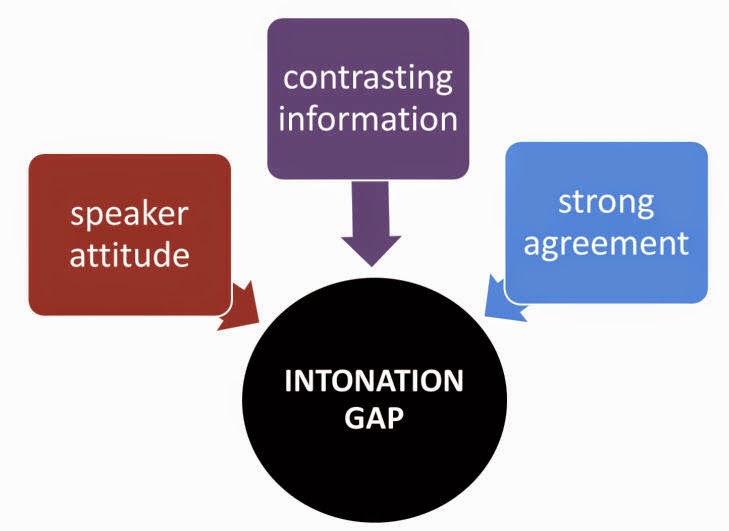
Reed and Jones both present some great ideas to work on learners' awareness of the role of intonation in the areas above.

Some of the activities required working with "minimal pairs", so to speak, and using the same wording with a different intonation pattern. In some cases students are invited to decide if the sentences are and mean the same, or happen to different. In other cases, the same utterance is exploited to mean different things, based on the intonation. Students may also be given a number of pragmatic interpretations to see which matches the meaning intended by the speaker in the context. (And no, I am not going to talk about the problems with the notion of "speaker intention" here, so don't frown!)

Changing the nucleus according to the meaning intended

Matching utterances to their meanings
This is a TOEFL-based activity on what Jones called "emphatic surprise" (I would probably use it to deal with rise-fall in GB, or high key)


Some activities require that students see the patterns in the real word by conducting "field work", that is, getting native speakers to read these sentences to them:
Some interesting production and also awareness raising activities proposed by Jones were related to prediction and inference work. By relying on intonation, students can be asked to predict what will come later, or what happened earlier.

This is one of the moments in the presentation where I think the speakers were not dealing with "implication" as they said, but rather, "deaccentuation". It may have been a slip, though!

An activity by Judy Gilbert


Jones presented a few tips on how to help students produce prominent words/syllables. She referred to Gilbert's use of the rubber band (which you stretch every time you accent an item), and its alternatives: opening or closing your hand, raising your eyebrows, closing your eyes. And a very interesting alternative was presented, as inspired by Linda Grant: the use of yo-yos!
Many of the activities above encourage peer work, and the following activity is quite interesting, and can be used to exploit several functions of intonation in context. Jones presented this activity to deal with corrections and contrast, thus:

(Student A has B's card:)
A: 'My favourite colour is \blue. 
B: Your favourite colour is /purple?
A: \No, my favourite colour is \bluuuuue. (Wide range, and high key, I suppose? Sorry, I am transcribing the prosodic aspects I think I heard when Tamara read the activity)

I think this activity can also be used to exploit the fall-rise, probably leading into more polite corrections. Something like:
A: So your favourite colour is \red.
B: 'My favourite colour is \/not red, I am afraid,  it's \blue. 


Another activity which also engages metacognition and prediction is the marking of dialogues. Students can be given a script, they predict possible accents, and compare with the scene. Jones suggested the following Seinfield scene:


Very interesting scene to deal with deaccentuation, contrastive focus AND counterpresuppositionals as well, though to be honest, I would have made different nuclei choices myself!
And this one from Friends:


***
Marnie Reed concluded that all aspects of pronunciation should be integrated into core classes, and they should be part of regular lessons in much the same way other areas and skills are. (Yay!). I think both Marnie and Tamara have shown to us attendees that intonation is essential for meaning in English, that meaning does not reside in words alone, and that students need to be made aware of that. I believe their activities are really engaging, and easily integrated in the language classroom.

In my personal opinion, "theory" is very important when it comes to the teaching of intonation, much to my students' dislike. Because in our own language tones may have a different role, we cannot always rely on our ears when it comes to the communicative values of intonation in a different language. That is another argument against the teaching of attitudinal values of intonation, in my humble view. Our "it's not what they said, but how they said it" radar may work perfectly well in our L1, but we may miss the point in our L2. So teaching intonation in a realistic context, be it within a specific speech genre, or in micro-contexts of conversation like the ones in this presentation, needs to be part of the English lesson if communication is the aim.


***

The session was recorded for PronSIG members. If you want to know more about IATEFL's PronSIG and join, visit their website.
The bibliographical references included in the presentation have been posted at the PronSIG Facebook page here.


viernes, 13 de febrero de 2015

A PS to my latest post - Part 1: Pronunciation Goals and Questions

My latest post received a number of varied responses, ranging from suggestions that I write my own linguistic stand up comedy show, to a former student jokingly (I hope!) reminding me I did not give her a passing grade in her pronunciation test, to colleagues asking whether it was an advocation for ELF, to people sharing their own anecdotes, and other kinds of remarks.

Some of these serious and funny bits of feedback got me thinking about how my views were interpreted, so I thought I would expand on the last point of the post in question, a conclusion which may have got "lost in translation", so to speak. The issue I want to discuss has been developed at length by a number of well-known authors and bloggers, and I will not be able to do justice to them here (see Part 2 of this post coming soon!), and it has got to do with a key choice teachers need to make in ELT: pronunciation aims and goals.

***


Now, in many respects we may feel trapped when it comes to deciding how far we would like our students to get when it comes to any linguistic skill or content, and the issue of pronunciation is a very sensitive matter. When it comes to pronunciation goals, I generally think about lots of WH questions, and this is what my post will focus on first. 

I humbly believe that we teachers should be ready to acknowledge that the pronunciation goals issue is very, very complex, and we should be aware of the number of different scenarios we may encounter in each class we teach, in order to try to cater for the whole range of needs there may exist -or at least know where to go and search for info!-. This is why teachers need to have a really thorough, yet practical, training in pronunciation matters, and as a teacher trainer, I feel a have a huge responsibility in this sense.

Find below my (non-comprehensive) list of WH questions for pronunciation goals, which in my humble opinion can change EVERYTHING when it comes to deciding what to do. The answers to these questions should enlighten us in the planning process, and particularly, help us decide on what accents to teach, and how far we should go in terms of expectations and learner achievement.


WHO?
Who are my students?
  -How old are they? Where are they from? What is their first language? What is their language level? How long have they been learning English for? Have they picked up the language, or learned it? Have they had any pronunciation instruction before? Have they taken this course before? 
-What about their existing skills and awareness in terms of their diction, propriocerception, phonetic coding ability, plasticity, learning styles?

-Who is their " model" speaker of English (native or non-native)? Where and how often do they regularly hear English: TV, videogames, music, social networks?

Who will my students be using English with?
  -Native speakers of English?
 -Non-native speakers of English using English to communicate? To work? To learn? To travel?
-Robots and machines?

WHERE?

Where are my students learning pronunciation now? 
At school? At a language institute? In company? At a call-centre? At university? At Teacher Training College? In a Translators' Training Programme? Over the Internet? In non formal ways, or contexts? By imitation? With the support of a thorough training in phonetics?

What are the expectations of the school/company/etc regarding these students, at the end of the course? What do they expect them and me as a teacher to have achieved? How likely and realistic is this, and what are the odds of redefining/negotiating these goals  after a diagnostic task, for instance? 

What is the role and influence of peers in the class? What are the students' views and feelings regarding the teacher and his/her English?

Where will my students be using English?
At a foreign country where English is the first language? Second language? Foreign language? Lingua Franca?
In their own country, but at their workplace, to their bosses, or co-workers or customers?
At the airport? On a plane? On the streets? Over a counter? In a classroom? On TV/radio?
Face to face? Via webconferencing? Through phone calls?

WHAT?
What are my learners taking classes for?
To travel? To make presentations? To answer phone calls? To teach? To sing? To become public or radio/TV speakers? To become tourist guides, or pilots, or cabin crew members? To be able to follow films, or lectures? Out of sheer pleasure and curiosity?

What are the specific skills, speech genres, procedures, vocabulary, my students need to polish their pronunciation for? What aspects of their interlanguage pronunciation or intonation will be most "damaging" or "face-threatening" for their performance? How can these be overcome? What kind of feedback/retribution/rewards will students get in their context of future or present use of English? What possibilities of repair, self-correction, monitoring will my students have in their context of use?

What English? Which Englishes?
What English, accent or dialect do they want or need to learn? British (which!?), American (which!?), Australian, South African, Singaporean, Indian, Hong Kong, among hundreds of other Englishes? What varieties and styles within a certain accent group will my students need to handle? What is the standing of a certain variety in my learners' context of use: is it considered "prestigious", " working class", etc?

What do my students expect of their accent? What accents do they personally favour? 
What accent do their employers/exam requirements/coworkers/syllabus/ institutional requirements or traditions expect them to attain?

What features should I prioritise in my teaching, given their background, context of use, target audience and the results of the diagnostic tasks?
What features can "seamlessly" be integrated to the teaching of other set areas/skills/content in the course? How much recycling and remedial work will I need and have time for?
What features are to be presented for perception, and which, for production purposes (or both)?
What features do I consider to be "teachable", given the conditions of the course I am teaching?

HOW?
How much are my students willing to work / can work towards this goal? How many hours of their week can/will they put in?  How much "ownership" can they take of the goals set?
How can I expand on my students' awareness of the importance of pronunciation and intonation in communication, and particularly, in their context of use? 

How can I train their propioception, articulation and self-monitoring skills so that they are significant and long-lasting?

How can I help my students reach the goals set? What materials, resources, time, background knowledge, student motivation and cooperation, infrastructure, student proprioception abilities do I have at my disposal? What methods would work better with this group?

How far would I like this student to get? How successful do I think this student will be, and why? What can I do to help this particular student improve?

How much room do we all participants of the educational experience have to agree on the goals? (In as ideal world, probably the students will have a greater say, but....)

***
All these questions appear to make up a sort of maze, reminiscent of those "Choose your own Adventure" books in which selecting one option from a set of possibilities may completely change the outcome. This is a pronunciation list, but I am sure we could ask the same or similar questions for other linguistic areas or skills. These questions address issues that will inevitably affect our planning, our students' success, and as a by-product, our own feeling of achievement, or frustration (Tell me about it!).

As with everything, we need to negotiate at times. Institutional and time restrictions are always there, students' motivations, effort and abilities are decisive if we want good processes and results, and as teachers we always need to decide where to draw the line. I wish I could be more definite or resolute when writing about these topics at times, but then, the great thing about teaching is that reality hits you in the face pretty often and each and every classroom, each student, even, drives you into making unique choices. There is no single answer or formula, and if I gave you one, I feel I would be oversimplifying a very, very complex matter that in my experience, can only be sorted out individually with each school, group or person I teach.

PS to this PS: I have corrected the serious mispelling of the word "proprioception" (which I wrongly for a long time called "prioperception"). 
End of part 1: Questions
Part 2: What the experts say. (Coming soon!)

miércoles, 11 de febrero de 2015

Reflections in passing #3: Why emulating a native-like accent may not (always?) help


Over the last few days I have been talking to colleagues from my own "environment" (that is, Argentinian teachers of English), and some have told me that they saw themselves reflected in some of my posts, particularly the "Voldemort" one. And yes, I completely understand why these friends and colleagues feel the way I do, and the rest of the world feels this is sheer craziness: our training, our Argentinian spirit (always looking up to Europe, for some reason) makes many of us want to "sound native" (whatever that is!). Some other Argentinian colleagues teaching French and Italian have told me they feel the same way about their own accents.

***
Now, the more I travel, the more I realise that my relentless efforts to "sound native" may not "help" in the streets. All right, my accent has helped me gain a certain position of "acceptance" (or something of the sort) in some academic circles. I know that there are certain things I say in certain places which are "taken seriously" because of my close attempt at an SSBE accent and my fluency in English. In academic environments, I have to admit that, sadly, some some people appear to have "respected" my views because of my accent, and this overruled the "disadvantage" (sic) that being a Latin American, Spanish-speaking teacher of English (and phonetician in the making, go figure!) would entail (and these last few words are not, unfortunately, mine!).

On the other hand, I won't lie. I do like the occasional "where in the UK are you from?" or "You don't sound Argentinian!" thing. I think it is my best introduction card in, at least, the ELT world.


***
As usual, disclaimers: these are opinions, reflections and anecdotes from someone obsessed with pronunciation, and carry no "scientific value". You read these at your own risk!
(♪♪ It's my blog, and I cry if I want to, I ramble if I want to! ♪♪)

***

Anyway! Going back to how sounding native may *not* help, I have a number of personal anecdotes which may illustrate the point:

-On a train to London from York, I ordered coffee. As I was being served, the steward -with a lovely Northern accent- asked me a question which I did not get, and after embarrasingly saying "Sorry?" three times, he just put the coffee on my tray and grunted. I shrugged, and the person sitting next to me, who had seen I was reading a book in Spanish, said that the man had thought I was making fun of him.

-The bus from Whitby to Scarborough I was on one day, broke down. Twice. (Yes, it happens in the UK, too! Don't despair, fellow Argentinians!). I was sitting towards the back of the bus, reading my book, and two lads  were talking about how awful the whole journey had been, and a few other things which I found dreadfully difficult to understand. At a certain point, one of them addresses me, and says what I decoded as: "Got a penner?". I replied "Sorry, come again?", to which I got a similar answer. The other man looks at me, as if I was silly or something, and says, really slowly "Got-a-pen-or-something?". "Ah, yes, here you are!", I said, and retreated to my Spanglish, to save face.

-The other thing that I find a bit embarrassing is the fact that my English is pretty "bookish" (I need a serious vocab refresher course!) and as a Latin American young lady, I'm all gestures and emotion, so British people who know me do generally comment on this sort of "mismatch" between my accent, and my wording. I love my Latin American blood, and my Italian hystrionism, and I am not planning to change that. But people say the "overall impression" is somehow "weird". My tutor once told me that when she was younger a very well known phonetician advised her: "Do you want to sound English? Then hire an English lady who can teach you how to sit, have tea, walk, and express your emotions as an English lady. Then you will sound English. Otherwise, you are more than fine as you are!". (LOL!)

(Linguistic digression: I think that my trips have also confirmed to me that I should never underestimate question tags, and phrasal verbs (believe me, students, they are used ALL the time!), and more importantly, street, everyday, language, if I want the "full package". As I told my Language teacher during my last year of college, "I feel all my language courses have "crippled" my language, I can't face the streets with my English but I can write 200-page-long papers!".)

-I think that what at times makes me feel worse than not being able to understand, is getting the comment "why do you want to sound posh?". Or I once even got "You sound Victorian!". I would feel a bit offended in my own Spanish if someone said I sound "cheta" or "old as the hills", but that's just because I don't see myself as such. My British friends tend to make fun of this accent choice of mine, and I have had "informal" sessions on glottalisation and a few other "tips and tricks" to "give my accent a lifting". I worry,  and I try to be truly aware of this when teaching my students. After all, I wouldn't want them to use slang and sound as if they were rehearsing to have tea with the Queen.

(BTW, any phoneticians out there? It would be wonderful to have oral practice materials with more updated accents! Ship or Sheep 3rd Edition has a few interesting voices, and so do some of the activities in the "...in Use" series, but I would be happy to have further practice material to focus on sounds with more "modern" accents. Apart from the  YouTube vids and British Council recordings of conversation I may find, having some updated pronunciation stuff for practice would be totes fabs!)

-Another Argentinian colleague told me that a UK immigrations officer, after stamping his passport,  jokingly told him, "Why do you speak like that, then? Are you a spy?".

***
Whenever I write my blog posts, I always think about my students and my practice. I am, by far, the most severe critic of my work. I know some of my ideas have changed over the last three or four years, and some others have not, and may not. I know some people may use these "thoughts in passing" to their own advantage and may misunderstand the meaning of my words as well. It has happened.

All in all, I think that my accent works fine in academic and work settings and it has made a difference, but it may not do the job in "street" settings. But I think that this realisation has really helped me reconsider language teaching, and more than anything else, what I should do in a General English language classroom. It has made me think about goals for both pronunciation and other areas of ELT: grammar, vocabulary, listening comp.
***
You may agree with this, or find it terribly "preposterous". I believe I am not "academically mature" still to voice certain ideas, to give them shape, and at times, to face some deeply-rooted beliefs. So for the time being, I'll just keep to my "reflections in passing" and to my books, and to my blog! (♪♪ It's my blog, and I ramble if I want to, I ramble if I want to! ♪♪)

lunes, 2 de febrero de 2015

Book Review #2: You Say Potato: A Book about Accents, by David and Ben Crystal


The book I'll be talking about is You Say Potato: A Book about Accents, a really entertaining, yet serious review of issues regarding accents and their role in everyday life, particularly in contexts where people may be self-conscious about them the most. In this short post, I would like to review the book in my own personal style.
This would be me in Trinity College Dublin, reading the book on a beautiful sunny morning.

***

The first appealing thing about the book is the fact that its style is conversational, and as a reader I felt I was actually at the Crystals' dinner table (and I have to say, after reading the book, I would defo love to be invited to have supper with them!). With David providing the historical background and the technical aspects of the discussion and Ben leading us through the world of the performing arts and illustrating his points with his anecdotes, this book is a great introduction for those people who have never pondered on the role of accents, or for those who have and need further evidence that accent does matter (but for what?)...

In this respect, as I read the opening chapters, I couldn't help thinking of the classic "Does Accent Matter?", by John Honey. I would be tempted to say the Crystals' book, in many respects, is an update of some of the chapters of Honey's material, and goes beyond it, by analysing accents in four sections, called: Accent Passions, Accents Present, Accents Past and Accents Future.

***

You Say Potato explores attitudes to accents on a first-hand basis -mostly through the anecdotes shared by Ben in his voiceover, acting and lecturing work - and through a great number of references to the media, including articles, surveys and TV shows, and extended to historical documents, films and advertising. The authors have taken to even retelling cases where forensic phonetics -with our lovely Jack Windsor Lewis - has a role to play!

The initial exploration of some basics of accents starts with a brief, simple explanation of the articulatory processes involved in the production and classification of sounds, and some comments regarding the acquisition of accents.  A more daunting endeavour later in the book is the making of an "Accent Map" that attempts to place all the accents discussed. This map proves to the reader how intricate the accent issue is, at least for, but not exclusively, Britain, where there are more accents per area than anywhere else in the English-speaking world.

David Crystal provides a really reader-friendly description of different accent groups, with plenty of examples for the non-specialist to have an idea of what a certain accent sounds like. One of the sections I found most useful is the "how to tell....from..." section, where David provides a few tips and tricks to distinguish Americans from Canadians,  New Zealanders from Australians, among other groups.

Issues of accent and identity, including historical and present "gut feelings" regarding accents are described through numerous quotes, including some mythical and prejudist views on Brummie (the old "ugly city, ugly speech" prejudice) in previous centuries (yes, including the 1990s....and probably still at present?) and a reivindication of regional accents in the media by those trying to explain why these prejudices are a mere "stupidity" (sic). It is true that we are all, to a certain extent, biased towards a particular accent group, so even though I am not a native speaker of English myself, I have to admit I felt a bit ashamed of having nodded in agreement when reading a few of these "stupid remarks" on accents.

As I have found in many current articles on accents (see my collection here), the book also goes over some of the issues we regularly see commented on the media and that non-specialists also pick out, like Brit pop and rock musicians using American accents, and Hollywood villains going for posh RP-like accents, and the role of accents when targetting certain audiences in advertising. Current phenomena worth exploring further, such as Uptalk, and Mockney, and notions of sound symbolism (what is known as "Phonesthesia") are also referred to briefly.

Another interesting thing about the book is the way accents are referred to in the different anecdotes retold by Ben, with notions like "blue", "rough", "smooth", words that refer to other senses and still help us picture different accents and voices (if I am not mistaken, this is called "synesthesia"). I particularly adored the definition of accents as "clusters of snowflake-unique sounds" (p.37). If you scroll below and hear Ben's rendering of a Shakespearean sonnet in original pronunciation, you will surely come up with your own adjectives and accent-resemblances as well.

It was, to me, so lovely to read about the reconstruction of Shakespeare's Original Pronunciation (OP) again, which is also described in such a lively manner in the book Pronouncing Shakespeare. When you read the accounts by both Ben and David, and you see this video, you clearly feel the power of accent, the power of voice quality and articulatory settings, and somehow, you go back to that wonderful setting of Elizabethan theatre.


All in all, I have to say I loved the book, as I felt I was reading many books into one, and I would love to see many of the points raised  developed into further work. I got a thrill out of reading historical documents and quotes, since probably the current views are more easy to trace on the Internet nowadays. Until the Time Machine gets invented, we can always read books by David Crystal, where we are sure to find the voices of times past brought into the present!

But, wait! This is by far not over. The Crystals invite us to be part of the You Say Potato experience. You can record your own "potato" pronunciation here. And if you want to see the authors at work and get a feel of the book and the issues presented there, then take a look at these videos!


And yes, the title of the book refers to this song we all know about!


 Other reviews and articles on the book:
TIME:http://time.com/3525767/you-say-potato-accents-david-crystal-ben-crystal/
CityLab: http://www.citylab.com/weather/2014/10/a-map-of-how-the-worlds-people-say-potato/381218/

martes, 6 de enero de 2015

Further thoughts on listening comprehension

This is another post in-passing on some of my observations regarding listening comprehension. This time, related to real life and on location! (Dublin, at the moment!)

I mentioned in my previous post that our expectations and knowledge may have a positive or negative effect on comprehension.  When it comes to travelling, the knowledge of what to expect in certain situations, particularly service encounters, is essential to avoid communication breakdowns. We all know the pragmatic  "scripts" for the institutional dialogues in our culture, the ropes are part of what Widdowson calls our "schematic knowledge". However, when placed in a foreign country, no matter how much you may know about the language, if you don't know what to expect, certain questions may catch you off guard.

Situation 1: Supermarket. Typical questions that I did not see coming and required extra effort:
-Would you like the receipt? (The transaction was over, and in my country they give me the receipt straightaway, which is why the question surprised me)
-Have you got a Nectar card? (Difficult to get at first,r but I thank the countless hours of English radio ads that clarified this for me. It is a kind of loyalty card for a certain supermarket.)

Situation 2: First time at Starbucks abroad. In my country, you always get the plastic cups, it's a given (and not at all ecological). But in Lotndon, after ordering my drink and taking great care to mention the size and type of drink, and feeling quite pleased with myself, I got the folliwing question: "To eat in?". If it had been, as I got in other places "To eat in or take away?", I would have surely understood at once. But this sole question in such a rush, just lost me.

Here ends my non-scientific post on list comp, in the hope that we realise that it's not all about language, that cultural conventions should be part of our language teaching practices (especially if we aim at communication), and that pragmatics has a major role in listening comp as well.

(Sorry about the typos and other atrocities, I'm writing this on my mobile)

sábado, 20 de diciembre de 2014

"Occupational Hazard": Intonation and Comprehension - Another set of observations in passing


Sorry I have not been updating the blog lately. Good news is that I have finally submitted my MA thesis, so I guess I will be getting up to speed with all my drafted posts and ideas soon!
***

This year I have read and heard a lot about the influence of phonology in listening and comprehension. It is clear that the ability to sustain one's attention through time is also a key element in making sense of speech.

In the book by Cauldwell that I have reviewed, there is a description of the complex phenomena that occurs in spontaneous speech, with all the blurred areas and the "squeeze zones", whose knowledge or awareness of can inform our listening comprehension practices.

Some interesting experiences I have had in the last few months have led me to (informally) hypothesize that phonological knowledge can at times affect comprehesion, particularly in my case, when this knowledge has hindered the possiblity of paying attention to the actual meaning of the message!

(BTW, this is a mere retelling of a personal experience and not an attempt at a research paper, but if any of you out there wants to take this up ..... go ahead!)

I posted a tweet in this respect a few weeks ago, and it got retweeted as:


So I guess that my basic knowledge of intonation can be an "occupational hazard" at times. And in this post, I would like to briefly, informally, share with you why.

This year, more than ever,  I have been involved in exams, interviews, lunch/dinner talks, and meetings with native speakers of English.  And one of the things I have almost unconsciously found myself doing, is trying to decode the speakers' intonation, in each and every of these interactions. As I listened to my interlocutors, I was matching contours in my mind, and linking them to the phonological theories and abstract meanings, and communicative values I recalled from the bibliography. 

In general, it all went pretty smoothly, and I think (or hope, rather) my interlocutors did not get to notice, until.....until something went wrong. The moment I could not place a certain contour in the "boxes" of my mind, the moment the intonational contour did not seem to match the pragmatic meaning I thought that utterance was projecting, then both the words and the contour would disappear from my short term memory, and I would miss my cue. These mismatches completely led me astray.


Of course, it could easily be claimed that I was forcing my attention to be split into decoding the actual meaning and decoding the form. After all, I do this all the time when I watch films or series, and I even echo certain utterances when they are interesting, intonation-wise (and I've taken to doing this for Spanish as well!). But I guess that there is something in the face-to-face, synchronous, live nature of communication which appeared to add some extra difficulty to my ability to sustain attention and decode at the same time.

These experiences led me to think about my Phonetics II dictations. I have to admit I am not a big fan of dictations, myself, though I somehow acknowledge their contribution to the course and to the learning process. (I do have alternative ideas to test these skills, however. Who knows, I may introduce some big changes to my 2015 courses.....). What I notice in my students' dictation papers is that their focus is so greatly placed on the form, that they sometimes fail to decode certain items or whole utterances because they are not making sense of the meaning. I do, in general, provide a short context, but as students have so many "on-the-task" concerns, as they are, in fact, being assessed through dictations, there is no room for meaning. In this respect, I attended some thought-provoking talks at the conference in UNSAM by professors at Universidad de La Plata and also Universidad del Comahue, who presented some very interesting activities to contextualise dictations and make them "meaningful". There is also a research paper on dictations and pragmatic expectancy grammar by my friend and colleague Francisco Zabala that also discusses these issues. So I guess that one thing is what we expect to hear, another is what we hear, and yet another thing is what happens when these two factors interact in an activity that is to be assessed and marked.

So in my introspection as to what "blocked" my ability to start producing answers straightaway whenever my interlocutors nominated me to produce the next turn, I found another element - an affective element. I guess I also feel I am being assessed. Probably not by my interlocutor, who is genuinely communicating with me, but by my own personal expectations and misconceptions, and even, obsession, regarding the intonation I feel I should hear, and the one I should produce "in return". I am assessing my own knowledge of the intonation systems of English. I am probably, even trying to still find evidence that some of the theories I have read do work. I am even, I guess, trying to find answers for the things I can't explain, theoretically-wise.

Looking back, affective issues and self-esteem are important in my ability to comprehend spoken language. I had this experience in the streets of York (my favourite place in the world, by the way) last March. As I was walking, a lady who was selling Avon products approached me. She asked me a question with a rising tone that completely lost me. I could not get a word she said and I started feeling hot and red in the face. I replied with a high rise "Sorry?", and she repeated the question. I felt so ashamed about having lost it again, that I risked a "No, I'm afraid" as an answer, and I got a "Oh, that's why!", which made me feel so puzzled and embarrased that I just uttered "I am sorry, I have to go" and stormed off. I kept thinking, as I walked away, that if I had said "Sorry, I don't understand" with a Spanglish accent, I would have received a more intelligible answer by this woman. And I think that this is what made me so angry at myself. (Shrink alert!)

All in all, this post has been an attempt to present some feelings regarding intonation and comprehension in a personal diary style. I guess that some of you out there have experienced similar situations and emotions regarding listening comprehension. If you are studying phonetics and writing dictations, you may even find some of these frustrations familiar. I'll try to "relax my grip", or as someone has suggested, "suspend my knowledge" on my next interactions with English speakers to see if things change. I'll keep you posted!

P.S. I am sorry if any of my readers happened to be one of the people in the occasions I described. You are then duly warned that you may encounter an intonation-freak in our next meetings....

martes, 11 de noviembre de 2014

The "Voldermort Effect" of second/foreign language learning: Another reflection in passing

The usual disclaimers: I have tried to make this post as spontaneous as possible. There are a number of lexico-grammar, pronunciation and intonation issues I would definitely correct, but I have decided not to. And, YES, I might be a bit looney. But if you don't see yourself reflected in at least one of the remarks I make, I seriously doubt you speak a second language.....

Enjoy!


sábado, 18 de octubre de 2014

"Non-Native" Accents and Chastisement: Reflection in passing

These last two weeks, I have been engaged in conversation with friends and with colleagues from different parts of the world who, for some reason or other, ended up discussing pronunciation issues with me. This is a post which will only take me twenty minutes to write, but I did not want these thoughts to "fly by".

I could not help noticing that in each and every of these weeks' exchanges with these colleagues, there was common feeling, a shared assessment of the whole "non-native accents" experience, which I dare call "chastisement". These are some of the situations I have witnessed to or been told about:

  • At one of the places where I work, a teacher trainee was "chastised" for using a glottal stop instead of a final /t/. I myself have been "chastised" for producing a glottal stop intervocalically.
  • A friend was in the United States and was "chastised" for attempting a "native like" accent (and a British one at that!) and not going for an "Argentinian Espanglish" instead. Another friend had a similar questioning look by someone from Israel, who was also a teacher trainer.
  • A student was "chastised" at work for not attempting a "native like" accent in his communication with North American customers and going for a "more global variety" of English, (if such a thing actually exists, beyond Jenkins' ELF Core, I mean).
  • A teacher trainer was "chastised" for upholding RP as a model. Another teacher trainer I know was "chastised" for attempting an Estuary English-like accent (no time for a debate on the "existence" of this accent here!) as a model. A group of students have "chastised" these two teacher trainers for not upholding a General American accent instead.
  • A methods teacher "chastised" a phonetics teacher trainer for not expecting an "international English" approach for her trainees. The phonetics teacher "chastised" the methods teacher for downplaying the expectations teacher trainees had for their own accents, and language proficiency in general. The teacher trainees "chastised" both teachers for not considering their expectations of a more modern variety of standard British English or American English accents for themselves.
I was wondering, having been "chastised" myself , whether the "chastisers"(myself included) had cared to ask the objects of their criticism:
  •  What type of accent they wanted, what model speakers they have got in mind. I know what accent I want, at least! and I ask my first year trainees what model speakers they have in mind (I have received answers to this question with models from Harry Potter movies, American series, even a Nigerian poet, the accents their previous teachers of English proudly "sported", and one student who said she wanted to have her mum's accent...sweet!)
  • The reasons behind their personal choice of accent: preference? imposition? didactic concerns? identity? 
I guess that in any side of the scale, we can all be "chastisers" and "chastisees" (!?). At times we read the newspapers, and we see how the British appear to react to RP as an  acrolect and to certain basilects as well, and I wonder whether we are not doing the same, whether we uphold General British, or RP, or General American, or an Australian variety of English, or even English as Lingua Franca as an approach to pronunciation. I can't help feeling a certain "guilt", given that what I do is, in a way, "accent reduction" (awful as it sounds!), but at least I try to be empowering in my teaching of Phonetics, so that in any moment of their careers, my teacher trainees can end up selecting any accent of their choice by knowing the basics of articulation and transcription (my knowledge of Phonetics, for example, has allowed me to learn French phonetics even knowing very little French!).  I introduce my teacher trainees to the complexities behind pronunciation teaching and the factors involved, and we consider in the last courses during their training what the different "accent needs" of our English learners in different scenarios might be, and what learner expectations they may encounter.

I won't stop feeling guilty, but what makes me feel a little bit better is the fact that I know my context, I know my trainees want to have a great command of the language, and I know about the limitations we may have in our teaching contexts as well when it comes to trying to cater for the linguistic needs and wants of 20-35 students per class. Which does not mean there is a lot of thinking to be done. And I've got another 30 years of teaching ahead of me, so surely a lot will change, a lot of new voices will be heard, and I hope, plenty of updates will be introduced.

I guess that just asking questions and recognising oneself both in the role of "chastiser" and "chastisee" is a great starting point for change, or at least, for some common sense.


An afterthought. I have edited this post for linguistic "horrors" (just a turn of phrase) a couple of times today, as I initially typed it in a rush at 4 in the morning.
I am currently doing in--service pronunciation training, and I am working with graduate teachers who need to improve on their accents, and being able to help a teacher who wants an American accent after being exposed to a British variety during her training has been a great challenge, and a great joy. 
As I was re-reading this post, I couldn't help thinking about my ideal Laboratory Practice classroom, one with no time concerns or technical limitations where I could have training materials for different accents and cater for different individual interests.

I would like to enter the Lab on day 1 and say, "what English accent  would you like to have as a future teacher or translator?". And then have parallel syllabi, parallel sets of training materials, time to teach a general class AND to give individual feedback....If you ask me, that is what I would like to do! 

martes, 7 de octubre de 2014

Phonetics-To-Go: Mobile Apps for Pronunciation Practice


Today I made a very humble presentation at one of the Colleges I work at, and the one I graduated at as well, for the annual "Jornadas", organised by a special commission in the English Department called EDAPI.
Bad hair day, as usual :p

I have decided to call the presentation "Phonetics-To-Go", as I have mostly done a review of some free or "low-cost" mobile apps I have found that allow you to take pronunciation with you, everywhere!

A few disclaimers:

  1. I have only reviewed free apps, free trials and some 1-dollar apps. I know there are brilliant paid apps out there, but they exceed the scope of my presentation...( and my pocket at the moment!.)
  2. The inclusion of these apps in my PowerPoint slides does not entail any endorsement. During the presentation I listed some of the pros and cons of each app and made a point of whether they include ads or require further payment, for instance.
  3. I have focused on a few apps and a few skills. I know there are more advanced apps out there that allow you to work with spectograms and waveforms, to mention but a few, but I have addressed the profile of my audience and I have mostly focused on ELT.
  4. I don't get any benefits out of reviewing these apps. Feel free to try them, and test them, install them or uninstall them, but do so at your discretion.
  5. Not all apps will work on all devices, in spite of the operating system. For example, the apps for Blackberry only run in BB10 devices.
  6. Before downloading an app, always read its description, check the company/individual behind the design, and particularly focus on the "permissions" you need to grant for the app to work on your device.
  7. What to do with these apps and how to apply them in your lessons is a choice you will need to make for your own groups, levels and culture. I will, in the future, devote a post to possible uses for these apps.


Having made all the preliminary remarks I thought fit (faithful to my usual quest for "down-to-earthness"), here's the PowerPoint for you:


Phonetics-To-Go from PronunciationBites

Hope you find these apps (and my warnings) useful!
Best,
Marina

sábado, 13 de septiembre de 2014

Conference Report #1: III Jornadas de la Didáctica de la Fonética (UNSAM, August 29th, 30th - Sept 4th, ENSLV JRF)

I attended a truly enriching event two weeks ago: a conference on the teaching of Phonetics, called " III Jornadas de la Didáctica de la Fonética", at Universidad de San Martín and the "Post-Jornadas" at "ENSLV Juan Ramón Fernández".
This post will be an attempt at reporting some of the highlights of the conference, at least according to my own personal interests. The pictures of the slides are a bit blurry but you can enlarge them by clicking on them, at least.

The conference started with a recorded interview to Alan Cruttenden by Mgtr Roxana Basso, which tackled points such as the use of the label "General British" and the motivations behind that choice (which I'd seen Jack Windsor Lewis explore years ago here) and the current associations in the media with RP. Mgtr Basso also discussed the future of the so-called Estuary English, to which Cruttenden, as many such as Prof Wells have done, agrees it will not become a future standard or "replacement for RP" as some people have claimed. Some interesting bits that were mentioned that make instruction and priorities for pronunciation teaching different from the ones ELF may propose were related to the role of word stress and hesitation pauses, which help learners become "native sounding", if that is the aim. There were quite a number of interesting views in these 20 minutes, and I could not take them all down, but the videoconference by Basso-Cruttenden will be made available online soon, so I'll link to it HERE once it is online.


The opening panel was brilliant, and I particularly enjoyed the presentations by:
  • Alejandro Renato, who is working on an "intonation map" of Argentinian accents of Spanish using Sp-ToBI, from a connectionist perspective of perception. Renato mentioned the complexities behind the study and systematisation of intonational features, including the effect of sonority and duration, for example, in the measurement and meanings of contours, the need for a consideration of a "microtonal" dimension, and the multiplicity of dimensions operating and the amount of different layers of info encoded in a single contour. Brilliant remarks included the fact that human processing time is not lineal, as we work on different "temporal windows". There was also a critical review of ToBI.


  • Leopoldo Labastía, made a fantastic presentation on the ways we mark foreground and background information in Spanish and English through tone and focus (in my humble opinion, the best talk at the conference):


  •  María Emilia Pandolfi, an expert in the Phonology of Italian, discussed different activities to make pronunciation work more significant, communicative and contextualised.

On Friday afternoon, I made the most of the talks by:

  • Francisco Zabala, friend and brilliant colleague, who discussed ways of teaching Phonetics I from a top-down perspective. He has found that making students aware of stress, the contrast between content and function words, and the overwhelming presence of schwa, together with a few rules of thumb regarding spellings, can ensure student success in transcription and pronunciation.
  • Marisol Hernández,  teacher and actress who discussed some ideas to relate our pronunciation work to drama, and made a point of how talking another language is a way of "staging something through our bodies" 

  • Gonzalo Espinosa, Alejandra Dabrowski, Leopoldo Labastía from Universidad Nacional del Comahue reviewed the functions and intonation of cleft and pseudo-cleft sentences in English and Spanish and showed some great integrative materials for the Language and Phonetics lessons. I was truly inspired by the way they have managed to design instructional materials which place prosody in context and lead students towards using intonation naturally.
  • Adriana Cáldiz et al from Universidad Nacional de La Plata who reviewed different theories relating politeness to prosodic choices.


And later, I also made my own presentation on
ways of teaching the prosodic configuration of instructional discourse, based on my 2013 research and on the type of work I have been doing on Systemic Functional Linguistics and Discourse Intonation in the last two years, with my Lab 3 and 4 and Phonetics 2 courses.


Saturday morning was also interesting, with inspiring talks by 

  • Andrea Perticone, another colleague who has a great brain for Phonetics, particularly everything acoustic. She presented her preliminary findings on the way we hear tones, and particularly on what happens when there are "non-prototypical" tones, in our context, those tones that go beyond the "mould" presented by O'Connor and Arnold, which dominates our teaching of tones from an imitative perspective. There were thought-provoking remarks on micro-prosodic effects that need to be considered for pitch measurement (pitch scaling, intensity, duration, the temporal dimension) which ToBI may not consider; issues of stylisation and compression, and allotony. Looking forward to hearing more on this, it was great!

  • Lucía Rivas and  Miriam Germani from Universidad Nacional de La Pampa, who are also working on the prosodic configurations of genre from a SFL perspective (they are like my intellectual soul-mates!). They discussed their experience teaching intonation and discourse, and the need to get away from mere taxonomies to engage in discourse analysis proper, not only discussing linguistic but also paralinguistic features of text ypes.


  • Diana Martinez Salatín, who reported on an experiment relating pronunciation to transcription errors from interlanguage phonology theories.
There were also talks by colleagues from UNLP and UNCo stressing the importance of doing contextualised, significant dictation and pronunciation practice with authentic materials.

I missed the talks by Miriam Germani on Storytelling, and Ana Irazábal (Phonology FB page editor!) called "Funology", which I would have loved to attend, but concurrent sessions are like that.

***
On September 4th, the "Post Jornadas" took place at Lenguas Vivas Juan Ramón Fernández. My colleague Francisco Zabala made a presentation on the connections between phonetics and listening in our context of speakers of Riverplate Spanish learning English, and he reviewed some of the issues that affect comprehension and intelligibility. There were also some live comprehension experiments which proved how complex the whole process can be.


Almost a century of English pronunciation teaching in my country!


The next speaker was Patrick, a language assistant from the US, who commented on Upspeak, and some findings from the original paper on "Jeopardy" by Linneman. The presenter also made connections with political discourse and presented his own hypotheses on the matter.

Finally, another presentation by Andrea Perticone. This time, she discussed some connections between the Gestalt (notions of figure and ground) and issues of focus and tone in English, with clear examples and illustrative videos, very useful for learners. (And my intelligent phone run out of its unintelligent battery, which is why I don't have any pics, I am afraid :( )

***
Whenever I attend a conference, I generally feel excited about the networking, even more thrilled to learn new things, but I also cannot help feeling a bit miserable when I find that most of the research I do is self-imposed, non-funded, and that attending conferences generally means asking for the day off and getting that money discounted from my salary because the red tape in the City of Buenos Aires for us in tertiary education is just so impossible. 
Anyway, I believe this conference was brilliant, as I have found like-minded people doing work on prosody more even than before, and to see we all come from different places and traditions and still see eye to eye, and that we all "dared" trod the path of intonation and meaning, which many people fear so fiercely, was just inspiring, and I am really grateful for the experience.

So here's the bunch of us, like-minded Phonlings from ISP JVG, ENSLV JRF, UNCo and UNLPam phonetising over food! Obviously!
 ***

It is always the case with concurrent sessions that you miss out on a lot of presentations you would ehave liked to see, so I am not reporting on all the papers, obviously. If you are curious, the whole programme and presentation titles are available HERE. And I have made a summary of my live tweeting below: